Tohono O’odham Nation Chairman Verlon Jose was hopeful after a court hearing in a lawsuit challenging the Trump administration's plan to build a border wall across tribal lands.
Jose, along with other leaders and members of his tribe, made the long journey back to Washington, D.C., to attend the July 22 hearing. The Tohono O'odham Nation sued the Department of Homeland Security over its plans to take reservation lands and water to construct a border wall. Tribal leaders sought a preliminary injunction to prevent the government from taking any action to advance construction of the planned border wall or related infrastructure on tribal lands, including entering into any contracts or agreements.
Attorneys for the nation argued the border wall construction would illegally diminish the boundaries of the nation’s reservation. The attorneys also made the case that border wall construction crews would be trespassing on the nation’s lands and that building the wall would violate the nation’s exclusive rights to use its reservation and resources.
People are also reading…
U.S. District Court Judge Richard Leon considered the arguments and ultimately requested more information from both the tribe and DHS.
"It was a good day that we were able to present out case," Jose told The Republic. "It was a good hearing. It was fair. It's an important issue to the court, we appreciate the judge, the court for providing this opportunity for us to be here for this matter. The judge asked a lot good questions. But we do really appreciate and thank our legal teams that have spent a lot of time, a lot of nights putting this together, they did a great job."
It has been a busy and challenging summer for the Tohono O’odham Nation as it continues to grapple with the ongoing border wall dispute.
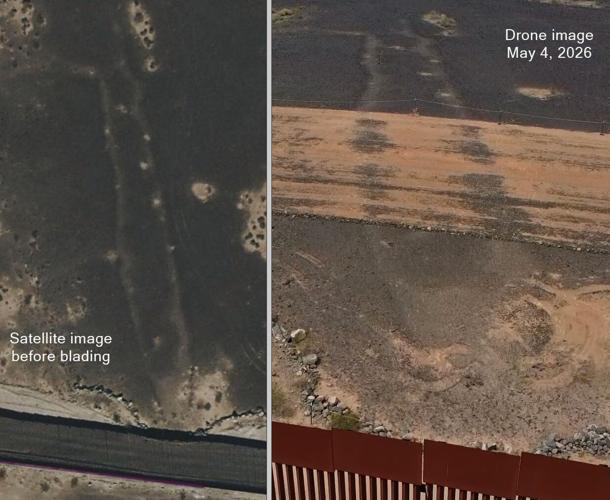
In late April, contractors destroyed a 1,000-year-old site in the Cabeza Prieta National Wildlife Refuge. Known as the Las Playas Intaglio, the geoglyph is a large, fish-shaped carving etched into the ground, one best seen from above. It sits roughly 30 feet from the border and stretches just over 250 feet in length and about 49 feet wide, forming a massive, clearly defined figure.

Before and after photos show the damage to an ancient fish-shaped intaglio in Cabeza Prieta National Wildlife Refuge. The image on the left is from a satellite, the one on the right from the site of border wall construction.
Following this destruction, and despite ongoing objections from the tribe to move forward with the construction of the wall, DHS continued to advance the project. On May 15, federal officials informed tribal leaders that contract solicitations for the construction of primary and secondary border walls, along with related infrastructure on the reservation, would be released that day. The agency planned to award construction contracts in June.
Jose said the legal team effectively argued that both the border wall's construction was unlawful: "That was the point we were trying to make to the court—that the Department of Homeland Security does not have the power to do that. Only Congress has that power, and all we wanted them to do is uphold the law."
Support from city, county and state leaders
Before Jose, leaders and other community members left for Washington, Tucson Mayor Regina Romero and the City Council unanimously approved a resolution opposing construction of the border wall on the Tohono O'odham Nation. With the vote, the city joined Pima County in standing with the nation against the construction of a border wall across its tribal lands.
Both the city and the county had previously passed resolutions opposing the border wall when the plan for the barrier was first announced in 2017.
"Chairman Jose called me immediately when they submitted their lawsuit against the federal government just to let me know this is happening," said Romero. "I truly believe in the words that he uses, that we are stronger when we work together."
The Pima County resolution that passed during President Donald Trump's first administration opposed Trump's executive order to build a wall along the U.S. border with Mexico. In 2017, Trump signed the order to build a wall along the border and to increase dramatically the already significant militarization of the border region.
The 2017 resolution asserted that existing border walls, fences and barriers are frequently breached or circumvented and are vulnerable to flooding and other natural damage, resulting in significant maintenance costs for taxpayers. It also notes that many security experts consider them among the most expensive and least effective methods of securing the border.
The resolution also argues that the existing border infrastructure and increased militarization have contributed to a human rights crisis in the border region that resulted in more than 6,000 migrant deaths in the borderlands and a detention housing disaster that allowed private businesses to exploit the situation at public expense.
The Pima County Board of Supervisors recently passed another resolution supporting the Tohono O'odham Nation's federal lawsuit to block DHS border wall construction across 62 miles of tribal reservation land with a 4-1 vote.
The county's recent resolution states that the existing border wall has caused substantial environmental damage, including catastrophic flooding, erosion, degradation of public lands and facilities, disruption of wildlife migration corridors and the destruction of critical habitat. According to the resolution, these impacts have harmed hundreds of species in the border region, including endangered animals such as the jaguar and ocelot.
The Tohono O’odham Nation, for decades, has cooperated with federal border security efforts. The tribe allocates annually about $3 million of its own funds to help fulfill the federal government’s border security responsibilities. Existing security infrastructure on the nation’s lands has already reduced unlawful border crossings by more than 95% over the past two years, according to the tribe.
The tribe has supported operations by Customs and Border Protection on its lands by providing locations for a checkpoint, forward operating bases and integrated fixed towers to strengthen electronic surveillance efforts.
"The Tohono O’odham Nation has continued to work with federal authorities to implement a modern, robust, and dynamic border security system on its lands including but not limited to forward operating bases for U.S. Customs and Border Protection, vehicle barriers, Integrated Fixed Sensor Towers, the all-Native Shadow Wolves tracking unity, and other measures," stated the county's resolution.
Jose emphasized that the nation has been working with federal officials and offers assistance on border security, emphasizing that the lawsuit is not about opposing border security efforts.

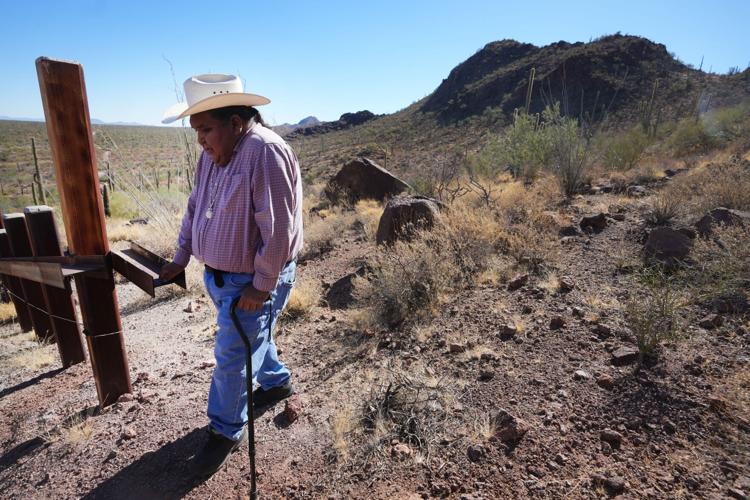
Verlon M. Jose, chairman of the Tohono O'odham Nation, stands on Mexican land as he talks about the tribe’s ancestral lands and its connection to the borderlands of the United States.
"We’re not saying, ‘No, you can’t patrol the area,’" Jose said. "We’re not saying, ‘No, you can’t use the access roads.’ We’re not saying you have to remove the integrated towers or do away with joint law enforcement centers. That’s not what we’re saying. What we’re saying is that you can not build the wall."
Rep. Adelita S. Grijalva, who represents the area, said Homeland Security is attempting to exercise authority it does not have by unilaterally altering the boundaries of a sovereign tribal nation.
During a House Natural Resources Committee hearing, Grijalva questioned Interior Secretary Doug Burgum about the destruction of the Las Playas Intaglio site during border wall construction. She also sought assurances that Quitobaquito Springs—an ecologically and culturally significant site that was damaged during construction of the first border wall—would be protected from further harm.
"We have already seen the devastating consequences of when this administration ignores Tribal governments with the destruction of the Las Playas Intaglio. Now, other sacred sites, such as Quitobaquito Springs, are under threat," said Grijalva. "This is not just temporary damage to land — it is irreparable destruction of a sacred place tied to the O’odham people’s history, identity and spiritual practices.”
'This is going to be a long road'
Jose said they knew they would leave the hearing without knowing what decision the court would make. He said the judge asked thoughtful questions and requested that both parties submit additional briefs within 10 days, limited to 10 pages.
"Once the transcript from today’s hearing is available ... both parties will then respond to the 10 page brief," said Jose. "So that kind of tells us that he's really seriously interested. He mentioned some of the previous cases that he was working on. He did mention that this case was unique ... and not like some of the other cases. So we felt comfortable because this is going be a long road. If either side doesn't prevail, they're going to appeal."
He said it was encouraging to have the strong showing of support from the Tohono O’odham Nation community. He said at least 30 or so supporters were there and it was uplifting to see.
"Now our issue is at the hands of the court," said Jose. "All we are asking is for them to follow the law. We are watchful because we understand that the Department of Homeland Security issued the contract to a contractor to build not only a primary wall but also a secondary wall along 62 miles on the Tohono O’odham Nation. We have not seen any significant activity there yet, that's why we are asking for an immediate injunction."
Jose said the support of the Tohono O’odham people and their prayers have given him and the delegation the strength to continue fighting against what the unlawful border wall being built through their tribal homelands. Before leaving for D.C., the community gathered for a prayer to wish the delegation a safe and successful journey. When he arrived at the event, Jose said he was surprised by the number of people who had come together to offer their support and prayers.
"It’s hard to try to paint that picture to a judge who has probably no clue of what, and who we are, and what the land looks like when you are limited to only 15 or 20 minutes to present your case," said Jose. "It's hard to explain. We don't share a lot of this. It's very private to us. I think that's what made us who we are today. A lot of Indigenous people don't share these cultural or traditional practices that we do. It's it's important to us and no one else."
He said the tribe, its leaders, and Vice Chairwoman Carla Johnson felt they were backed into a corner after receiving notice that DHS was moving forward with a potential border wall contract. He said DHS informed them that, by the end of June, it planned to issue contracts for the 62-mile section while continuing discussions with the nation. In other words, Jose said, the agency intended to move ahead with the contracts regardless of those ongoing conversations.

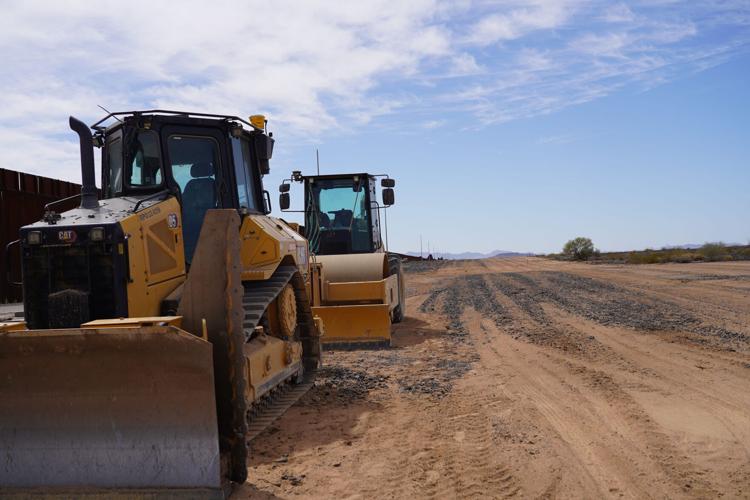
Construction equipment sits at a site near the border where crews damaged a 1,000-year-old intaglio at Cabeza Prieta National Wildlife Refuge.
"We would have rather not be doing this," Jose said about going to court. "Looking around the courtroom today, 30 people, that's a lot of resources that comes from our community, our members and from our nation that could go to other uses rather than coming up to D.C. But the people felt that it was that important to send the delegation up here. I'd rather that it didn't happen, but ... our elders have spoken, and those that we represent now — and those that are coming after us, the unborn — what are we leaving for them?"
"We hope and pray for the nation to be successful," he said. "If not, then we still don't back down and continue to protect and serve other people in whatever way, fashion or form that we need to do that."
'No way that we should walk away from this'
There are 17 O’odham communities, representing about 2,000 members, that remain in their historic homelands in Mexico. O’odham people on both sides of the border share a common language, culture, religion and history. They continue to cross the border for sacred pilgrimages and ceremonies at significant religious and cultural sites, according to Jose's testimony.
Jose said this issue is critical to his people in terms of "our cultural and religious practices, not only as individuals, but to families in communities...and the sacred areas that are there."
"I wouldn't be sitting here in Washington, D.C., if this wasn't a priority for our people," said Jose. "But for the 30-some people that are sitting in that room.... if it wasn't important, I don't think they would be here. Some of them have never even been to Washington, D.C., and so it was important for them to be here."
He said the federal government waived more than 30 federal laws to allow construction of the wall, a point also highlighted in the nation’s legal brief. He added that the case will be a long journey because he believes neither side is willing to give up.
"There's no way that we should walk away from this at this point now; we got way too much to lose, and that is the protection of our land, the protection of the people," said Jose. "Everything that they've instilled in us tribal leaders to fight the good fight.



 Two pregnant detainees hospitalized in Arizona; one claims border agent struck her