A federal judge has rejected a bid to temporarily halt the expansion of the Hermosa critical minerals mine onto public land in the Patagonia Mountains.
In a written ruling issued Friday, U.S. District Judge Raner Collins denied a request for a preliminary injunction that would have stopped the construction of an access road, a power transmission line and other mining infrastructure on Coronado National Forest land surrounding the mine now in development 75 miles southeast of Tucson.
That work will be allowed to continue until a lawsuit is heard over the U.S. Forest Service’s approval of the mine expansion.
The Patagonia Area Resource Alliance and the Tucson-based Center for Biological Diversity sued the Forest Service in September, accusing the agency of violating the Endangered Species Act by allowing industrial development by Australia-based global mining company South32 within critical habitat for jaguar, ocelot, Mexican spotted owl and other endangered animals.
People are also reading…

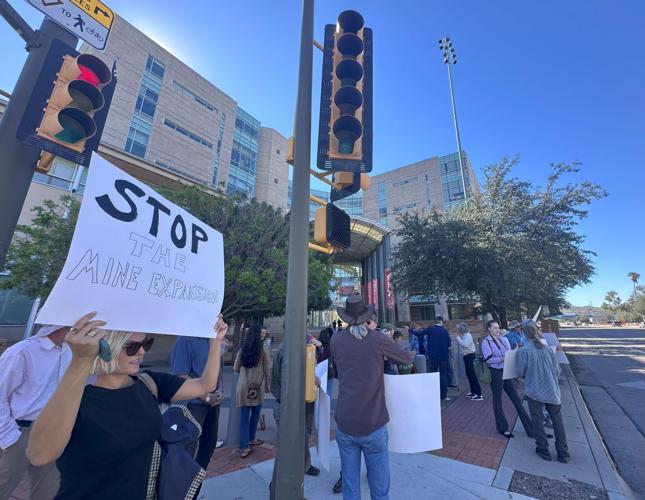
About 30 demonstrators gather in front of the federal court building in Tucson on Tuesday, Nov. 3, to protest the Hermosa critical mineral mine near Patagonia.
Collins ruled that construction could proceed on forest land while the lawsuit advances over the next year because the work will be limited in scope and plaintiffs failed to prove it is likely to cause irreparable harm.
The judge noted, however, that his decision “does not adjudicate all claims, validate every aspect of the project or authorize departures from existing permit conditions.”
South32 is more than halfway finished building its $3.3 billion underground mine on about 200 acres of private land in a historic mining district in the Patagonia Mountains. The operation is slated to start production in 2028 and could eventually produce zinc, manganese, silver and copper — each of which is federally designated as a critical mineral.
During a hearing Tuesday on the motion for a preliminary injunction, an attorney for the Forest Service argued that halting or delaying construction would pose a national security risk by leaving the government dependent on foreign suppliers of critical minerals.
An attorney for South32, meanwhile, argued that only minor work is planned on forest land over the next 12 months, though UniSource Energy Services is expected to complete the new, 7.3-mile transmission line it is building to the mine by early next year.

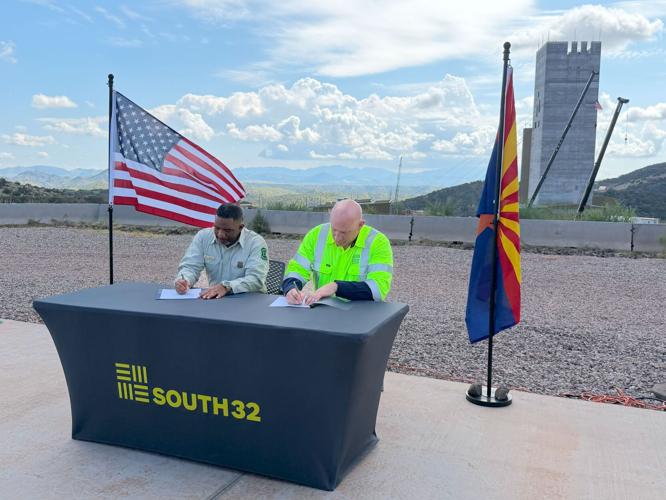
Coronado National Forest Supervisor Kerwin Dewberry, left, and South32 Hermosa President Pat Risner sign the final documents approving expansion of the mine onto adjacent Forest Service land during a ceremony earlier this year. The U.S. Forest Service is now being sued over that approval.
But plaintiffs' attorney Graham Rex, from the Center for Biological Diversity, argued that the government’s own analysis of the planned mining infrastructure indicates it could degrade critical habitat and alter a crucial wildlife corridor for endangered species moving between the U.S. and Mexico.
Hermosa officials insist the expanded infrastructure it has planned will help lessen the project’s impact on the environment and the nearby communities by rerouting traffic away from the town of Patagonia and allowing the operation to be powered by electricity from the grid, including from renewable sources, instead of by on-site diesel generators.

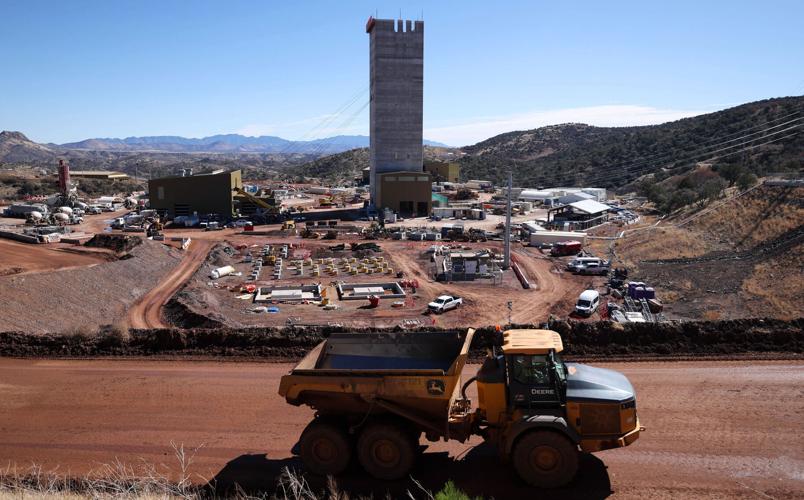
The view from an observation platform shows construction activity at the South32 Hermosa critical minerals mine in the Patagonia Mountains.
South32 also wants to use forestland to release treated wastewater from the operation into three ephemeral streams surrounding the site, and extend the life of the mine by eventually building a second tailings pile.
“Throughout this process, we’ve listened closely to the community and worked to develop solutions that address concerns about traffic, water management and environmental protection,” said South32 Hermosa President Pat Risner in a written statement. “Today’s decision allows us to efficiently move forward with those commitments.”
The mine is already sending treated water down Harshaw Creek, raising concerns from area residents and conservation groups about possible contamination downstream.
Get your morning recap of today's local news and read the full stories here: tucne.ws/morning