


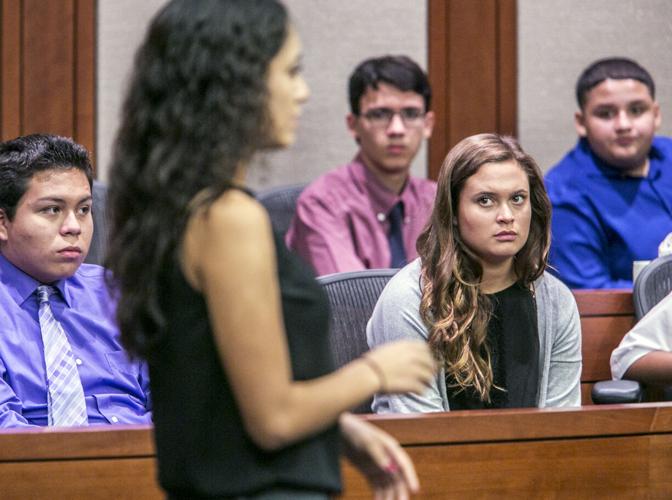
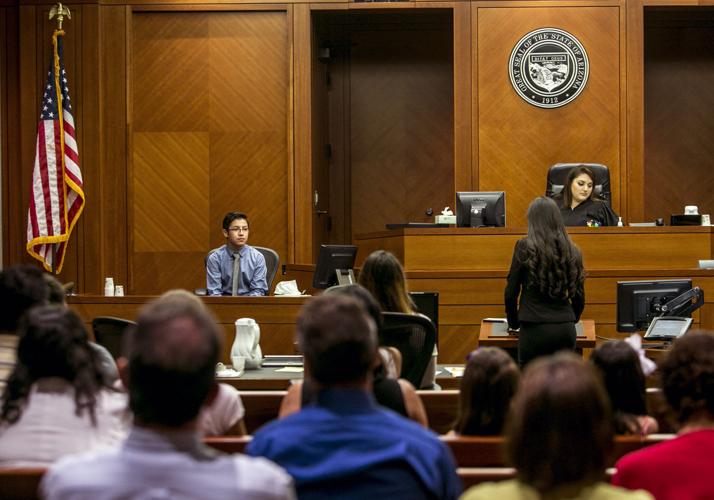
Orson Hayes was a marked man, the defense argued.
He was desperate for money, said Kyle Emmendorfer, the attorney for Hayes’ killer. Any number of real criminals could have done it.
His defendant, Quinn Penner, a Phoenix police officer, was not the one who shot him, Emmendorfer said.
The prosecution called Hayes’ cousin, who witnessed his murder, to the stand. When questioned by the defense, she said she did not remember seeing the shooter’s eye color, hair color or anything about him, but that she recognized Penner later.
“That was who shot Orson,” said Lee Hayes, the cousin.
Penner, the police officer, is accused of murdering Hayes, a seasoned criminal who escaped from Penner after a bank robbery attempt.
People are also reading…
But this isn’t a real trial. It’s a mock trial using a fictional case — a final test for 26 youths learning about the courts and legal system as part of the Courts Are Us summer program.
Lee Hayes was played by a student in the program, Florencia Ramacciotti.
Over the course of seven weeks, the students worked with the Pima County Juvenile and Justice courts, Tucson and South Tucson city courts and the Pima County Legal Defender’s Office.
The students worked 30 hours a week training — getting paid $8.05 per hour — for performing various tasks in the courts system. They were also assigned mentors who are attorneys and judges in the community.
The program exposes young students to the positive elements of the courts system, said Amy Fish, special projects coordinator at Pima County Superior Court.
“It’s not just coming for bad things,” she said.
Retired Pima County Superior Court Judge Norman Fenton created the program in 1992 after the verdict in the Rodney King case caused social unrest in Southern California.
He wanted to teach teens in Tucson about how the court system works.
Courts Are Us has continued every year since then, said Diane Brown, the program coordinator. Kids keep coming back because this is valuable work experience, she added.
The program attracts students who are considering careers in the criminal justice system, she said. The seven-week experience provides them with insight and training.
The added benefit is that most students who go through the Courts Are Us program end up pursuing higher education, she said.
“It’s a great opportunity,” she said.
Guadalupe Durazo, 17, is considering becoming an attorney or working for the Drugs Enforcement Administration.
In the mock trial, she’s on the defense side.
She has been a part of the program every summer since she was 14, she said. This year, she worked at the adult probation department, where she learned about defendants’ initial appearances and pre-sentence reports, among other things.
“It’s really great because you get work experience in a professional experience,” she said.
Her foe in the trial, Ycied Talavera, who is going on 16, said she is considering pursuing a law degree, but she’s not sure.
She is also interested in medicine, so she’s taking classes through Pima County JTED.
Hopefully, what she learns through the Courts Are Us program and those JTED classes will help her decide which path to take, she said.
“I’m hoping to learn more,” she said.
Contact reporter Yoohyun Jung at 520-573-4243 or yjung@tucson.com. On Twitter: @yoohyun_jung

Yoohyun Jung
Data reporter


