

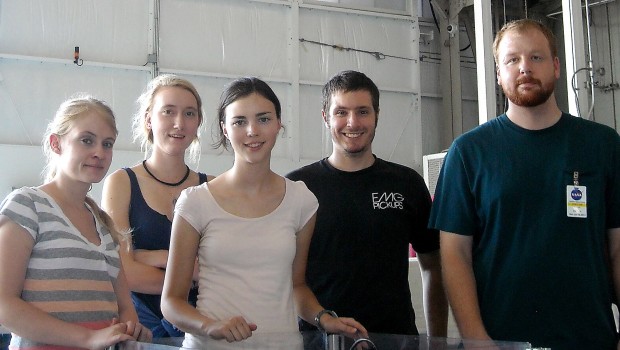
HOUSTON - UA students in Houston for an elite NASA program chose to perform an experiment this week that's been done countless times - but never in zero gravity.
After months of work, members of the second UA team involved with NASA's Reduced Gravity Education Flight Program completed their first microgravity trial to test the famous Miller-Urey experiment in weightless conditions.
Members Kyle Rine, Alexandria Stanton and Michael Iuzzolino of "The NASA Air Club for Men" -as they've jokingly called themselves - collected data in Thursday's flight and will replicate the experiment today with remaining team members.
The flights are part of "Grant Us Space" week, for students who attend schools associated with the NASA Space Grant program. Teams involved with the program propose, design, build and test reduced-gravity experiments.
People are also reading…
The University of Arizona won two of the 14 spots in the national program and was the only university to have more than one team represent it.
The ANGEL - ANalysis of Gravitational Effects on Liquid lenses - team flew Tuesday and Wednesday and will analyze its results upon returning to Tucson. The team attempted to measure the effects of zero-gravity conditions on liquid lenses.
The team that flew Thursday will continue to test the Miller-Urey experiment, which involves the production of amino acids - the building blocks of proteins - from basic gases. The experiment ties into the formation of life as Earth formed.
The team's idea was to test the experiment in microgravity to determine what effect it has on the development of amino acids from inorganic gases such as hydrogen, methane and ammonia. If the team can show that amino acids indeed form differently in zero gravity, it would suggest that gravity is a factor in their production via this process, Stanton said.
The team also will perform much data analysis upon returning to Tucson.
"Everything went according to plan, but we won't know what products we have until we get back to Tucson," Stanton said. Analyzing the data requires a mass spectrometer, Stanton said, which doesn't travel well.
Recent findings have shown these amino acids can form in hostile environments, such as on comets, the team said. Completing the experiment in varying states of gravity will be similar to conditions that might be found on a comet or on a small planet, they said.
Rine gave a simple explanation for how the experiment works: Hydrogen, methane and ammonia gases are circulated along with water vapor, then hit with a spark coil to simulate lightning. The gases are condensed into the water flask, then vaporized again, allowing for the creation of more complex organic products such as amino acids. If all goes according to plan, the team will create 20 common amino acids and even amino acids not natural to Earth.
The team prepared for months but faced some unexpected challenges when members underwent their Test Readiness Review - a process in which an expert panel evaluates the team's work and ensures the project is ready for takeoff.
Air Club member Jana Pence said the group had to make some last-minute changes to the experiment, such as adding a Faraday cage to the spark coil that creates the spark.
Pence said the expert panel insisted on the cage -an enclosure made with conducting material to block electric fields - to avoid possible electrical interference with the aircraft.
Team members took their flights on an internally modified 727 that NASA calls "The Weightless Wonder." As the aircraft is guided through a parabolic course from 25,000 to 35,000 feet, fliers experience 30 seconds of hypergravity (1.8 to 2 g's) on the ascent, and roughly 25 seconds of microgravity (zero g on the way down.
Just because an experiment has been replicated before doesn't make it easy to do when you're neutrally buoyant, Rine said.
"It's amazing how hard it is to flip a switch when you're floating around," he said.
Editor's Note
This is the third of a three-part series on the UA students in Houston for the Reduced Gravity Education Flight Program. Learn more online at microgravityuniversity.jsc.nasa.gov
TEAM Q&A
Kyle Rine, 26, mathematics and physics senior:
Q: You joked around earlier that crying in microgravity was a bigger concern to you than losing your lunch. How was the flight?
A: More "Weightless Wonder" than "Vomit Comet." The flying was every bit as wonderful as you would have thought. It was … totally worth it.
Michael Iuzzolino, 24, aerospace engineering and mathematics junior:
Q: You've spent months on this project, had a week in Houston and experienced microgravity. What have you enjoyed most?
A: The project was really interesting, from coming up the idea to working in the lab to getting to fly it. The flight was amazing. I think in our 19th parabola I lost it, but I came back right away.
Jana Pence, 21, physics junior:
Q: You'll fly today with the experiment. What's been the biggest challenge up until now?
A: The most difficult part was getting … ready for the (Test Readiness Review). We required some changes, and the challenge was meeting the changes that (the expert review panel) expected. We weren't expecting it because we'd already fixed stuff from before, but when it was done, we were relieved. We knew at that point we weren't going to be restricted from flying.
Alexandria Stanton, 18, chemistry senior:
Q: Despite the seriousness of the project, your team name is pretty ridiculous. Were there other contenders before you picked The NASA Air Club For Men?
A: [Laughing] That was Kyle's fault entirely. I have nothing to do with that. We told him he was in charge - then he came up with a name that was so embarrassing, we asked him to change it. But I think if you're going be embarrassed, you might as well be really embarrassed. We like it now, though. We're proud.
Shelley Littin, 20, an organismal biology senior and a writer for UA News Service who's following the team:
Q: You'll fly today. What do you think microgravity will be like?
A: Everyone says it's indescribable, but, as a writer, I really hope not. I hope I feel like I'm flying. In terms of what I hope to get out of it, I think the experience and the greater understanding of myself and how I handle the situation.
Victoria Blute was a NASA Space Grant intern for the 2010-11 year.


