John Michael has two businesses — and two phone numbers — so he gets some 20 political text messages per day.
He’s not alone.
Arizona voters say their cellphones are being flooded by a never-ending stream of voter outreach and fundraising pleas this election season.
“I don't like them, personally, but I think more information is better,” Michael said at a “No Kings” protest in Chandler earlier this month.
Americans received 15 billion political text messages during the 2022 midterm election year, according to call-blocking service Robokiller. There’s reason to believe that number has grown in the four years since then.
“It's so cheap to send texts,” said Chuck Coughlin, president of the Phoenix public affairs firm HighGround. “You can send out so many of them.”
People are also reading…

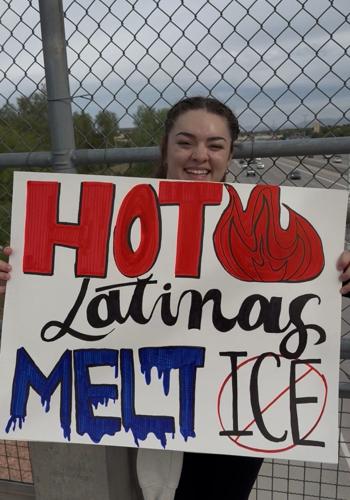
Auryon Alvarado, seen here at a “No Kings” protest in Chandler earlier this month, says she gets about 10 texts a day from candidates she already supports.
For decades, campaigns have used TV ads to reach as many voters as possible. They’re still spending big on TV — $127 million has flooded the Arizona airwaves in the general election, according to AdImpact — but broadcast and cable viewership has been declining for years, Nielsen data show.
At the same time, voters have never been easier to target on their smartphones. And in the wild west of political texting, many messages arrive unsigned, leaving it unclear who is sending the texts and trying to influence the vote of the recipient.
“Text message spam annoys everyone,” said Alex Logvin, a campaign finance watchdog who lives in Tempe and gets three or four political texts a week.
Even political campaigns that do sign their texts were reluctant to talk about how many messages they are sending this election season.
The Arizona Republic reached out to 10 Arizona political campaigns about their texting habits last week. Only one responded.
“Text messaging is an extremely effective method to serve micro-targets with messages that will resonate with an individual the most at the optimal time,” said Brady Smith, strategist for GOP congressional candidate Jay Feely.
The Feely campaign has seen “excellent responses” to its text messages, Smith said. Texts are especially helpful in getting voters to check out long-form content such as podcasts that are often hard to promote, he noted.
Targeting is an imperfect science, some voters say.
Registered Democrat Denise McDougall is bewildered by why Republicans keep texting her. It might be a case of mistaken identity.
“They always use the wrong name. I'm either Sandra or I'm Peter. So I don't know,” McDougall said at a “No Kings” protest in Chandler. She blocks the Republicans who text her, she added.
Campaign calls and texts are exempt from the Federal Communications Commission’s Do Not Call Registry requirements, though they are subject to other rules.
As a result, political campaigns are free to send tons and tons of texts.
Former Vice President Kamala Harris’ presidential campaign sent up to 3.5 million texts per hour during “high-volume periods” in 2024, according to a case study from the texting firm Scale to Win.
The company has worked with Sen. Mark Kelly, D-Arizona, its website said. The state's senior senator is a prolific political fundraiser and texter.

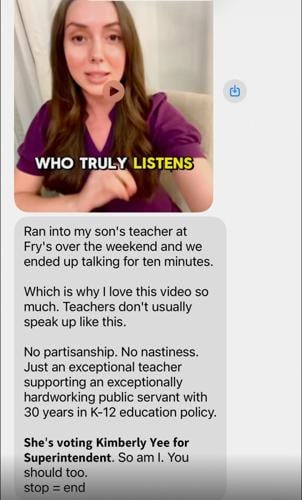
A political text message supporting Kimberly Yee.
“If you want to raise money, grassroots money, that’s the best way to do it. It works,” said Kelly, who reported having $26.5 million in his campaign bank account at the end of September.
Kelly reminds annoyed text message recipients that they can text “STOP” to end the deluge. However, he has found that even people who complain about the texts would prefer to keep getting them.
“They do annoy me,” said Chandler resident Auryon Alvarado, 25, who added she gets 10 texts per day from candidates she already supports. “I'm already voting blue, guys. Call those red people, get them on our side.”
Rick Smith of Chandler said he, too, gets flooded with fundraising pleas from campaigns he’s supported in the past. Smith understands that they need to raise cash and compete, he said, since he knows dark money is flooding political races.
There’s another side of political texting, where shadowy political actors send mysterious or misleading text messages.
“I don't know all the nefarious (expletive) that's going on underneath the surface on a lot of that stuff,” Coughlin said. “It's to promote voter confusion. It's voter suppression. There's all kinds of motivations. We know that most of them are not good.”
Some internet communications need a disclaimer under Federal Election Commission regulations, but certain text messages are exempt because of their limited size, FEC spokesperson Myles Martin said in an email.
The Arizona law governing advertising disclosures, ARS 16-925, does not apply to text messages, noted Arizona Citizens Clean Elections Commission Executive Director Thomas Collins.
There were no disclosures on a flurry of texts promoting Republican Kimberly Yee’s campaign for Arizona Superintendent of Public Instruction. The messages read like they had been sent by a friend. They were not signed by any campaign or political group.
“Ran into my son’s teacher at Fry’s over the weekend and we ended up talking for 10 minutes. Which is why I love this video so much. Teachers don’t usually speak like this,” one such text read.
The message included a video of a middle school teacher named Kelly endorsing Yee in a selfie-style video.
The Republic called the number and received a busy signal. Nobody replied to a text message asking who the number belonged to. Yee did not respond to a request for comment.