About a month after Arizona forward Mabil Mawut collected about 300 donated pairs of shoes to send underprivileged South Sudanese youth, former Salpointe standout Majok Deng also felt the desperation from afar.
All it took was giving away some underwear.
After spending last season playing professionally in Spain, Deng took a trip to Nairobi, Kenya, in April and made his way to the massive Kakuma Refuge camp near the country’s border with South Sudan so he could visit his father and other relatives.
Deng, who will team with Mawut for a charity drive at Zemam’s “Z Street” on Saturday, brought a bag of underwear and other clothes with him.
As happened when his mother and brother visited there previously, none of it lasted very long.
“I never really quite believed it … I’d be like ‘why do you guys come back empty-handed?'” Deng said. “They were like `Oh, we just gave up our clothes. We can always get them here.' I’m thinking they’re just being kind.
People are also reading…
“So I left my suitcase in Nairobi with all the other clothes that I needed, but I took a duffel bag with me to the refugee camp. People came over: family, non-family members, friends, and everything you have is attractive to them.
“I was like, `Why do they want my underwear that much?”
A naturalized U.S. citizen who moved to Tucson in 2011, having lived at Kakuma as a child, Deng realized more than ever in that moment how fortunate he was. He said standards at Kakuma have worsened, in part because USAID's recent demise has left "everybody in shambles."
Deng said he initially planned to stay at Kakuma for four days but that the visit “turned into six days” because of all the connections that hit him squarely in the heart.
“It finally came to me how my mom always came back empty-handed, and how my brothers came back empty-handed,” Deng said. “Being here, I can always go to Ross or wherever and get a pack of underwear, for $7 or $20 or whatever it may be, and I’d be fine for some time.
“They don’t have the luxury of that. So my underwear was the first thing they wanted.
“They play sports over there, they play soccer all the time, and they don't have underwear to wear underneath their shorts sometimes. So shorts, hoodies, pants, all the stuff, was gone. It was interesting too because I wear a large and some of my underwear wasn't even fitting some of the guys that are my age, because they're just so skinny. But they just took them.”
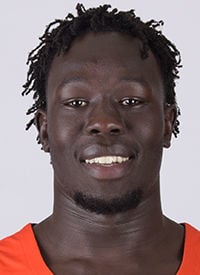
Majok Deng
One day, while showering in one of the camp’s bathing areas, Deng also noticed a need for even more basics.
He saw rags hanging up to dry, and asked about them.
“I was kind of thrown back,” Deng said. “Like, I'm back to this place, and some things don't look familiar. I asked about that, and somebody wasn't afraid to tell me exactly what it was: ‘That's a sanitary pad.’
“It was a piece of clothing they just cut up and they wash it and reuse it. I was like ‘Man, doesn’t this cause sickness?' But it was no care in their mind because they need to do what they need to do.”
Deng’s experience led to the latest charity effort for the Children of the Nile initiative Mawut started: A drive to collect underwear and other basics on Saturday between 6-8 p.m. at Zeman's "Z Street," 2731 E. Broadway.
The two had become friends in 2025 thanks to their shared South Sudanese roots, with Mawut actually having been born at Kakuma. Mawut arrived last summer to join the Wildcats last summer and Deng had just finished a five-year college career playing for Pepperdine and the Colorado School of Mines.

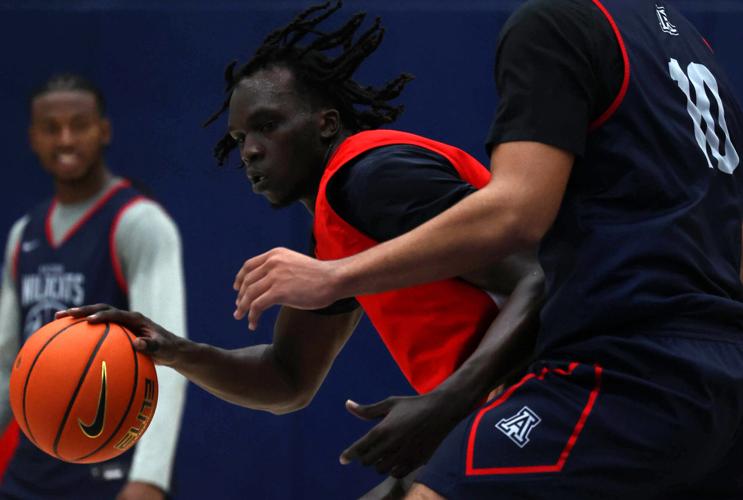
Arizona freshman forward Mabil Mawut (in red) pushes into forward Koa Peat during a partially open practice at Richard Jefferson Gymnasium on Aug. 12, 2025.
This year, they have jumped in with the Children of the Nile charity. First, Mawut started the charity and held a shoe drive at the Arizona spring football game that brought in roughly five times as many shoes as he expected.
Then a drive for essentials Saturday became a no-brainer after Deng's visit to Africa.
“He didn’t know how important those things were to those people," Mawut said. "He's giving me ideas on things that we can do because he gets the chance to always go back home there. He can be my direct intel, telling me what the people need back home, giving me a clear picture of what the situation might be,”
So this time, Children of the Nile will be specifically seeking men’s and women’s underwear, women’s sanitary pads, tampons and slides (open toed sandals), as well as financial donations.
“It’s going to be mostly focused on basic essential stuff,” Mawut said. “These items seem basic but they can make a big difference to the people back home.”
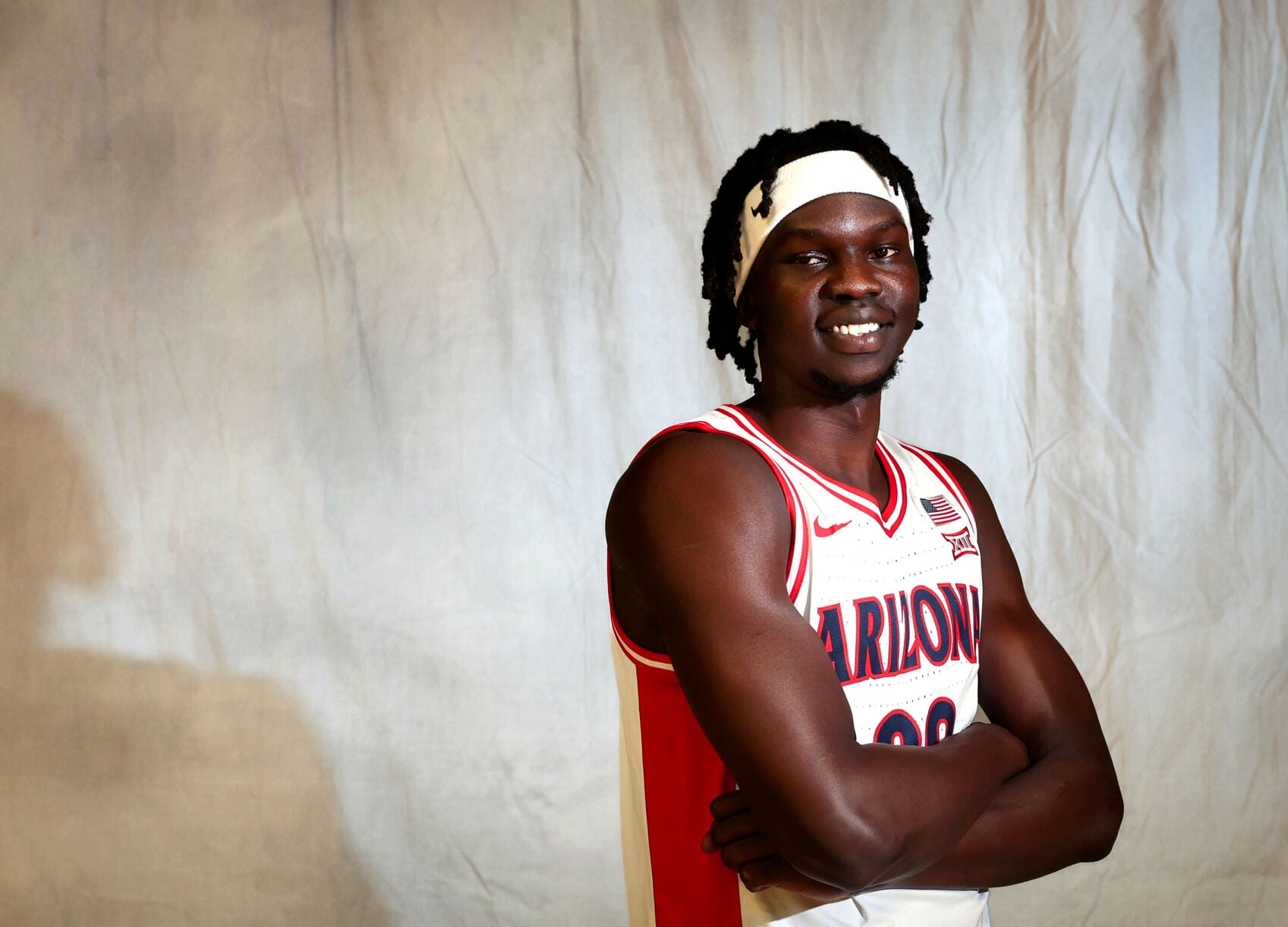
Mabil Mawut (20) poses for a photo on media day at McKale Center, Sept. 17, 2025.
There is only one problem, but Mawut and Deng have started figuring it out: They have to somehow get all this stuff to Kakuma, another refugee camp or South Sudan, on a limited budget.
With the shoes, Mawut started by securing 15 large bags from DoorDash and filled them all. That was the first step.
“I had just gotten back (from Kakuma) and Mabil told me `Bro, we need to ship these bags. I did this shoe drive at the spring game,’“ Deng said. “I told him, ‘Look, this is probably going to cost us a lot of money, and we're a new nonprofit with no funding. Let's talk to an airline, share the story with them and see what they can do.’"
Then Deng heard of a family of six that was traveling from Tucson to Nairobi in May, and soon after went to the airport. Since the family was flying Alaska Airlines to Seattle and then Qatar to Doha and on to Kenya, Deng spoke with an Alaska manager.
The airline agreed to take eight bags – one extra checked bag for every passenger, while carry-on bags helped with the rest of the load. Seven other bags of shoes remain in Tucson for now, and many more bags are likely to be filled up soon.
With much different contents this time.
“Everybody talks about food. Everybody talks about clothes,” Mawut said. “People’s dignity is based on their hygiene, how they present themselves. And it's just being safe from diseases and stuff like that.
“I feel we’re connected. Connected. Maybe we can step in and help.”
Contact sports reporter Bruce Pascoe at bpascoe@tucson.com. On X(Twitter): @brucepascoe
Bruce Pascoe
Reporter