The Tucson Convention Center is more than just a venue.
It’s the home of Tucsonans singing along to their favorite artists.
It’s the home of kids seeing their first hockey or indoor football game.
It’s the home of college students walking across the stage for graduation.
But once upon a time, the space where the convention center was built was the home of hundreds of Tucsonans.
Here’s a history lesson on how a cultural hub became one of Tucson’s iconic sports venues.
A complicated beginning
Long before the Tucson Convention Center stood on the outskirts of downtown Tucson, it was a place many Tucsonans called home.
People are also reading…

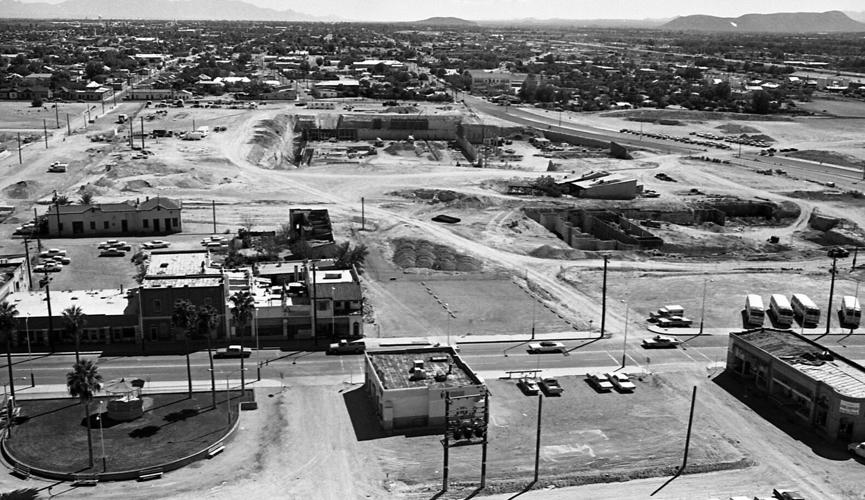
Work on the new $15 million arena and exhibition area of the Tucson Convention Center, upper middle, was progressing along with the music hall, right, as the downtown area was changing as part of its march toward urban renewal on Sept. 17, 1969. The small park and gazebo in the foreground was spared, as was the Mariano Sanmaniego house in the middle of the photograph. The Sosa-Carrillo-Fremont house is next to the music hall. The building on the bottom is the Ronquillo Bakery and the old Menager Dry Goods building, which was torn down, is on the bottom right.
The area had several barrios, including Barrio Libre and Barrio Viejos, which housed multiple barrios such as El Hoyo, Santa Rosa and Armory Park. Within these barrios were numerous houses and businesses, primarily occupied by Mexican families, as well as Black and Chinese families.
By the 1950s, economic redevelopment, also known as urban renewal, began gaining popularity across the U.S, mostly due to the passage of the Housing Act of 1949.
Urban renewal talks made their way to Tucson by the mid-1950s.
It was then that some of Tucson’s barrios were dubbed “slums” that needed to be “cleaned up,” local newspapers reported at the time.
The idea of urban renewal spurred mixed emotions among Tucsonans.

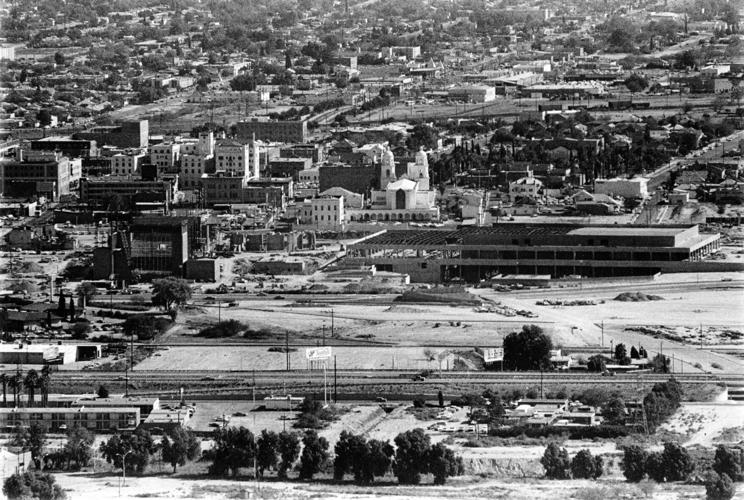
Downtown Tucson in November, 1970. Symphony Hall and the the Tucson Convention Center are under construction.
While some were in favor of new developments in the area, others feared what it would do to local families and businesses, as many of them would be displaced.
But the city continued to focus on the quality of local housing in the barrios to gain support from the community and also secure federal funds for redevelopment.
By the early 1960s, urban renewal was a real possibility for Tucson.
When it came time for Tucsonans to speak their mind about the city’s 76-acre urban renewal plan, they showed up in full force.
On April 24, 1962, around 800 Tucsonans showed up at the Pioneer Hotel to express their views to Mayor Lew Davis and six council members. The meeting ran for hours as both sides of the proposition shared their thoughts.
Despite the hours-long meeting, there wasn’t much headway made.
Less than two weeks later, urban renewal in Tucson was out of the question (for now).
“In a surprise move yesterday, the city council killed the long-pending urban renewal program and ordered stringent enforcement of minimum housing regulations and other city codes in the project area,” the Tucson Citizen wrote on May 8, 1962.
It’s important to note that this was actually the second urban renewal plan rejected by the council. The first plan originated in 1957 and proposed redeveloping 360 acres.
Talks about urban renewal picked back up by 1965.
“Tentative plans for the current 79-acre project also include the convention center and Old Pueblo shopping village areas,” the Tucson Citizen reported in spring 1965.
A year later, urban renewal was officially on the ballot in Tucson.
“By a decisive majority, city voters have given approval to the city’s $15.2 million urban renewal project,” the Tucson Citizen reported on March 2, 1966.
The vote was 10,208 for urban renewal and 7,155 against.
After the bond election results, Davis said the result was a “good omen for Tucson,” the Tucson Citizen reported.
“We will now proceed with the programs introduced in the past few years that mean that the people of Tucson are in favor of progress,” he said.
Demolition for the redevelopment began a year later, but the city wouldn’t break ground on the convention center until 1969, due to working to secure funds for the facility.
The project led to the displacement of hundreds of Tucsonans and local businesses. The City of Tucson estimates that number could be close to 800 residents and 200 businesses.
Construction on the facility, including the arena and music hall, continued into the ‘70s.
Two years of construction and $17.6 million later, the Tucson Community Center at 260 S. Church Ave. was finally completed in 1971.
Where teams found a home
The Tucson Community Center held its grand opening to the public on Nov. 6, 1971. Festivities continued throughout the weekend with band performances and folklorico dancers.
“This center is the embodiment of the new Tucson — an understanding of the heritage and peoples of the past and a recognition that the people of this community have dedicated themselves to better opportunities for everyone,” Mayor James Corbett told the public at the center’s dedication ceremony.

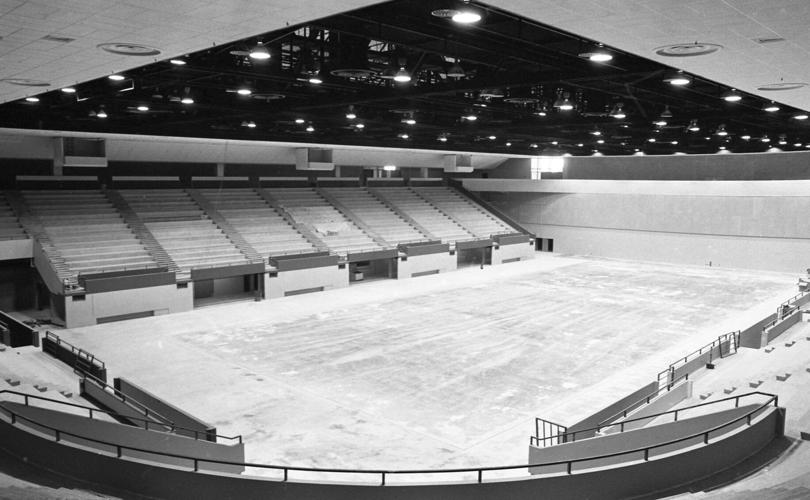
The concrete floor of the new Tucson Community Center arena after it was poured in June and July 1971. It featured pipes buried within the concrete to keep ice frozen for hockey or skating events.
The Tucson Community Center, which would later become the Tucson Convention Center in 2002, hit the ground running after its grand opening.
In its first couple of weeks open, the facility hosted the Ice Capades, a home show, wrestling and boxing matches, a car show and the Miss Tucson pageant.
Soon after, the venue began hosting numerous unforgettable concerts (but that’s a story for another section of the newspaper).
By 1972, sports had become a big part of the community center’s scheduling, especially hockey.
The arena, later named Tucson Arena, got its first taste of professional hockey in 1972 when the Phoenix Roadrunners faced the California Golden Seals for a series of exhibition games.
Followed by the Tucson Mavericks, who made their debut at the TCC in 1975 but quickly dissolved after going 1-12-1 in their opening season.

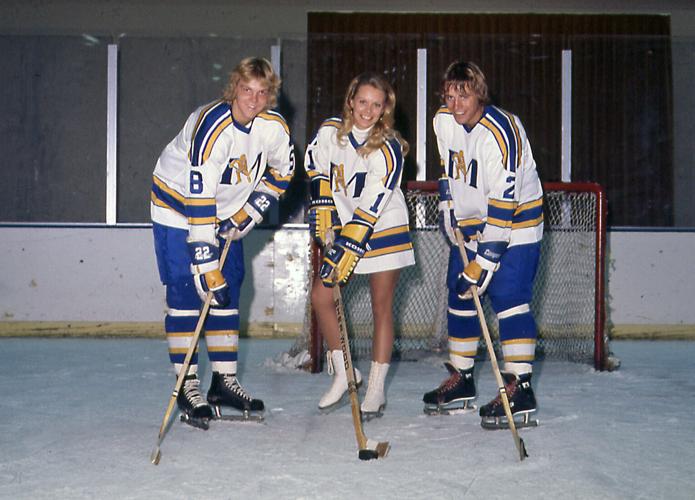
Tucson Mavericks players Neil Lyseng, left, and Blair Davidson pose with an unidentified woman during the 1975-76 season.
In 1976, the arena hosted the Tucson Icemen, a team in the Southwest Hockey League, which acted as a pro-development league for hockey players ages 18-22.
The Icemen era was short-lived as the league folded in early 1977.
A year later, the TCC became the home of another professional hockey team: the Tucson Rustlers.
The Rustlers played at the arena during the 1978-79 season in the Pacific Hockey League before they went defunct.
No professional hockey team would call the TCC home for another four decades.
But there was plenty of hockey action over the next 30-plus years, starting in the early 1980s, when the University of Arizona hockey club began playing at the TCC.

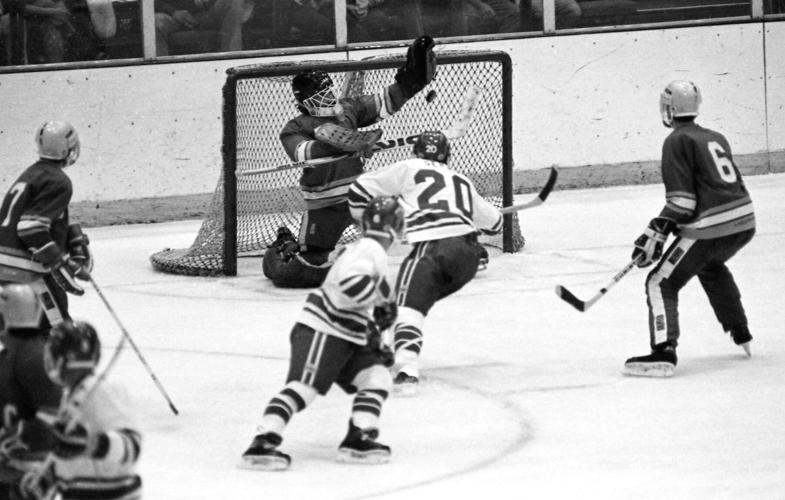
Arizona Icecats hockey vs. USC at the Tucson Convention Center Arena on Nov. 2, 1985.
“The Wildcats have been forced to play most of their ‘home’ games in Tempe the past two seasons because of the unavailability of a rink in Tucson,” the Arizona Daily Star wrote in July 1981. “They played two games at the Community Center last season and averaged more than 3,000 fans per game.”
The Icecats, now the Wildcats, have played at the arena since the early ‘80s. (That will change in the coming years, but more on that next week.)
The Tucson Gila Monsters, a minor league hockey team in the West Coast Hockey League, also played at the arena from 1997-98. They only played 21 games before disbanding.
However, the biggest hockey development at the TCC would come in May 2016 when the city council agreed to a 10-year deal to bring the Arizona Coyotes’ minor league hockey team to Tucson.
The American Hockey League team got its name a month later: the Tucson Roadrunners.
The Roadrunners held their home opener on Oct. 28, 2016, to a large and excited crowd of Tucsonans (and Phoenicians) at the TCC.
The Roadrunners have played there ever since.
In April of this year, the Roadrunners extended their lease with the TCC for the 2027-28 season.
“We are excited to officially extend our lease with our partners at the City of Tucson, Rio Nuevo and Legends Global,” Tucson Roadrunners President Bob Hoffman said in a statement. “More than 140,000 fans have come through the doors at Tucson Arena this season, and over the franchise’s 10 years, that total number is close to 1.25 million.”
But only time will tell if the Roadrunners stay in Tucson long-term, as their NHL affiliate, the Arizona Coyotes, relocated to Utah and became the Mammoth in 2024.

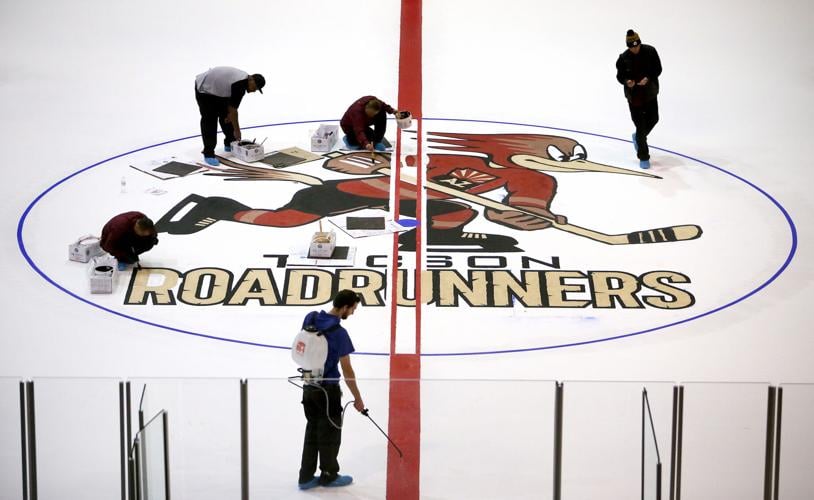
Tucson Convention Center staff operations employees work to paint and seal the Tucson Roadrunners logo for the ice surface going in at the arena, 260 S. Church Ave., on Sept. 22, 2016, in downtown Tucson. The whole process of painting and freezing approximately 10,000 gallons of water took three to four days.
Hockey isn’t the only sport to leave its mark on the TCC.
The Roadrunners gained an arena neighbor when the Indoor Football League’s Tucson Sugar Skulls moved in in 2018.
The Sugar Skulls hosted their home opener on March 10, 2019, against the Bismarck Bucks. The announced attendance was 5,198, the Star reported.
“It was pretty loud compared to some of the others, to tell you the truth,” Marcus Coleman, the then Sugar Skulls head coach, told the Star after the home opener. “Once we get into the season and people start to see what we’re doing, it’s going to be even louder. I would rank it right up there with some of the other arenas.”

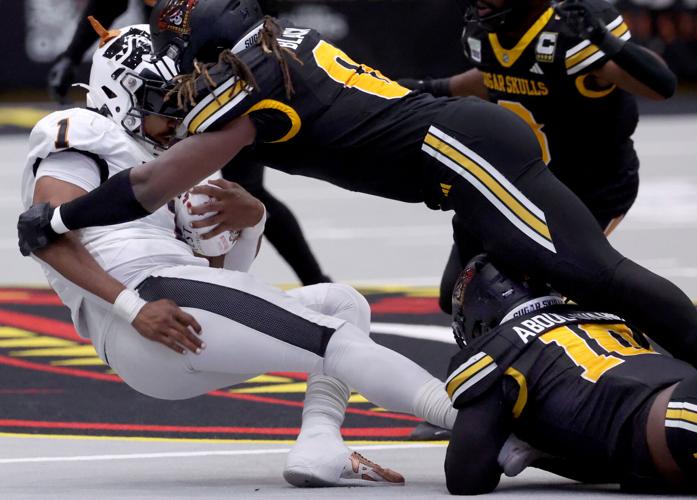
Sugar Skulls linebacker Benari Black (0), top, and defensive lineman Rafiq Abdul-Wahid (10) team up to drop Rattlers quarterback Drew Powell (1) for a one-yard loss in the second quarter of their IFL game on June 20, 2026.
Through sporting events, concerts and more, the TCC has grown into a landmark venue in Tucson over the last 55 years.
Now, the future possibilities for the TCC are endless.
But when thinking about the future, it’s important to reflect on the past and the people who gave the TCC life.
Because you can build a venue, but you can never remove the roots of a community.
Contact Elvia Verdugo, the Star's community sports editor, at everdugo@tucson.com. A journalism and history graduate from the University of Arizona, she shares stories highlighting what makes Tucson and its community special.

Elvia Verdugo
Sports Editor