It’s been almost a century since what we now know as Casino Del Sol Stadium opened its doors to the Tucson community.
In the last 97 years, the University of Arizona football stadium has grown into one of Tucson’s most iconic sports venues.
But how Casino Del Sol Stadium came to be what we know today was a journey in itself.
Here’s a history lesson on the creation and growth of Arizona’s football stadium.
A community effort
Arizona’s inaugural football season occurred in 1899, 14 years after the university was initially founded.
Over the next 20 years, the Arizona football team, which would be dubbed the “Wildcats” in 1914, made a name for itself in the rising college football scene.
People are also reading…
By 1921, UA was thriving under head coach James Fred “Pop” McKale.
Drop-kicker and receiver Harold “Nosey” McClellan led the U.S. in scoring with 124 points, the Wildcats finished the season with a 7-1 record and they even made their first bowl game — the East-West Christmas Classic in San Diego. (Arizona ultimately lost to Centre College of Kentucky, 38-0.)
With an overall thriving team by the mid-1920s, university leaders began to toss around the idea of Arizona having its own stadium.
One of the biggest voices surrounding the idea was Alter Louis Slonaker, the graduate manager of athletics and executive secretary of alumni for Arizona’s alumni organization.
In early 1928, Arizona’s alumni organization dedicated the January issue of its monthly publication to promoting a fundraiser to build a stadium for the university’s football team.

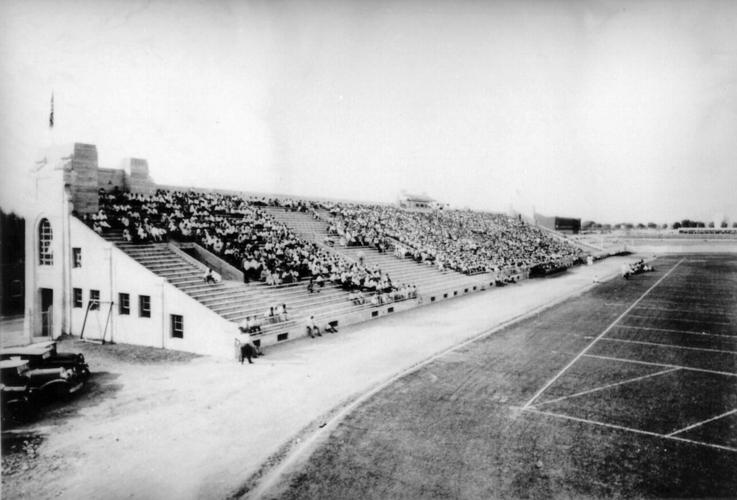
A look at Arizona's new football stadium in 1929.
The group stressed “the need of such a structure in order that the athletics of the institution may keep pace with the advances made recently in other departments,” the Tucson Citizen reported on Jan. 17, 1928.
Slonaker took charge of the fundraising efforts by going on trips around Arizona and California to connect with other Arizona alums and seek funds for the stadium campaign. At the time, Arizona’s alumni organization had over 800 members.
By April 1928, he helped raise $25,000 ($468,286 today) of the needed $100,000 ($1,873,145 today) to build the stadium. (Some records show that the costs could have been up to $160,000).
Slonaker told the Arizona Daily Star on April 7, 1928, that the “results of his tour of the state have been better than expected.”
Less than a year later, the stadium campaign raised $92,000 ($1,723,293 today).
However, a few thousand dollars were still needed to reach the alumni organization’s goal, so they launched a second campaign to secure the remaining funds.
With the help of students, faculty and “prominent Tucson business men,” the additional funds were raised by February 1929, the Star reported.
After another successful fundraising campaign, Arizona’s football stadium was no longer just an idea. It was the real deal.
With $100,000 secured, ground was set to be broken on March 12, 1929 — 44 years to the day the university was founded.
“The rickety stands will disappear with the caliche fields used at present and Tucson will be able to see real football in a real stadium,” the Star reported on Feb. 2, 1929.

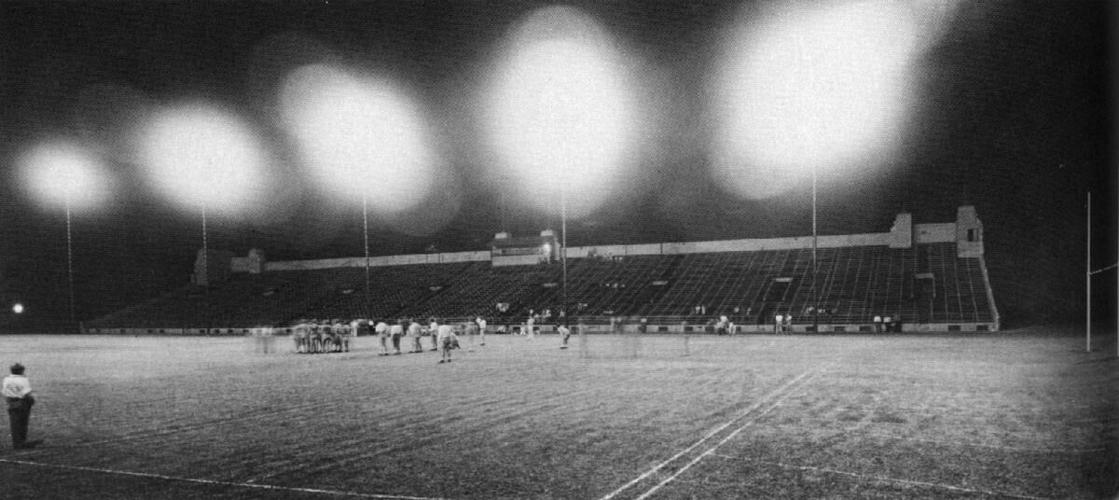
The first game under the lights at Arizona's football stadium took place on Sept. 25, 1931, against San Diego State. The Wildcats lost 8-0.
Construction of the stadium, designed by architect Roy Place, was divided into several sections that had to be completed to be football-ready.
Throughout the spring and summer of ‘29, construction crews worked tirelessly to build the 7,000-seat stadium by the time the first football game of the season (and homecoming) rolled around on Oct. 12, 1929.
During the summer, workers hit a couple of hurdles as monsoon hurled storms their way, often threatening the concrete crews just laid down. One night in July, construction crews worked until 4 a.m. to stay on schedule, the Tucson Citizen reported.
On the morning of July 26, 1929, workers finished pouring concrete for the south end of the stadium. And by early August, the second section of the stadium was completed.
On Aug. 3, 1929, Slonaker confirmed with the Star that stadium construction was on track and would be completed by the Oct. 12 game.
And it was.
What would become known as Arizona Stadium officially opened on Oct. 12, 1929.
At the time, the stadium was 360 feet long and 34 “tiers high,” the Star reported in August of that year.
The stadium included a “spacious press box” with telephone and telegraph wires for press members and plenty of stadium seats for attendees, according to the Star. The seats were made of 3-inch lumber. (Imagine sitting on lumber seats today?)
The Tucson Citizen called Oct. 12 Tucson’s “BIG DAY” as thousands of people in the community and alumni from across the southwest made the journey to Arizona Stadium for its first day open. (The Star reported a little over 8,000 people were at the stadium.)

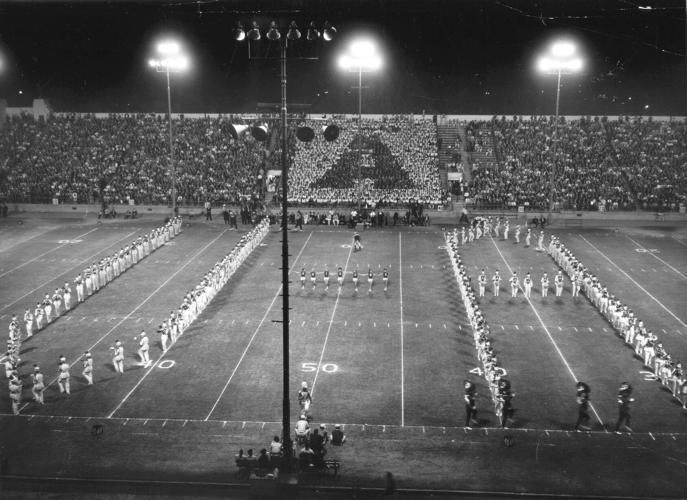
A mid to late 1950s photo of Arizona halftime activities with the band spelling out UA and the student card section with a big block "A".
The university was prepared for the influx of people and had ample parking available for “thousands of automobiles” around the gymnasium and the campus itself, the Tucson Citizen wrote on Oct. 11, 1929.
Even Arizona’s third governor, John C. Phillips, made his way down to Tucson for the occasion and delivered a speech during the stadium’s dedication.
“The completion of this splendid structure and the financing of it without special appropriation from the legislature is a splendid accomplishment,” Phillips told the filled stadium at the end of his speech. “I share the pride which should be that of every public-spirited citizen in our state today and congratulate the alumni and the students who gave so generously of their time and efforts that we might today dedicate this stadium to present needs and to posterity.”
Shortly after the dedication, the Wildcats faced and defeated Cal Tech, 35-0, in the first game at Arizona Stadium.
That game was only the beginning for the Wildcats in Arizona Stadium, as hundreds of games would be played there in the next 97 years.
A century of growth

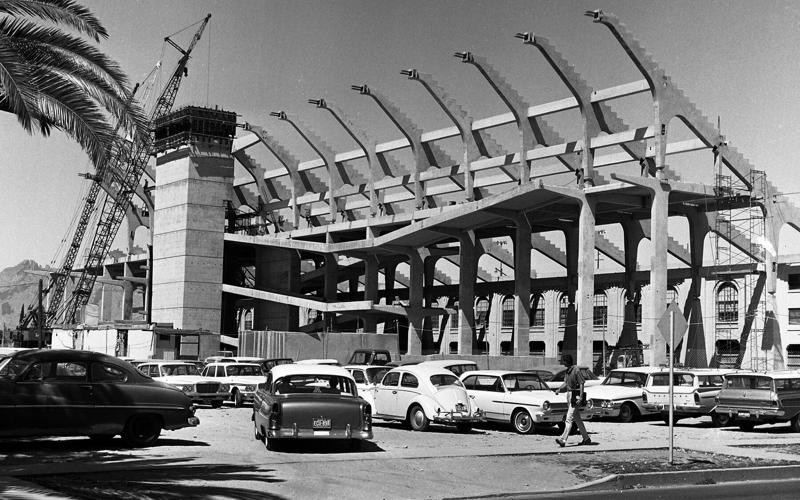
Arizona Stadium starts to take shape as 10,000 new seats are added to the west side along Vine Street as part of the University of Arizona's $1.4 million addition to the structure on April 16, 1965. The completion date for the addition to the stadium was extended a month to October 2, 1965.
After its opening in 1929, Arizona Stadium continued to grow over the next several decades.
In 1931, the stadium added lights, so evening and night games could be played. The Wildcats’ first night game at Arizona Stadium was played on Sept. 25, 1931. (Arizona lost 8-0 to San Diego State.)
The stadium’s seating arrangements expanded throughout the years, starting in 1938, when 3,000 more seats were added, bringing the total to 10,000.

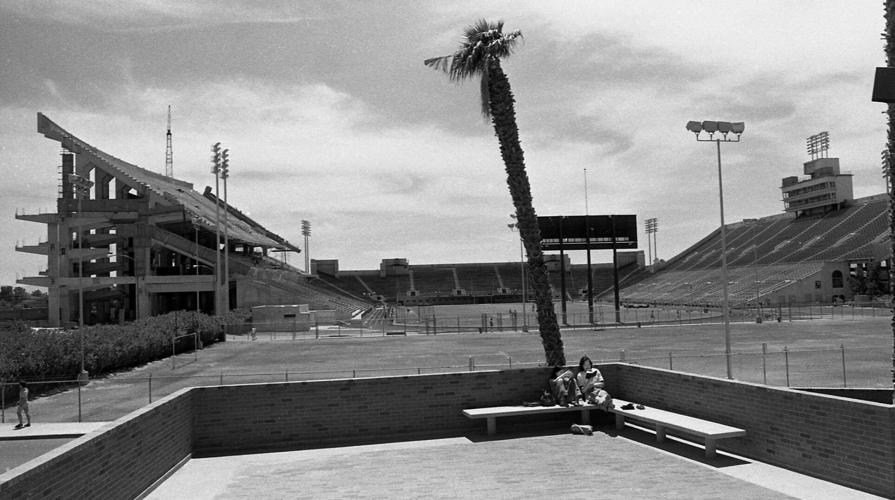
From the patio of the new University of Arizona main library, students hang out as construction on the east side of the football stadium, on the left, continues on April 21, 1976. Arizona Stadium's seating capacity was to increase to a total of 57,000 seats for its season opener against Auburn on Sept. 11.
A decade later, an electronic scoreboard was installed that remained until the 1970s.
Expansion continued in 1950, 1965, 1976, 1988 and in the 1990s. These changes included upgrading the press box, adding thousands of seats to various parts of the stadium and eventually installing a video board.
For reference, the stadium’s current seating capacity is 50,800, according to the Arizona football media guide.
Along with the seating upgrades in the ‘80s, Arizona Stadium became the home of the Copper Bowl, which continued until 1999, when the bowl moved to Phoenix. (Now, the stadium has been home of the Arizona Bowl since 2015.)
Change continued all the way through the 2000s, when Arizona Stadium was a part of an overall estimated $378 million Arizona athletic department upgrade and expansion project that included many of the university’s athletic facilities. Arizona Stadium’s cut was roughly $80 million, according to the Star.
As a part of the project, Arizona Stadium was set to get a four-story, mostly glass building in the north end zone, the Star reported in 2009.
“The structure would have about 5,000 premium seats, replacing aluminum benches,” the report stated. “The proposed building would house football offices, locker rooms and a public concourse. A new video board would be located in the south end zone.”
That building, which was completed in 2013, would become the Lowell-Stevens Football Facility, which is still in use today.

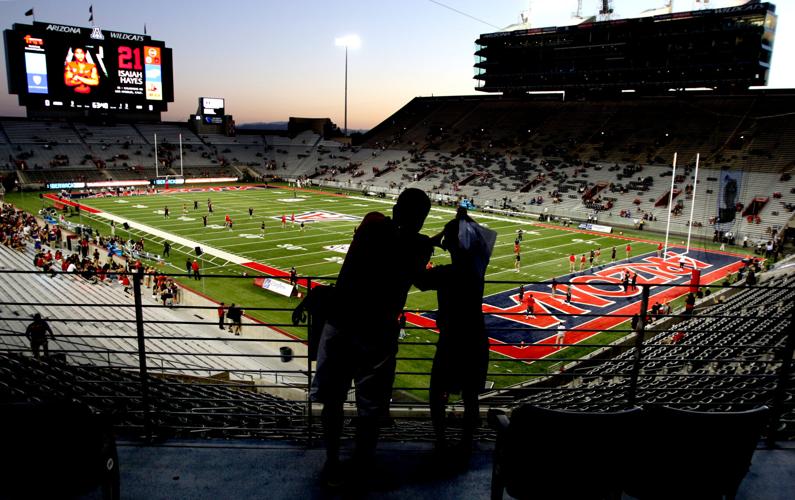
Marcos Moore and his son Matthew, season ticket holders from Yuma, watch the team warm up before Arizona takes on Washington at Arizona Stadium, Sept. 24, 2016.
Interestingly, “naming rights to the end-zone building and the stadium itself” would be available, former Arizona Athletic Director Jim Livengood told the Star in 2009.
While the end-zone building did receive a name as the Lowell-Stevens Football Facility, Arizona Stadium wouldn’t reach a naming rights deal until nearly 15 years later.
Last November, Arizona Athletics agreed to a 20-year naming rights deal with Casino Del Sol, an enterprise of the Pascua Yaqui Tribe, for Arizona Stadium.
The 20-year deal with Casino Del Sol is valued at more than $60 million — the largest total amount in the Big 12 and one of the largest valuations in Power 4, the Star reported last year.
When the naming rights deal was reached in 2025, current Arizona Athletic Director Desireé Reed-Francois told the Star:
“We want to provide competitive resources for all of our programs, including football. This is one of those levers that provide comprehensive support. We keep investing in our football program, we keep investing in our student-athletes and this is the modern era of college athletics. Resources are critical.”
Despite an ever-changing college sports industry, Casino Del Sol Stadium has stood the test of time.
The stadium has seen countless sporting events, graduations, a couple of concerts and tons of memories — both good and bad, depending on the score.
As the stadium approaches its centennial, it has remained, and will always be, a part of Arizona football’s story and legacy.

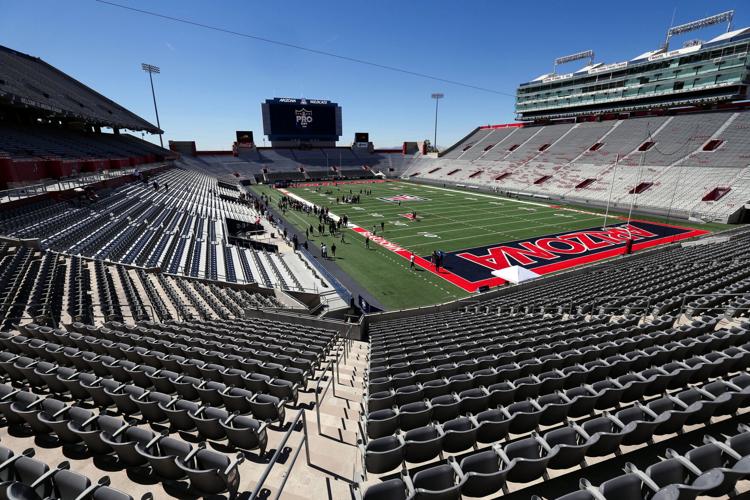
Arizona football pro day kicks off at Casino del Sol stadium, March 25.
Contact Elvia Verdugo, the Star's community sports editor, at everdugo@tucson.com. A journalism and history graduate from the University of Arizona, she shares stories highlighting what makes Tucson and its community special.

Elvia Verdugo
Sports Editor


 The Mount Rushmore of Arizona Wildcats head coaches