They knew the name before it was even built.
McKale Memorial Center.
That’s what the University of Arizona and its alumni organization planned to name its new state-of-the-art athletics facility in 1967 — six years before it would open its doors to the Tucson community.
The Arizona Alumni Association proposed the name to university leaders, including then-Arizona president Richard A. Harvill, in honor of J.F. “Pop” McKale, a former coach, professor and athletic director for the school from 1914-57. McKale died on June 1, 1967.
The alumni organization stated that the “student activity sports center be named in appropriate fashion after James Fred McKale so as to perpetuate his memory in the minds and hearts of past, present and future students and alumni of his adopted alma mater,” the Arizona Daily Star reported on Aug. 6, 1967.
People are also reading…

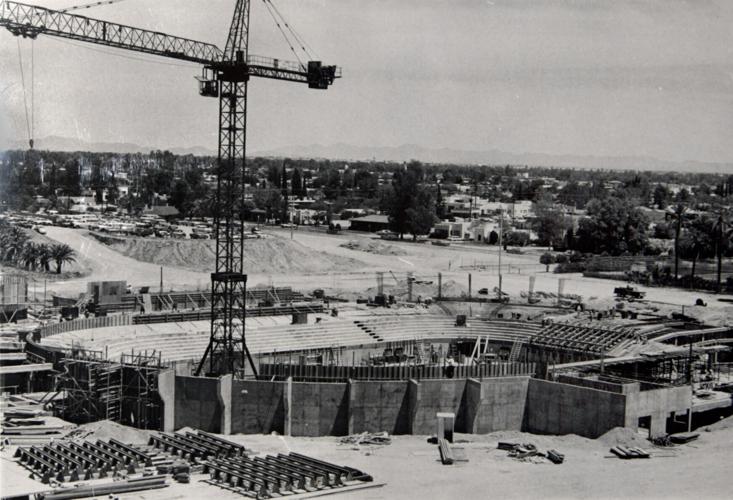
Work continued on McKale Center during the summer of 1971, seen here on June 9, 1971.
Thus, McKale Center was born. Well, kind of.
Naming the facility was the easy part of the process.
Over the next three years, the university worked to secure funds for the estimated $2 million (about $19.7 million today) center.
The “all-campus meeting center,” as described by Harvill, would serve various purposes. The facility would provide a home for Arizona basketball, gymnastics, swimming and wrestling and be a headquarters for all university sports programs and men’s physical education, the Star reported in 1967.
The space would have numerous offices, conference spaces and around 15,000 seats in the arena. (The reported 15,000 seating capacity actually ended up being 13,658).

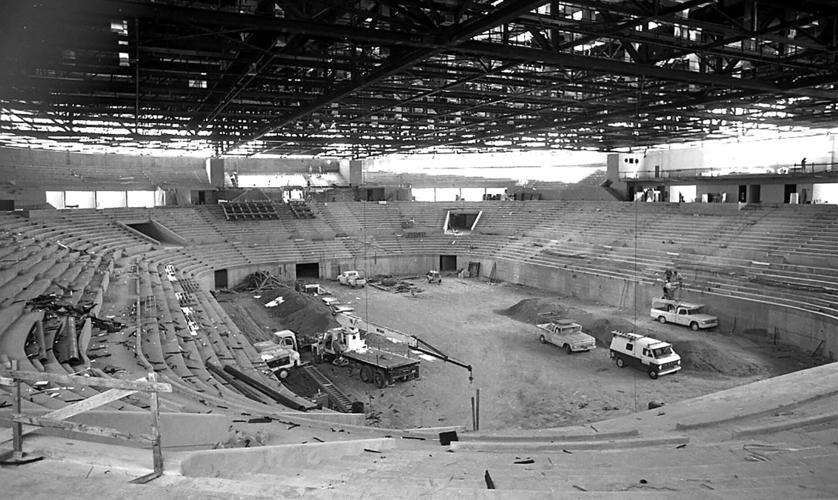
The interior of the new McKale Center started to take shape as construction continued at the University of Arizona on Aug. 4, 1972.
However, due to rising costs and pushback from state officials, the start of the project’s construction phase was delayed multiple times over the years.
By the time 1970 rolled around, the estimated costs for the project had quadrupled. The university then found itself having to seek additional funds to reach the newly estimated $8 million ($68.7 million today) total needed to complete the project.
On Jan. 30, 1970, Harvill appeared before the Senate Appropriations Committee in Phoenix to request the additional $4.1 million needed for McKale Center.
Sen. Ray Goetze accused Harvill of “ridiculous disregard” for state taxpayers by requesting more money for the project.
“I know you need a new field house, but you don’t need an $8 million establishment down there to play basketball,” Goetze told Harvill.
Harvill followed up by reminding the committee that Bear Down Gym, which was built in 1926 and became the home of Arizona basketball, was the smallest athletic facility in the Western Athletic Conference (WAC) and had the “lowest seating capacity of any major conference school in the country,” the Tucson Citizen reported. (Bear Down Gym’s seating capacity was estimated to be around 3,600).
Despite the uphill battle, the university continued working toward compiling the needed funds through the spring. In May 1970, McKale Center finally got the go-ahead to begin building later that year.
The Arizona Board of Regents approved plans for the university to use “$4 million of its $4.5 million capital outlay funds for the 1970-71 toward the facility,” the Tucson Citizen reported on May 25, 1970.

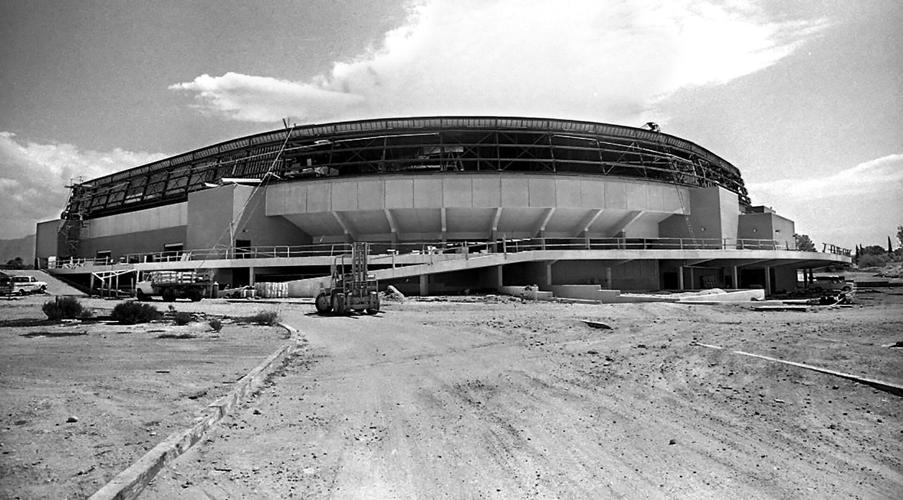
An outside view of McKale Center as construction continued on the sports facility on Aug. 4, 1972.
“The university previously had received $4 million in state funds and has approximately $500,000 in federal funds on hand for the project, adding up to a total construction budget of $8.5 million,” the Tucson Citizen stated in its report.
McKale Center officially broke ground in mid-November 1970.
Arizona basketball coach Bruce Larsen, athletic director Dick Clausen and Harvill participated in the groundbreaking ceremony and shoveled the first scoops of dirt with a custom three-headed shovel.
By March 1971, excavation was completed, and foundation work was underway.
McKale Center was finally starting to take shape.
Nothing but net
For the 1971-72 basketball season, the Wildcats were presented with the opportunity to play their games at the Tucson Community Center (now known as the Tucson Convention Center).
Arizona ultimately decided to remain at Bear Down Gym until McKale Center was completed, which, at the time, was estimated to open in a year.
“If it was a matter of several years until completion of McKale, I’m sure we would move into the (Tucson) Community Center immediately,” Clausen told the Tucson Citizen on Aug. 19, 1971. “But for one year, particularly the upcoming one, when we’ll have a new team, we don’t anticipate needing the facility. We simply don’t expect to be crowded out of Bear Down (Gym) next season.”
Work continued on McKale Center into 1972, but hit a hurdle on Jan. 25, 1972, when a 170-foot beam fell 40 feet and damaged 11 steel girders, the Star reported on Jan. 27, 1972.

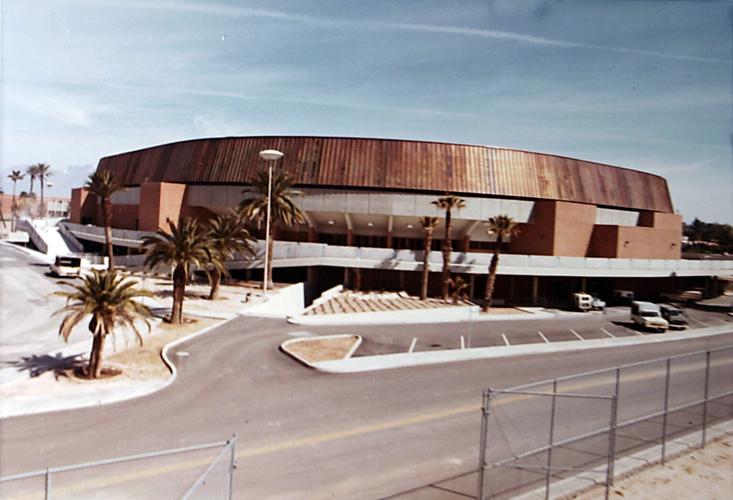
McKale Center, pictured here on Feb. 28, 1973, a few weeks after it officially opened its doors. Note the bright copper crown that looks quite different today.
Fortunately, the incident didn’t postpone construction or the expected project completion date.
Several months later, McKale Center was ready for its finishing touches.
By December 1972, McKale Center was “crowned” with $100,000 worth of copper, and the flooring had been placed in the arena, according to the Tucson Citizen. That copper has developed a brown appearance over the years.
The facility wound up with 7.5 million cubic feet of space and is “equivalent to a regular building of nearly 390,000 square feet,” the Tucson Citizen reported.
At the time, McKale Center was the second-largest University of Arizona building, just behind University Hospital (now Banner-University Medical Center).
With everything in place, there was only one thing left to do for the Wildcats: open the doors to McKale Center.
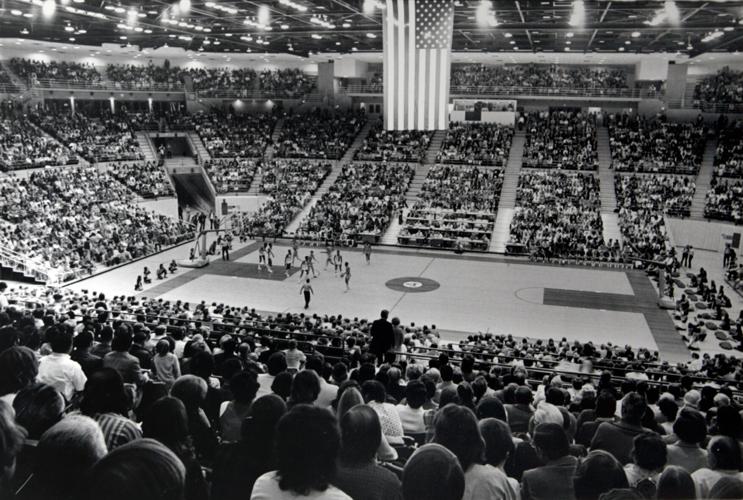
McKale Center officially debuted to the public on the evening of Feb. 1, 1973, when the Wildcats faced Wyoming in their first game at their new home.

A crowd packed the house for the opening night of the McKale Center on Feb. 1, 1973.
“I don’t attach much significance to it being the first game there,” Arizona basketball coach Fred Snowden told the Star. “I’d like to win every one we play. I wanted to win the last one in Bear Down. I’d like to win the first one in McKale and I’d like to win all the ones in between.”
In its first McKale Center game, Arizona defeated Wyoming, 87-69.
Since then, the Wildcats have played hundreds of games in McKale Center and have cultivated a dedicated fanbase and community.
And now, McKale Center is home to Arizona volleyball and gymnastics, too.

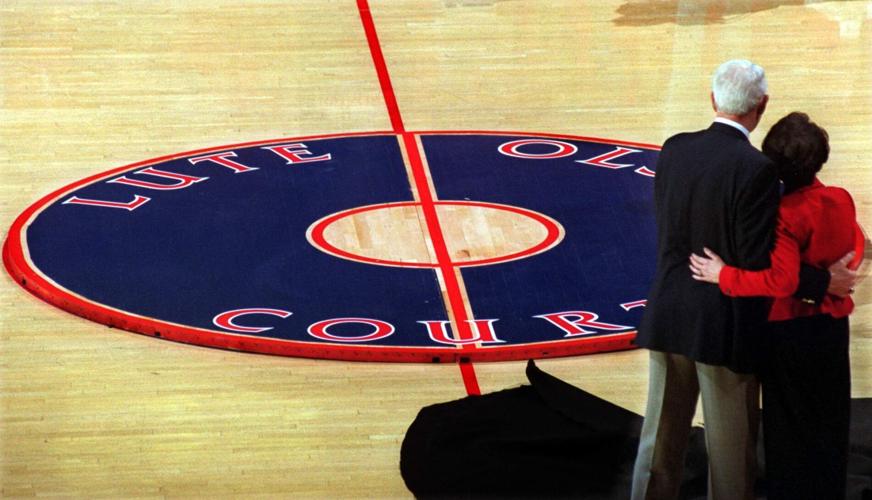
Lute and Bobbi were arm in arm in March 2000 during the unveiling of the Lute Olson Court at McKale Center.
To keep up with the times, McKale Center has seen its fair share of changes and upgrades over the last several decades.
The facility has added more seats and video boards, in addition to upgrading the concession stands, restrooms and teams’ locker rooms.
In 2000, McKale Center’s court was named after Lute Olson, Arizona’s legendary head basketball coach from 1983 to 2007. A year later, the court was renamed the “Lute and Bobbi Olson Court,” also honoring his wife Bobbi Olson, who died from ovarian cancer on Jan. 1, 2001.
The biggest change McKale Center has seen happened only a few months ago when Arizona partnered with Alkeme Insurance for a 15-year, $27.7 million naming rights agreement.
Now, the facility goes by McKale Center at Alkeme Arena.
The agreement between Arizona and Alkeme “provides critical resources that allow Arizona Athletics to continue our momentum and position our programs for long-term competitive success,” said current Arizona Athletic Director Desireé Reed-Francois. “Alkeme leadership's commitment to education and giving back as Arizona graduates reflects a shared belief in excellence — on the field, in the classroom, and beyond.”
But no matter what you call it — McKale, McKale Center, McKale Center at Alkeme Arena — it’s all the same place for Arizona fans who have spent endless hours there cheering on the Wildcats.
McKale Center (at Alkeme Arena) is so much more than just a sports venue...

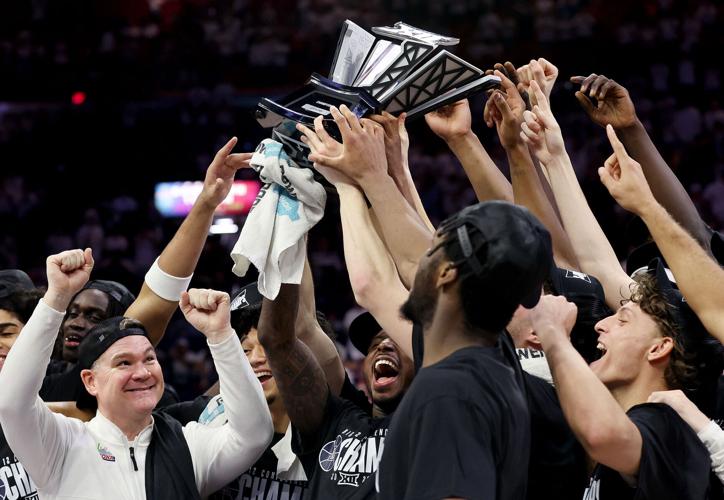
Arizona Wildcats clinch Big-12 regular season title after defeating Iowa State 73-57 at McKale Center in Tucson, Ariz. on March 2, 2026.
It’s the place where Arizona legends are made.
Contact Elvia Verdugo, the Star's community sports editor, at everdugo@tucson.com. A journalism and history graduate from the University of Arizona, she shares stories highlighting what makes Tucson and its community special.

Elvia Verdugo
Sports Editor


 The Mount Rushmore of Arizona Wildcats men's basketball players