Just 90 seconds into his remarks Tuesday morning at Big Ten football media days in Chicago, commissioner Tony Petitti referenced the conference's national titles in football and men's and women's basketball and proclaimed the Big Ten is "in the strongest position in its history."
This being college sports, Petitti spent most of the subsequent 40 minutes answering questions unrelated to the Big Ten's championship sweep.
Instead, he offered insight and opinion on Congressional legislation, the future of the College Football Playoff, his relationship with a rival commissioner and a new model of governance at the top of the major college food chain.

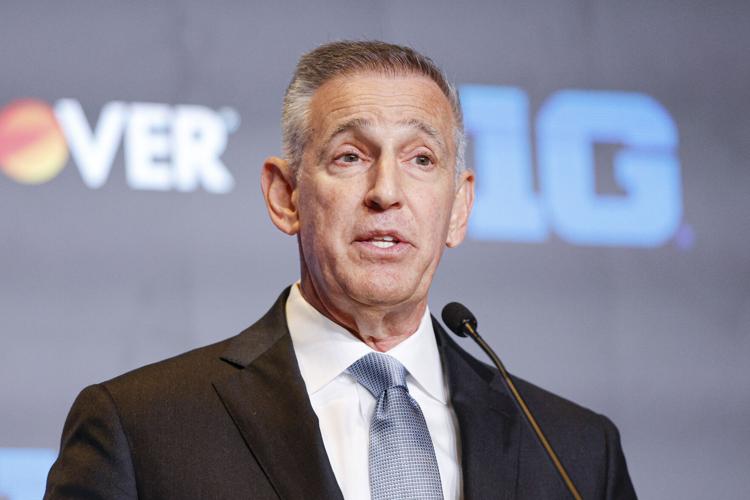
Big Ten Conference Commissioner Tony Petitti speaks during Media Days at Hilton Chicago on July 28, 2026.
Despite the Big Ten's immensely influential position, Petitti struck a collaborative tone on the most sensitive issues, including the potential for the conference to join the SEC in what has been loosely described as a "breakaway" from the NCAA.
People are also reading…
The inflammatory issue took center stage last week during the SEC's football media event, when commissioner Greg Sankey described frustration within his membership about the lawless nature of college sports in matters of roster spending, tampering, transfers and eligibility.
Asked whether conversations inside the SEC about a possible breakaway were real, Sankey said:
“They’re real. People have talked about that. They have opined about the frustrations that bring them to the point of saying we should look at something significantly different. I do not believe that it’s a leverage point. I think that’s honest communication.”
But what would a breakaway entail?
In limited form, it would result in the SEC establishing and enforcing conference-specific rules governing eligibility, recruiting and spending.

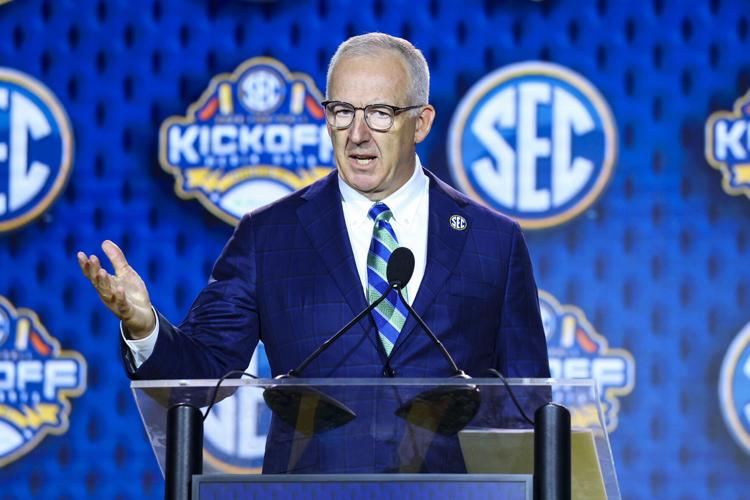
SEC Commissioner Greg Sankey speaks to the press during SEC Football Kickoff Media Day at the Tampa Marriott on July 20, 2026.
In extreme form, it would lead to the SEC not only forming its own rules but also competing only against itself, perhaps with its champion playing the best team from the Big Ten.
(Any attempt by the SEC and Big Ten to join forces and create a 34-team super conference would undoubtedly encounter antitrust scrutiny.)
Sankey, Petitti and their peers across major college sports want the Protect College Sports Act (PCSA), which is currently moving through the U.S. Senate, to provide a reasonable framework for the industry to function with uniform rules and some level of liability protection.
However, the bill has a treacherous journey ahead, both in the Senate and House of Representatives. The challenge stems, in large part, from sweeping provisions opposed by the Big Ten and SEC. (Two major points of contention are parameters around conference expansion and media rights.)
"We preferred a much skinnier bill," Petitti said Tuesday.
The timing is precarious. If the PCSA does not reach the Senate floor before the August recess at the end of next week, momentum could fizzle as the focus on Capitol Hill turns to the midterm elections.
With that as the backdrop, Petitti was asked if the Big Ten might, like the SEC, consider a new model of governance that takes either the limited approach (conference-specific rules) or the extreme form (conference-only competition).
"The focus is in stages," he said. "The first thing we are focused on is getting the (PCSA) right. It's taking up a tremendous amount of time. If the bill can't address some of the changes we need to make ... the first place you go is with our colleagues in the other conferences and the NCAA.
"How do we come together to make the necessary changes so we can give our athletic directors, coaches and student athletes a system that seems to be more sustainable? It's not a breakaway. But is there another path ... where you have conference-based rules?
"That's not necessarily breaking away. It doesn't mean you don't play anybody else. But is there another path to have rules that (we can) at least operate?
"We absolutely have to do everything we can to prepare for every one of those things. So while we're focused on the bill, we have teams of people that set the groundwork" for alternate scenarios.
Petitti, who took the stage in Chicago at 10:45 a.m. local time (Central), noted that he had already spoken to Sankey five times Tuesday morning — a reflection of the furious pace of negotiations with the PCSA's sponsors, Sens. Maria Cantwell (D-Washington), Ted Cruz (R-Texas) and Eric Schmitt (R-Missouri).
"There is just incredible effort about getting this bill right, and that's all about staying together in the system we have," Petitti said.
"'Breakaway' is a word that creates a lot of emotion. I've never heard that anybody doesn't want to play anybody else. We want to schedule more good games. We've just got to get to a system that allows us to do that."
In the meantime, Big Ten and SEC executives are preparing Plans B, C and DEFCON 1.
Other notable comments from Petitti during his Q&A with the media:
– On the Big Ten's support for expanding the CFP to 24 teams, a move currently opposed by the SEC and contingent upon the TV revenue: "We're trying to do this together. We have to see if (24) has the right value."
CFP media consultants are attempting to determine whether the media revenue generated by 12 additional games would offset the cash lost by eliminating conference championships, which become obsolete with a 24-team playoff.
"They are doing what they think best," Petitti added of the SEC, "and we are doing what we think best."
– On his relationship with Sankey: "I don't think it could be much better."
– On the Big Ten adopting a requirement that each team plays at least one nonconference game against the ACC, Big 12 or SEC: "Our focus is on seeing clarity around the CFP before we make the next decision."
(The Big Ten is the only power conference without the policy.)
– On whether the Big Ten will seek jersey patch sponsorships at the conference level, a model the Big 12 pursued with its $20 million annual Monster Energy deal: "Our analysis ... led to the decision that it's best to pursue those decisions at an institution-based level."
Notably, Ohio State announced a jersey patch deal Tuesday with Chase that reportedly will pay the Buckeyes $17 million annually.
– On the strength of the Big Ten's middle-tier teams, which are perceived to be weaker than their SEC counterparts:
"The idea that the middle of our conference isn't hard is just not right. ... The reason we have been so successful (in the CFP) is our teams are prepared."