

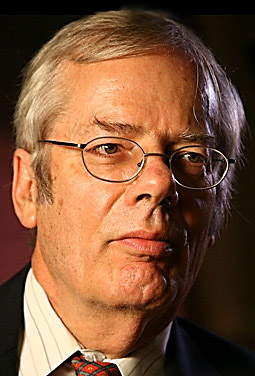
University of Arizona Regents Professor Roger Angel is one of three winners of the $1 million Kavli Prize for astrophysics - given to three men who made it possible to build ever larger telescopes.
Angel said he learned of the honor in a 5 a.m. phone call from Norway and then started doing research to find out what it was.
"It's a Nobel look-alike or something. You get to go to Oslo and meet the king," he said.
The 2010 prizes were given to eight scientists in three fields. The prizes, awarded for the first time in 2008, are a partnership of the Norwegian Academy of Science and Letters, The Kavli Foundation and the Norwegian Ministry of Education and Research.
Angel said he knew about the Oxnard, Calif.-based foundation but hadn't heard about the prizes. He was pleased that the astrophysics prize was given for technology development.
People are also reading…
"There are lots of well-deserving people in the theory and the observing side. It's pretty remarkable to make that nod to us," he said.
He shares the $1 million award with two other innovators in telescope design - Jerry Nelson, of the University of California-Santa Cruz, and Ray Wilson, formerly of Imperial College London.
All three had critical roles in developing competing technologies for the world's biggest telescopes, with mirrors up to 30 feet in diameter.
Nelson and Angel are now moving from large telescopes to giant ones, working on competing designs for telescope mirrors up to 100 feet in diameter.
Angel, founder and director of the UA Steward Observatory Mirror Lab, was cited for his development of methods to build larger telescope mirrors, using a spinning furnace and a honeycomb structure that make the mirror lightweight and rigid at the same time.
Mirrors cast at Steward are up to 8.4 meters (27.6 feet) and collect light for some of the world's premier ground-based telescopes, including the Large Binocular Telescope atop Mount Graham, where two 8.4-meter mirrors were built to work as one giant eye.
Angel is now at work on the Giant Magellan Telescope, one of three next-generation telescopes proposed to make a quantum leap in ground-based astronomy. The GMT's seven 8.4-meter mirrors will be shaped to provide a single focus for the light collected. The first petal of the GMT is nearing completion.
He also has embarked on a project to make solar energy competitive with low-cost fossil-fuel generation.
"It is obviously a very welcome recognition of the huge impact Roger has had on modern astronomy," said Peter Strittmatter, director of the Steward Observatory.
On StarNet: Find more science, technology and health stories at azstarnet.com/news/science
Contact reporter Tom Beal at 573-4158 or tbeal@azstarnet.com


