Hamid Saadatmanesh has been called Dr. Carbon. Some people might call him the bridge doctor.
The University of Arizona civil-engineering professor has made a career of developing methods to use carbon fiber to strengthen concrete, steel and brick on bridges and other structures that have been damaged or otherwise fallen into disrepair.
Among some high points to date:
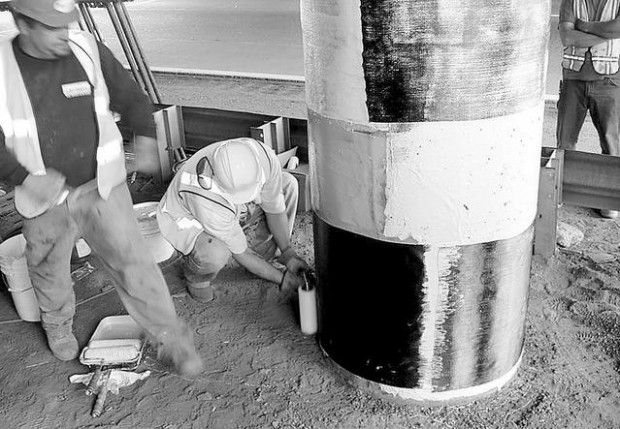
● Getting the California Department of Transportation to use carbon-fiber fabric to wrap around bridge columns damaged by the 1989 Loma Prieta earthquake in the San Francisco area.
● Demonstrating that a concrete block wall could withstand an explosive blast from 230 pounds of TNT after it had been covered with carbon fiber and a special epoxy he formulated.
Saadatmanesh (Sah-DOT-man-esh) said he stumbled onto his key findings by chance.
People are also reading…
Saadatmanesh had just arrived at the university in the summer of 1987 after earning his Ph.D. at the University of Maryland to work on rehabilitation of bridges.
He described himself as "a young, nervous assistant professor trying to look for something to do, to get a grant" that would lead to job security and eventually tenure.
One day, he noticed corroded steel rebar — bars of steel used in reinforced concrete or reinforced masonry — next to the engineering building.
"Suddenly, it sparked in my mind that this is a problem all over the world, that there are billions of dollars actually spent every year on deterioration of structures because of (rebar) corrosion," Saadatmanesh said.
That's when he thought about making a product that doesn't corrode, ultimately settling on plastic rebar reinforced with carbon fibers, providing strength, durability and resistance to corrosion.
But given the limited application for rebar and the fact that corroded steel rebar can't be extracted from concrete, Saadatmanesh said he turned his attention more to carbon fibers, which were being used in the aerospace industry but not in civil engineering or construction.
Among its qualities, carbon fiber is lightweight, noncorrosive and much stronger than steel. "On the average, the material strength of carbon is 10 times stronger than your average steel," he said.
Saadatmanesh has strongly advocated the transfer of advanced composite materials technology in use in the aerospace industries into construction, for repair of public works and other infrastructure.
Saadatmanesh received eight National Science Foundation grants between 1990 and 1997, totaling more than $1.25 million to pursue his goals.
One grant went toward the TNT explosion demonstration.
With a special epoxy he developed after several years of research, Saadatmanesh bonded carbon-fiber sheets, which he calls carbon wrap, on the outside of corroded or cracked steel or concrete beams, columns or slabs, right over the corroded elements.
Today, the professor has his third company, Carbon Wrap Solutions LLC, and sells the materials to contractors across the country.
He said projects are under way from Hawaii to New York — from repairing a 2 million-gallon water tank in Honolulu to several bridges near New York City.
The California Department of Transportation has also made wide use of the carbon fiber technology, Saadatmanesh said.
One customer for the past four years is Richmond, Calif.-based industrial contractor J.T. Thorpe and Son.
"You can put it over existing structures that may have lost their integrity like a concrete tank or steel tank, and you can re-establish that to above its original strength," said company official Gary Stewart.
The company has used the carbon-fiber-epoxy process in strengthening steel storage tanks and other storage vessels, particularly in refining applications "that otherwise would have had to be replaced or go through a process that may have had to be shut down at the cost of power generation or refining capacity," Stewart said.
"We have been able to go in and do repairs using carbon fiber and save down time."
Another current customer is JMA Ventures, landlord for Ghirardelli Square in San Francisco. A contractor is using Saadatmanesh's carbon-wrap product to strengthen the brick covering on the historic chocolate factory building, said Joe Nootbaar, a principal in JMA Ventures.
"Their technology enables you to do a strengthening with minimum visual impact. . . . There's really no difference in the look of the wall," Nootbaar said.