Growing up in an industrial part of Cleveland, the son of hardworking Hungarian immigrants, Milton Frank developed an empathy for the working poor and others who found life a struggle.
His father was a metalworker. His mother was a homemaker. Hungarian was the primary language in the Frank home, and learning a trade was valued more highly than a college education.
Yet it was the experience of growing up in the gritty urban area that inspired Frank to go to college, where he studied social work and psychology.
He pursued the professions until five years ago, when he developed myasthenia gravis, a chronic autoimmune neuromuscular disorder that causes fluctuating muscle weakness.
In recent weeks, his health declined even further. Frank died March 28. He was 83.
"He was a very articulate person," said his wife, attorney Kay Richter. "He went from his background of a poor academic education as a child to a lot of achievements."
People are also reading…
Richter credits the Settlement Movement — a social reform movement to serve the poor in urban areas — with sparking her husband's interest in the arts and community involvement. Frank took part in children's cultural programs in Cleveland and by the time he was 10 had learned to paint, memorized dozens of poems and developed an appreciation for Metropolitan Opera productions he heard on the radio.
The Settlement Movement pioneered the field of social work and kindled Frank's interest in helping others.
Frank served in the Navy during World War II and parlayed the money from the GI Bill into bachelor's and master's degrees in social work from what's now Case Western Reserve University in Cleveland. (Decades later, at the age of 61, Frank received his Ph.D. in psychology from Union Graduate College in New York.)
After graduating from Case Western, Frank was a social worker at Jewish community centers in Cleveland and Chicago before heading west to take a job at the Tucson Jewish Community Center in the mid-'50s. He started as a program director, and within a few years had become executive director.
Frank left the JCC in the mid-'60s to become chief psychiatric social worker at the Southern Arizona Mental Health Clinic. A few years later, he was recruited by Dr. Alan Levenson as the first chief of psychiatric social work in the University of Arizona's new department of psychiatry in the College of Medicine.
Levenson was impressed by the range of Frank's experiences in social work, his clinical work with patients and the work he did as a program director.
"Most of all, it was just Milt as a person," Levenson said. "He was someone who had an enormously good intuitive sense about people and about working with patients and providing care for patients.
"He did a wonderful job."
By then, Frank specialized in psychodrama and group therapy.
Frank was a mentor for Maureen Hutter when she studied psychology, as well as for social- work student Mary Romaniello.
"He was a wonderful man. He was a gentle and kind man. His personality was healing," Romaniello said. "People sometimes called him 'Uncle Milt' because he was the kind of person you'd want as a relative."
Hutter met Frank when she was in graduate school and her husband, Dr. John Hutter, was a colleague of Frank's in the College of Medicine.
"He was a very skillful teacher, very warm and engaging and inclusive," now-psychologist Maureen Hutter said. "As a group therapist, he was very engaged and felt very strongly that people's social community and their connection to each other was going to be very important in working through whatever they were dealing with."
The Hutters became friends with Frank and Richter, spending weekends in the White Mountains, taking ski trips in the winter — Frank learned to ski when he was 60 — and taking professional retreats in the Chiricahua Mountains with members of the Arizona Group Psychotherapy Society, which he co-founded. Frank entertained colleagues on the outings by singing folk songs into the evening.
Richter, too, was a student of Frank's. They met in the early 1970s, when Richter was pursuing her master's degree in social work. Frank, a father of two, was a widower. The couple dated for four years and married in 1979.
"I was attracted to his intellect, his humanness," said Richter, 26 years his junior.
Frank and Richter led an active life, taking a month off each May to travel. Their adventures took them around the world — trekking through Nepal and Malaysia, bicycling through Europe, participating in archaeological digs in Israel and Greece, taking a photo safari in Kenya.
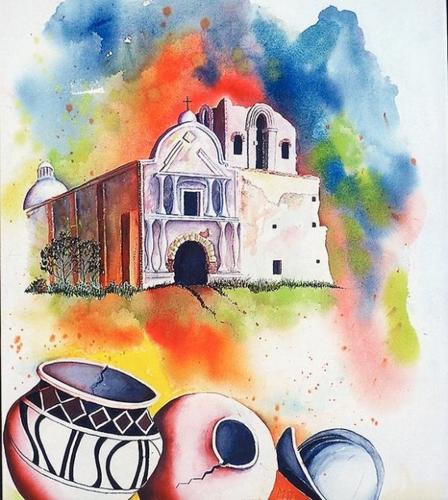
When Frank retired from the UA in 1990, he opened a private therapy practice and returned to his childhood love — painting. He became a juried member of the Southern Arizona Watercolor Guild, but worked in a variety of media. He composed poetry, too, and painted two watercolors the week before he died.
"He was totally accepting of his (physical) problems," Richter said. "He was not an angry person. He was very, very motivated to do as much as he possibly could."
the series
This feature chronicles the lives of recently deceased Tucsonans. Some were well-known across the community. Others had an impact on a smaller sphere of friends, family and acquaintances. Many of these people led interesting — and sometimes extraordinary — lives with little or no fanfare. Now you'll hear their stories.
On StarNet
Did you know Milton Frank? Add your remembrance to this article online at: azstarnet.com/lifestories
Find a photo gallery of this Life Story at: azstarnet.com/slideshows