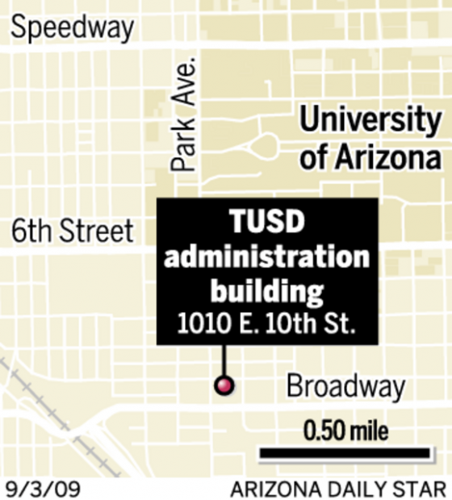
"1010" has for decades been verbal shorthand for all things of authority in the Tucson Unified School District, from central administration to the governing board.
But every few years or so, the question comes up about what to do with the district's public face at 1010 E. 10th St. Sell it? Trade it? Move it to another site?
The questions have surfaced again, as the governing board is being asked to give staff direction as a new facilities plan is drawn up for the district — a process full of political land mines.
Among trial balloons being floated:
• Build two new schools to absorb growth on the southwest side.
• "Right-size" the district, as it continues to lose enrollment.
• Spend bond money in schools as promised, even if they're underenrolled. That's a big question. On the one hand, no one wants to pour money into a sinkhole. On the other, it could be seen as signing a death warrant for a school by not giving it the resources it would need to make a pitch to parents and make a comeback.
People are also reading…
• Consider opening a district-sponsored charter school.
• Trade all vacant property. The district has about 18 surplus properties, ranging from 0.2 of an acre to 61 acres.
Then there's the question of the nearly five acres at 1010, including its parking areas and its 72,000 square feet of building space — much of which was built in 1941, with expansions in 1948 and 1957.
Staffers have begun taking the temperature of the board to see if there's support for unloading 1010, which could mean moving central administration into an underenrolled school or even dispersing administrators into several schools.
This isn't the first time the board has been asked to come up with an alternative for the headquarters, more formally known as the Robert Morrow Education Center.
At one point in the early 1990s, when the board voted to close the then-underenrolled Catalina High School, there was a movement to put administration there. In 2001, a proposal fell apart that would have given 1010 to the University of Arizona for student housing, with district staffers moving into the former Tucson Electric Power building at 220 W. Sixth St.
Superintendent Elizabeth Celania-Fagen said the district has so many needs that it would have to make money or break even on any move from 1010.
Like most things TUSD, there's no shortage of opinions.
"I would have to say that the building itself probably is not as efficient as it should be for the needs of the district," said Luci Messing, head of the local teachers union, the Tucson Education Association.
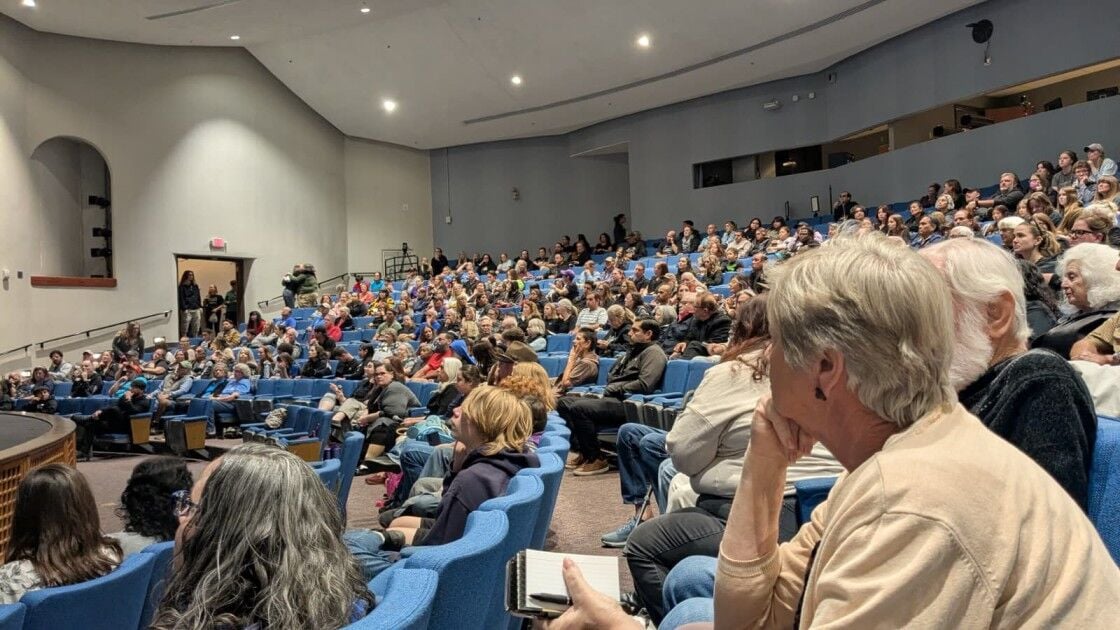
Indeed, governing-board hearings often overflow, leaving people to sit on the lobby floor, watching the action through the glass windows and listening to speeches piped in via speakers.
Aside from the building's age, Messing said, it's not very user-friendly. "It has all these little rooms all over the place. You have to wind here and there. It just doesn't look like a place parents would want to go to."
Still, she said, she would be concerned about spending any additional money on administrative digs when schools are in such need.
On the other hand, John O'Dowd, an attorney and member of the site council at TUSD, is rather attached to 1010.
"I like that old building," he said, noting renowned Tucson architect Josias Joesler, of St. Philip's in the Hills Church and Catalina Foothills Estates fame, had a hand in its design.
"It's quaint and it's a timepiece. It's got its problems — no doubt about it. It's difficult to know where people are or where to go," he acknowledged. But there's a big plus in a time of tight budgets: "We own it."
Community organizer and stay-at-home mother Lori Oien said she thinks putting 1010 on the chopping block is a good idea. "They have a good handful of underenrolled schools that they could move into," she said.
Administrators might see more closely what's happening at school sites, she said, especially at a time when her son's school, Magee Middle School, is going without sports and is minus an assistant principal.
"It would help with their overall appearance in the community — that they're trying to help this budget along and that they're willing to make some cuts and be inconvenienced themselves," she said.
There are no appraisals on the site currently, but the board would have some options.
It could sell the property, but any revenues would have to be used to pay down outstanding bonds, which wouldn't help with immediate budget shortfalls.
Or it presumably could lease the property or trade it for land elsewhere, although some trades have hit snags recently, either falling apart altogether or raising questions about whether TUSD was getting a good enough deal on its property.
It's going to take more discussion before the staff gets a clear answer from board members, who "voted" on proposals at a board meeting at the end of August by putting sticky dots next to the concepts they supported.
They were allowed to add more than one dot if they felt very strongly about an issue. And they could introduce alternatives on sticky notes for colleagues to consider.
A few key staff members got in on the action, too.
There were five dots to leave 1010 alone, with someone writing there's no money and no reason to switch.
There were seven dots to move from 1010 because it wasn't public-friendly.
Hank Amos, head of Tucson Realty & Trust Co., said he's not convinced this is the best time for any decision anyway.
"The market is a little soft right now with the vacancies out there," he said.
There are other drawbacks, too, he noted. The building's design would limit its use fairly dramatically. And while it's centrally located, it's not right on a main thoroughfare, which decreases its visibility.
"Given today's market, it would be difficult to find someone to take that space," he said. "There might be a couple of candidates out there, but I wouldn't say there's going to be huge demand for it."
DID YOU KNOW
The district headquarters is named for Robert D. Morrow, who took the helm of TUSD in 1941, the same year the headquarters was built. Morrow, who was born in Nebraska, was superintendent of the Arizona State Schools for the Deaf and the Blind when he agreed to accept the position with TUSD.
It was the retiring superintendent, C.E. Rose, who recommended calling a bond issue in 1941 for a new administration building, along with several schools.
The bond package of $450,000 was approved in May 1941 with 688 approving it and 266 voting against.
Sources: Tucson Unified School District, Arizona Daily Star