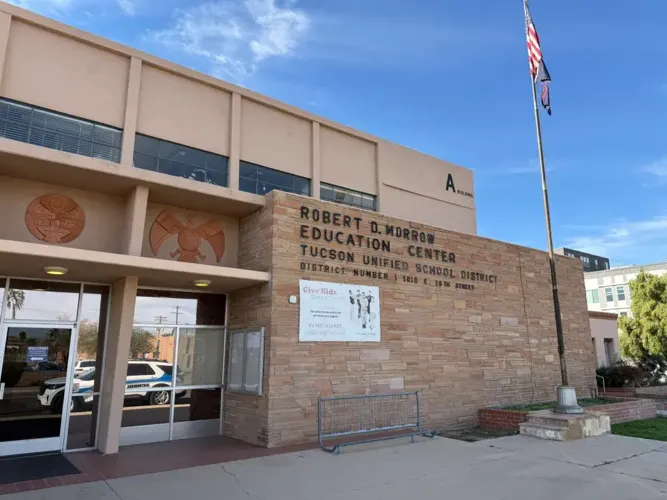
The Tucson Unified School District governing board narrowly approved a community engagement timeline on potential school closures.
The board voted 3-2 Tuesday night to approve a months-long community engagement plan that will precede possible school closures, consolidations and grade-level reconfigurations. Board members Sadie Shaw and Jennifer Eckstrom voted no on the plan, citing concerns that the plan lacks community representation and is moving too fast.

The vote officially starts a community engagement plan that will run through December, when the district's administration is expected to bring the board a phased proposal identifying which schools could be closed or merged, with the earliest changes potentially taking effect in the 2027-28 school year.
People are also reading…
The plan is being led by consultant Bill de la Cruz of De La Cruz Leadership Solutions, working alongside Superintendent Gabriel Trujillo and two advisory bodies: an internal district task force and a superintendent's advisory committee. De la Cruz told the board the district is grappling with declining enrollment, competition from charter and alternative schools and shrinking birth rates that have left some buildings underused.
“As great as a job as we can do with community engagement, when y'all sit up here in December or January to make a decision, it's still going to be challenging,” de la Cruz told the board at the beginning of his presentation.
The timeline currently includes three meetings held in September open to all TUSD families and community members to voice any concerns they have with looming school closures. Rather than giving a straight list of schools that could close, de la Cruz and Trujillo told the board these sessions would walk people through declining enrollment, birth-rate trends, building utilization and student loss to charter schools and Empowerment Scholarship Account voucher-funded schools in plain language. The district will then use roundtable activities and scenarios to gather feedback on what kinds of consolidations, closures and program shifts might be acceptable, and under what conditions.
Trujillo clarified to the board that schools on the chopping block would not be made public, and an official list would not be crafted, until after these community meetings.
“We want childcare, we want food, and there better be no less than 100 people at every session. This has to be massively publicized,” he said. “The goal there really is to have a packed house. We understand that (the governing board is) not going to be in a position to make this very very difficult decision, or even consider it, unless we are above and beyond with engaging this community.”
In October and November, the schools up for closure will be notified. TUSD communications director Karla Escamilla told the Star it’s crucial for school teachers, parents and administrators to be the first to know if and how they would be affected before the greater community is made aware. She also confirmed there is no official or unofficial list of schools up for closure yet.
In December, the district will present the list of schools to the board for a vote.
Much of the board’s discussion focused less on whether to move forward and more on how transparent and inclusive the process has been so far. Eckstrom questioned who sits on the district's advisory committee, saying members were not “made up of our community” and the district was “not getting a cross section of people on this committee.”
Trujillo said the committee includes representatives from county supervisor and city council offices, union leadership, a handful of principals, parents and former TUSD teachers. It’s a network of "people of influence" meant to carry the district's message into their own communities, he said.
He said the district could publish the full committee roster and was open to adding members Eckstrom or other board members identified.
Shaw suggested adding a virtual option to the September meetings, saying families might not be able to make one of the three meetings scheduled within just one week of the month, and de la Cruz agreed to look into it.
She also raised concerns about the district's plan to roll out closures in phases over several years, warning that families zoned for later phases might leave for other schools preemptively rather than wait out a multiyear timeline. Trujillo said phase one would target schools where consolidation logistics were simplest — for example, two nearby schools with enough combined capacity to merge without renovations — with more complex moves following in later phases.
Shaw suggested delaying the vote by a month so the district and de la Cruz could add in board suggestions, but did not garner enough support from other board members.
“I think we've given a lot of feedback in terms of what we want to see in those public forums to make them more robust,” board president Ravi Shah said before the vote.
The advisory committee and task force will be convening this Saturday in a closed-door, eight-hour meeting to review birth-rate, enrollment, school-departure and more regional data for all 88 district schools. Escamilla told the Star the district wants the entire TUSD community involved in the process.


 Resiliency key to Vail educator's journey to become Arizona Teacher of the Year