Two of Pima County's largest school districts have spent years fighting chronic absenteeism above the state average, but neither can say, with specific data, why their students are actually missing school.
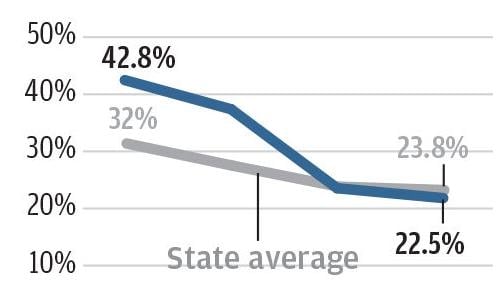
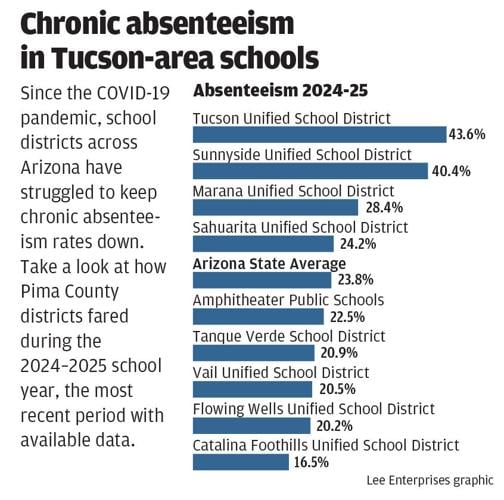
Tucson Unified School District had a chronic absenteeism rate of 44% in the 2024-25 school year, according to Arizona Department of Education data, while Sunnyside Unified School District had a rate of 40% — nearly double the statewide average of 24%.
The superintendents at both districts, which serve some of Pima County's highest-need student populations, pointed to likely causes including economic hardship, immigration enforcement fears, mental health and school-safety scares, but acknowledged in interviews with the Star that none of it has been formally studied.
“We really keep data on attendance rates and our chronic absenteeism rates. We track that from week to week, month to month,” said Sunnyside superintendent José Gastélum. “(But) I don't have that specific data point, what's causing it.”
People are also reading…

Tucson Unified and Sunnyside Unified school districts have battled high absenteeism rates for years without knowing the root causes. New initiatives aim to target this and boost attendance.
The Arizona Department of Education defines chronic absence as a student missing 10% or more of the school year, excused or unexcused, while enrolled at a given school. In a typical 180-day school year, this equates to missing 18 or more days of school.
TUSD saw its absenteeism rate decline by 17% over the two years after the 2021-22 school year, which showed 51% of students being chronically absent, before it jumped 10% again in 2024-25.
“Sixty-two percent of (our) absences were excused by parents,” TUSD Superintendent Gabriel Trujillo said on the most recent year's data. “I think the tendency is to look at a district with high rates of chronic absenteeism and really point the finger at the system … ‘What's happening in X school district? Why aren't they doing a better job of getting kids into school?’ when really it's a combination of both."
Trujillo said the most common reasons the district sees for excused absences include personal trips, family emergencies, illnesses and medical appointments.
“Now, with that being said we still have a 38% unexcused absenteeism rate within this overall 44%,” Trujillo said. “That is absolutely unacceptable and we really do need to dial down and really work towards getting both sets of students back into school on a regular, full-time basis.”
A few new initiatives the district is launching this school year aim to do that. TUSD will pilot a case management system with 37 assigned student liaisons, launch a messaging campaign on "attendance awareness," and make changes to next school year's calendar, which is currently being surveyed.
“We're going to be pivoting away from letters and phone calls and mass emails and texts, and we're going to pivot towards more person-to-person engagement,” Trujillo said. Liaisons will “get out into school vans, get out into the community, knock on doors, interface with parents (and) find out what the specific barriers are to kids not coming to school.”

As summer comes to an end, school districts across Pima County share concerns about high absenteeism rates.
The 37 liaison positions were already funded by the district, and the duties were already part of the job description — but now they'll be enforced and measured consistently, TUSD Director of Student Relations Anna Warmbrand said during a May governing board meeting. The positions, previously funded by Title I family engagement dollars, are now funded by Title I funds and voter-approved override dollars, freeing up roughly $227,000 back to schools while still meeting Title I family-engagement requirements.
The district will require liaisons to document each visit and phone call in a data system that can be checked every 10 days, Warmbrand told the governing board May 26.
“It's really important that they're able to track student by student, name by name, their parent contact, the intervention that they're working on, the date that they did so, what the supports were, what the narrative was, so that as our program coordinator pulls data every other week, we're able to monitor that all of the students that are high risk and are struggling in this space are getting that support,” she said.
Warmbrand said this is a three- to five-year effort, with regular data pulls and twice-yearly evaluations of each liaison's impact on attendance. The district will also track whether those attendance gains translate into better academic performance and increased state funding.
"Any initiative that I've managed or seen successful … it's a three-to-five year process," she said. "(We will) continue to analyze programmatically. Is this working? What do we need to change and shift, and then what can we refine?"
The district also has four draft calendars currently out for community input, ranging from minimal changes such as a slightly longer Thanksgiving break to another featuring a four-day school week.
“They seek to accomplish a variety of goals,” Trujillo told the Star. “Strengthening or providing more teacher professional development time, carving out more days for student academic intervention, finding a way to start the school year a little bit later. But ultimately, it is the governing board that will make that decision.”
The district aims to get 20,000 responses before the survey results go to the board in August. The survey, open only to TUSD families, will remain open until then.
Finally, Trujillo said the district needs to do a better job of informing families how important school attendance is, better communicating "what the academic consequences are when students miss school, whether that's performance on state assessments or it's performance in classroom grades, impact on grade point average, impact on school connectedness (and) impact on student disciplinary outcomes.”
“We know a lot of our parents say, ‘Oh, I'm only going to pull my son out for a couple of days here’ … ‘We're going to take an extra week for Christmas.’ Now, all of a sudden, we're pretty close to the 18,” he said. “We're pretty close to being chronically absent.”
At Sunnyside, Gastélum said the district will continue pushing a five-year attendance plan that aims to drop absenteeism rates to pre-COVID levels in K-8 schools, which was a little less than 40%, by 2030.
"This is a piece where we want to make sure that from early on that our students create good habits of being in school," he said. The district will also continue awarding schools with the best monthly attendance rates with shoutouts, which started last year, along with hosting quarterly parent engagement forums and continuing home visits.
According to information obtained through a public records request, the district will also identify a “key contact within the SUSD IT Department who will serve as a liaison between site leadership and the Abre Attendance Data platform. This is a crucial step forward as obtaining and deciphering data is an obstacle that can prevent leaders from utilizing data effectively.”
Abre is a comprehensive, cloud-based data and management platform specifically designed for K-12 school districts that SUSD began using last year.
“It's not perfect yet, it's not where we want it to be yet, but it does provide us dashboards of quick data sets that are very helpful,” Gastélum said. Before this platform, absenteeism cases were tracked by counselors on a case-by-case basis.
Throughout the next school year, he said the district plans to add more data to make the Abre system a more well-informed framework and “build a system that provides us the data we need.”
Few ways to hold parents accountable
While TUSD and Sunnyside still have the highest absenteeism rates in Pima County, it's been an issue for most districts since the COVID-19 pandemic.
Amphitheater Public Schools Superintendent Todd Jaeger said, in a way, the state did it to itself.
“I mean, for about a year and a half, two years, we essentially told kids and their parents that it was okay to miss a lot of school,” Jaeger said, referring to when school districts told parents not to bring in any students who showed cold-like symptoms.

Since the COVID-19 pandemic, school districts across Pima County have struggled to keep chronic absenteeism rates down.
Amphi had a 43% chronic absenteeism rate in the 2021-22 school year and has consistently brought it down each year, dropping to 22% in 2024-25.
He said once students returned to in-person classes, districts had to re-educate parents on why attending school is important.
“We had given parents all the good reasons … ‘Here's the things, the positive that come from it,’ but what we realized was that that wasn't entirely hitting the mark with everybody,” he said.
Around the 2024-25 school year, the district began bringing back some of the penalties for chronically absent students. Through a slow process, students began receiving grade penalties or weren't allowed to join sports if they didn't have good attendance.
“I got a phone call from a parent who said her son was going to be in club baseball, and he travels, and he will miss she said at least 35 days of school,” Jaeger said. “I said, ‘Ma'am, there are only 178 days of school. So your child is missing one-fifth of the entire school year, not mentioning it's condensed within a season. It would impact (performance) dramatically.’”
Jaeger said that while punishing students is controversial among absenteeism solution strategies, it's hard to hold parents accountable without a county truancy office.
“There used to be an office at the Pima County Attorney's Office that was called Act Now, and that was specifically centered on student truancy,” he said. The Abolish Chronic Truancy, or ACT, Now program aimed to reduce truancy by addressing the root causes of student absences through services while simultaneously holding parents legally accountable for ensuring their children attended school.
“Barbara LaWall was Pima County Attorney at least 10 or 15 years ago when she disbanded that office,” he said. “So the only thing we can do legally is refer the students for truancy, but our local law enforcement systems do not prosecute it in any way.”
Elliot Lyle, a school resource officer from the Pima County Sheriff’s Department, said Pima County doesn’t typically charge kids for truancy because it’s a status offense, meaning it cannot be handled with standard adult criminal prosecution.
He said past attempts to charge students typically didn’t lead to substantial change; kids kept missing school because there were no meaningful consequences or support structures changing their home situation.
Since student-focused legal consequences didn’t work, law enforcement only seeks legal retribution when neglect is clear.
“Oftentimes it's just, for a lack of better term, bad parenting on their end, and then that's when we come in and we educate them and say, ‘Look, this is your warning,’” Lyle said. “Sometimes the parents, they just don't give a darn. And unfortunately, we'll have to, you know, follow through with charging them for those things.”
He said legal action is a very last resort, and he tries to use supportive measures rather than punitive ones, but that varies by district.
The Pima County Attorney’s Office said it has not handled cases involving the ACT Now Truancy Program in over a decade.
“However, we also understand that truancy remains a chronic issue that requires attention,” Pima County Attorney Laura Conover said in an email statement. “If local schools, juvenile courts and law enforcement agencies are interested in developing a new program to better serve our community and help mitigate this issue, we are more than willing to partner with them in that endeavor.”
Pima County Schools Superintendent Dustin Williams said he’s had discussions with the attorney’s office about the issue, but there is a large need for a collaborative approach across districts and organizations.
“What we really need to do is look at this in a holistic approach,” he said. He said going forward, he hopes to work with Read On Arizona to get even more absenteeism data, especially in high schools, look at what school districts are doing right and communicating with other districts about functioning solutions strategies and better connecting families with resources.

Higher absenteeism leads to lower test scores
Marana Unified School District has seen a similar drop in chronic absenteeism to Amphi, starting at 44% in the 2021-22 school year and falling to 28% in 2024-25.
Marana Superintendent Dan Streeter said that while the drop has been significant, it still remains a top priority moving into this school year.
“This is my No. 1 concern going into this next school year,” Streeter said. “We're seeing dramatic impacts on student achievement.”
He said the district looked at third-grade literacy rates and saw a site where only 66% of students were at or above the benchmark. When the district filtered the results to exclude chronically absent students, the number jumped to 96%.
“That means that when kids are in schools, our teachers are doing great work, and our students are achieving,” Streeter said. “But there's a big gap when our students are not in school, and the younger that we're seeing absenteeism rates begin, the bigger the deficits that are building up over time.”
In the 2024-25 school year, 35% of Marana students rated at or above proficient in math and 41% at or above in English, according to state data. TUSD students were only 22% at or above proficient in math and 28% at or above in English.

TUSD is implementing a multi-pronged approached this school year to fight chronic absenteeism. The district currently has the highest rates in Pima County.
“I think this is one of the biggest issues in education,” Streeter said. “I don't think anybody is doing a good enough job of understanding the connection between attendance and student achievement, and I don't think you can have either conversation without discussing the impact on the other.”
Catalina Foothills Unified School District, which had the lowest chronic absenteeism rate in Pima County at 17% in 2024-25, is still targeting increasing attendance rates, Superintendent Denise Bartlett said in an email statement.
“While we may be performing slightly better than some districts, that does not mean that our numbers are ideal, and we need to maintain a forward-looking stance,” she said.