
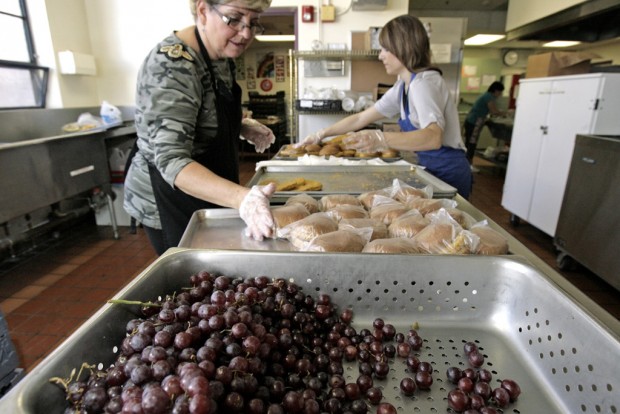
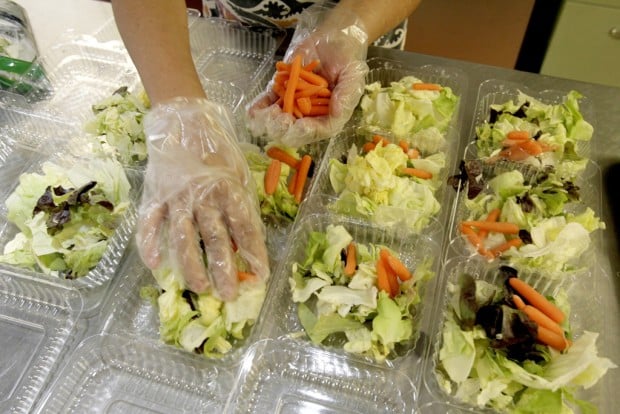
Tucson-area school districts are providing healthier meals to students as part of a nationwide effort to improve children's nutrition.
The initiative, which applies to schools receiving federal funding for meals, is part of the Healthy, Hunger-Free Kids Act, which was championed by first lady Michelle Obama and signed into law by President Obama.
While the act was authorized in 2010, it is being phased in starting this school year. Districts that are certified as complying with the new standards will receive money to help offset higher food costs.
Districts follow state and federal nutritional guidelines for meals, which include such things as calories for meals and what types of food and beverages can and cannot be served.
Districts must take several steps to comply with the new federal rules:
People are also reading…
• Serve more fruits and vegetables.
• Offer more whole grain-rich foods.
• Serve only fat-free or low-fat milk.
• Limit calories based on the age of children.
• Reduce saturated fat, trans fats and sodium.
Doing all this "improves the nutritional quality of the meals being provided to our children," said Mary Szafranski, deputy associate superintendent for the Arizona Department of Education's health and nutrition services department.
complex transition
For Tucson's largest district, which serves about 40,000 breakfasts and lunches a day, the change has been in the works for two years.
The transition has been complex, with officials reviewing everything food related including the size of bread and seeking out new food vendors.
Within the Tucson Unified School District, the Healthy, Hunger-Free Kids Act has meant transitioning from regular to whole-wheat pasta; switching to smaller slices of whole grain breads - even for hamburger buns; using whole wheat tortillas over the traditional white flour; offering smaller burger patties and chicken; and switching from American cheese to cheddar, which has a lower sodium content.
"Most of our entree items are the same, just developed a little differently," said Lindsay Aguilar, TUSD dietitian and production technical coordinator. "In the past, perhaps we would have a turkey sandwich with reduced-fat Cheez-Its and baby carrots. Now it would be a turkey sandwich with apple slices and carrots."
Because more fruits and vegetables are being served, there has been an effort to make the items more appealing, said Shirley Sokol, TUSD's food services director-designee.
"We've reviewed and introduced clear packaging so that when students are on the line, they can see the bright colors and the freshness," Sokol said.
But sometimes, it takes more than packaging.
Last year when TUSD introduced kale crisps, food service managers were given samples to hand out to students before placing them on a food tray.
The kale crisps were quite the experience - positive for some but not all, Aguilar said. "Many students were fascinated by the idea of a vegetable having the texture of a cracker," Aguilar said.
"Sure, there are things that aren't quite as popular," Aguilar said. "But I think that's part of our role is to introduce them to different things in the school environment. It may take a few months for students to get the courage to try something new, but that's the importance of having it appear throughout the menu cycle."
In TUSD, the changes to breakfast and lunch menus have boosted food costs, said Pam Palmo, who formerly headed TUSD's food services department but now is serving as the district's interim chief human resources officer.
It now costs TUSD 40 cents more per breakfast meal - going from 80 cents per meal last year to $1.20 this year - and 20 cents more per lunch, from $1.11 last year to $1.31 this year.
Students who are on the free or reduced-price lunch program will not be affected by the increase, but families of full-pay students are feeling the increase in prices, which have already gone into effect, Palmo said.
For example, the lunch price for elementary students went from $1.85 last year to $2 this year. For students in middle schools, K-8s and high schools, lunch went from $2.35 to $2.50.
The price of milk for all grades has remained the same - 30 cents.
Breakfast prices have also remained steady - $1.25 for elementary students and $1.50 for high schoolers.
Sixty-nine percent of TUSD's 51,000-plus students are enrolled in the free or reduced-price lunch program.
Picking more fruit
The meal changes are not intended to be noticeable to students, like Evan Nelson, a sixth-grader at Utterback Magnet Middle School.
Nelson eats lunch at school everyday and says his favorite meal is nachos. Also a constant: his dislike of school pizza.
The 11-year-old has found himself picking more fruits for his side options, and said he occasionally goes for a salad.
Nelson's father, Jimmy, who also coaches Utterback's basketball team, has made his way into the lunchroom and has been pleased to see more healthy items.
"I'm continuously reading how the U.S. is an obese country," Jimmy Nelson said. "If this effort can help that, I support it."
The elder Nelson appreciates the increased offerings of fruits and vegetables, saying with the ever-increasing prices at grocery stores, it is likely that some families have had to pass on purchasing those items for the home.
Palmo said many Americans may have forgotten about the importance of proper portion sizes and how particular foods contribute to a healthy diet. She hopes the new school meals model will emphasize that.
"The philosophy is one of a simple public health model - eat this kind of food this many times," she said.
The need for a "simple" public health model is of growing importance as childhood obesity rates have tripled across the country over the past three decades, with nearly one in three children being overweight or obese, according to Michelle Obama's "Let's Move" campaign.
In Arizona, 28 percent of high school students were either overweight or obese, said a 2009 report from the Centers for Disease Control and Prevention. Boys were more likely to be overweight or obese than girls.
salad bars offered
The Sunnyside Unified School District, has also put substantial time - about two years - into implementing the new program, said John Oakley, director of food services.
"We offer salad bars at all 22 schools that provide fresh fruits and vegetables daily to meet the vegetable subgroups in the new guidelines," said Oakley.
Steamed broccoli, black-eyed peas and garbanzo beans may be on the salad bar or available on the cafeteria food line, Oakley said.
Implementation of new foods is done in stages. "We are moving now toward everything being whole grains, and that must be completed by 2014," he said.
Like TUSD, Oakley has learned that eating healthier costs more.
"Eating healthy is expensive," said Oakley. However, he said it is too early to tell what the increase in costs will be to provide healthier meals for students.
Sunnyside does not plan to pass the increase in food costs to its paying students, Oakley said.
In mid-August, the Sunnyside district's enrollment was 17,311. About 86 percent of its students qualify for free and reduced-price meals.
The food service budget for Sunnyside is $10 million, with nearly $3 million for food costs. The district gets another $500,000 in federal commodities for meals, Oakley said.
In anticipation of the new standards, the Marana School District began to introduce new food items including whole grains, fruits and vegetables, and lower fat milk last school year, said Tamara Crawley, a district spokeswoman.
As a result, the district does not expect to see a big increase in food costs this school year.
Over the years, the food budget in Marana has risen, going from $2,118,809 in the 2010-2011 school year to $2,199,950 in 2011-2012.
The estimated forecast for food costs this school year is projected to be $2,403,900.
The fact that the budget has increased, however, doesn't necessarily reflect an increase in general cost per meal because the number of meals served per day has risen.
Still, Marana has spent nearly $500,000 to implement the new standards, to include:
• $420,000 for new kitchen equipment, fresh fruit/vegetable bars, and other cafeteria and kitchen renovations. Those costs were funded through a 2010 bond passed by voters.
• $60,000 to hire a dietitian and train employees on the new standards.
The increase in food costs have yet to be determined.
Amphitheater School District reached out to parents over the summer to notify them of the new standards and the fact that they will result in higher food costs, with lunch prices increasing by 10 cents at all levels.
There is a bit of relief, however, as the Arizona Department of Education will provide an additional 6 cents per meal to districts that receive certification for implementing the new healthier food model.
School districts have until June 30, 2013, to be certified. The 6-cent increase will become available in October.
Packing a healthy lunch can be a lesson / A10
what's for lunch?
Area school districts are retooling their menus to meet the requirements of the federal Healthy, Hunger-Free Kids Act.
2010-11 Menu
Cheddar cheese crisp, Southwest beans and rice, fruit, milk 632 calories, 954 mg sodium, 5.7 g fiber
Bean and cheese burrito, baked tortilla chips, fruit, milk 568 calories, 804 mg sodium, 7.0 g fiber
BBQ beef sandwich, scalloped potatoes, fruit, milk 596 calories, 1,816 mg sodium, 4.4 g fiber
Pepperoni pizza, side salad with low-fat ranch, fruit, milk 619 calories, 1,016 mg sodium, 5.83 g fiber
Current Menu
Whole grain cheddar cheese crisp, butternut squash, fruit, milk 525 calories, 797 mg sodium, 6.8 g fiber
Whole grain bean and cheese burrito, spinach salad, fruit, milk 609 calories, 663 mg sodium, 11.1 g fiber
BBQ beef sandwich, sweet potato bites, fruit, milk 601 calories, 1,514 mg sodium, 9.3 g fiber
Pepperoni pizza on whole grain crust, baby carrots with low-fat ranch, fruit, milk 552 calories, 935 mg sodium, 7.6 g fiber
In Monday's Star
Sunnyside students' school garden promotes healthy eating.
Did you know?
Area school districts now post school menus on their websites, but Tucson's two largest school districts - TUSD and Sunnyside - have also included the nutritional values for meals.
• Sunnyside: www.susd12.org/dept/menu-nutritional-information
Reporters Carmen Duarte and Phil Villarreal contributed to this story. Contact reporter Alexis Huicochea at ahuicochea@azstarnet.com or 573-4175.