When Edwin Hawkins mounted the gallows in downtown Tucson on Aug. 14, 1908, a gasp went up from the crowd.
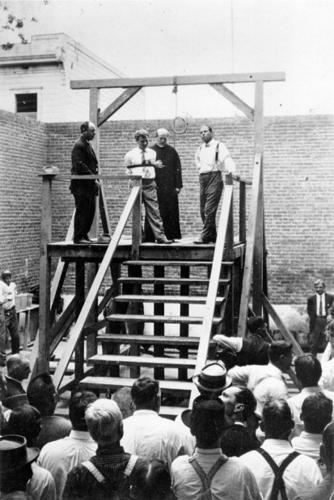
Hundreds of people were packed into the courtyard of the Pima County Sheriff’s Department to see Hawkins be hanged for murder. They were surprised to see Hawkins smoking a last cigar after he climbed up to the gallows without assistance. Then Sheriff Nabor Pacheco asked him, “Have you anything to say?”

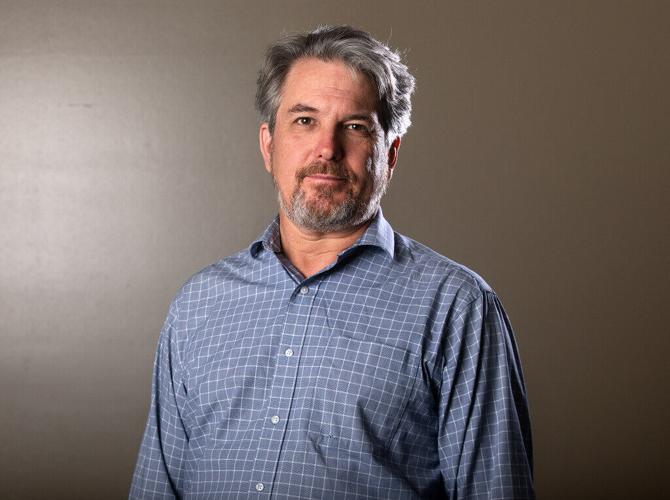
Arizona Daily Star columnist Tim Steller
“It was a full minute before he could speak, as a bunch of the morbidly curious who had perched themselves on trees in the courtyard and on the courthouse would not be silent even when a man in the show of death was about to address them,” the Tucson Citizen reported.
The Arizona Daily Star reported the next day, “Quite a number of small bets were made, based upon Hawkins’ last acts. Those who wagered he would need assistance as he ascended the scaffold or at anytime thereafter lost out.”
People are also reading…
Hawkins’ hanging was the second execution Pacheco carried out in that Tucson courtyard, not far from where Presidio Plaza is now, over a one-month period. It would be the last. After the hanging, in which Hawkins’ neck did not break and it took 14 minutes for him to die, Pacheco demanded the end of public executions carried out by Arizona’s sheriffs.
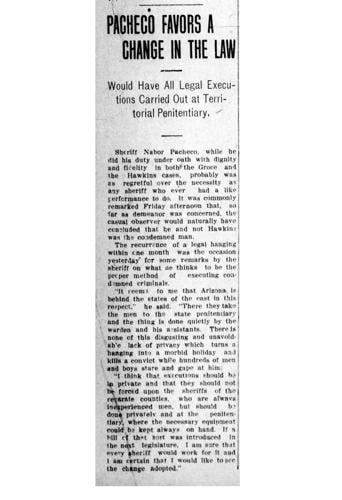
“It seems to me that Arizona is behind the states of the east in this respect,” Pacheco said in a Star article two days after the execution. “There they take the men to the state penitentiary and the thing is done quietly by the warden and his assistants.”
“There is none of this disgusting and unavoidable lack of privacy which turns a hanging into a morbid holiday and kills a convict while hundreds of men and boys stare and gape at him.”
A Pima County sheriff, born in Tucson in 1863, understood the gravity of the state killing a man in 1908 and wanted to eliminate the spectacle, debasing to the crowd and to the condemned, of public executions. The U.S. federal government in 2026 apparently cannot.

1908 photo of the last hanging in Tucson. E.W. Hawkins is the condemned man. Standing next to him is the Rev. Peter Timmerman. At right is Sheriff Nabor Pacheco and at left is Undersheriff Henry Meyers. The scaffold stands in the high-walled yard on the south side of the Pima County Courthouse. Copyright 1996 Arizona Daily Star.
Secretary of Defense Pete Hegseth, born in Minneapolis 117 years after Pacheco, has announced his plan to not only execute mass-killer Nidal Hasan by firing squad, but to livestream it so the public can see it. His justification: "We'll make sure that people are able to watch it, that it's public, because people need to understand that ... there's serious consequences for these types of things.”
To me, the decision is one of several Hegseth has made that reveal a sociopathic inhumanity. The policy of attacking alleged drug-smuggling boats in the Pacific and Caribbean, killing 235 people so far, is perhaps the best example. (It has not, by the way, led to a documented decrease in the U.S. drug supply.)
That bloodthirstiness is contrasted with the humanity Pacheco displayed when forced to carry out hangings, first of Horace Groce on July 17, 1908, then Hawkins.
“Sheriff Nabor Pacheco, while he did his duty under oath with dignity and fidelity in both the Groce and the Hawkins cases, probably was as regretful over the necessity as any sheriff who ever had a like performance to do,” the Star reported Aug. 16, 1908.
“It was commonly remarked Friday afternoon that, so far as demeanor was concerned, the casual observer would naturally have concluded that he and not Hawkins was the condemned man.”

An Arizona Daily Star news story describes the effort by Pima County Sheriff Nabor Pacheco to put an end to public execution after carrying out the hanging of Edwin Hawkins.
In contrast to what Hegseth would likely suggest, this is an example of a real man. It’s a man who understands the weight of his duty and does not relish it. In fact, the territorial legislature satisfied Pacheco’s wishes the next year, 1909, and removed executions from the sheriffs’ duties and from the public square. From then on, executions took place at the penitentiary, or prison.
I learned of Sheriff Pacheco’s successful campaign against public executions from Tom Prezelski, the Tucsonan and former legislator who is an independent historian and wrote the book Californio Lancers: The 1st Battalion of Native Cavalry in the Far West, 1863-1866.
“He was a kind of a dissident Roosevelt Republican, a progressive Republican,” Prezelski said. “I think he was very much about social reform in general.”
The Tucson of 1908-10 was part of a territory striving for statehood and looking to leave its Old West past and reputation behind. Various social reforms were coming into vogue, including women’s suffrage, prohibition of alcohol and even the abolition of the death penalty.
Arizona’s first governor after statehood, George W.P. Hunt, was also a progressive Republican and opposed to the death penalty.
“When he became governor, he said he would refuse all executions until there was abolition,” said Dale Baich, a former federal public defender and death-penalty expert who has witnessed 16 executions. “Hunt issued reprieves and pardons for those sentenced to death.”
In 1916, Arizona voters passed an initiative, supported by Hunt, that abolished the death penalty. But two years later they passed another measure repealing that abolition.
Public execution has not returned, though, since Pacheco aired his objections in 1908. It’s something former prosecutor Rick Unklesbay thinks is obvious. Unklesbay, who won death-penalty sentences in 20 homicides he prosecuted during his career at the Pima County Attorney’s Office, called Hegseth’s idea “horrific,” and “evil and satanic."
“This is what the Taliban did in their sports stadiums,” he said. “It’s equivalent to that.”
A Pima County sheriff born in Tucson in the mid-1800s understood that, too, even if it’s lost on the 21st-century man running our military machine.
Contact columnist Tim Steller at tsteller@tucson.com or 520-807-7789. On Bluesky: @timsteller.bsky.social

Tim Steller
Columnist


 Tim Steller’s column: Pursuit of ‘manliness’ at heart of U of A fraternity problem