

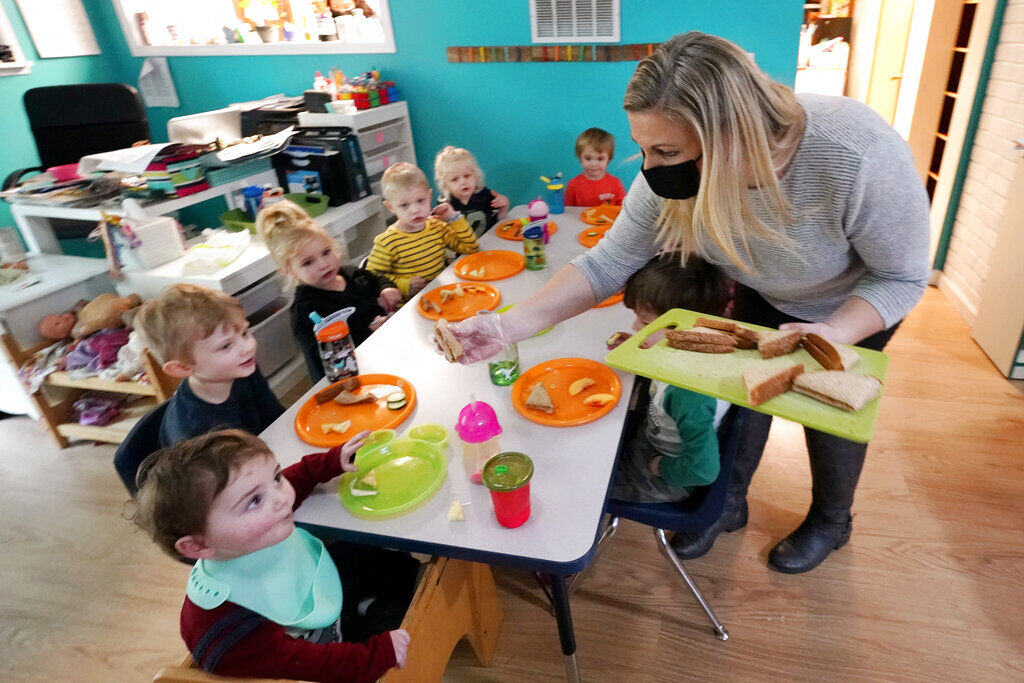
Arizona parents who are eligible for subsidized child care can once again get in line.
The new state budget that just took effect allocates $125.9 million.
However, that won’t be anywhere near enough to cover the entire waiting list.
Initial estimates are it will provide help for 900 children in 530 families. But there already are about 6,100 children from nearly 3,700 families on the list.
The system is set up so those who are at or below the federal poverty level — $26,650 a year for a family of three — are the first who will qualify, said Stacey Reinstein, deputy assistant director of the Department of Economic Security. She said there are about 2,200 children on the list who fit that category.
There is a chance there will be enough money to help even some who are not yet on the list, particularly if they fall into that poverty level category, Reinstein said Monday.
People are also reading…
They would have to wait their turn. But if they are among the most needy, they still would have a better chance of getting help than those who may have been on the list longer but have higher income.
Gov. Katie Hobbs has asked in January for $191 million in state and federal funds for child care, but the budget ended up with the $125.9 million.
Even with limited resources, however, this will be the first major dent in a waiting list that goes back years.
Arizona didn’t have a wait list until the administration of Gov. Jan Brewer (2009 to 2015,) when lawmakers cut state funding. The list shrank in 2018 when the state got a federal grant.
Then, when COVID hit, Arizona got $1.2 billion in federal COVID funds for child care.
The state also finally updated its reimbursement rate for child care centers several years ago, the first time that happened since 2000, said Barbie Prinster, executive director of the Arizona Early Childhood Education Association. That was no problem as long as federal dollars were coming in.
But then the federal funds dried up.
Last year lawmakers provided $12 million in state funds — the first state dollars provided to the issue in a dozen years.
“However, that wasn’t enough money to fund the system,’’ Prinster said, not only because of the number of applicants but also the higher reimbursement rate. “So that’s why the wait list had to start.” It was created on Aug. 1, 2024.
Eligibility starts with income.
Strictly speaking, the program provides subsidized child care for any families making less than 165% of the federal poverty level, about $43,972 for a family of three.
But the chances of anyone above the federal poverty level getting aid depend on how far those dollars stretch.
Reinstein said the system set up by DES will first use the funds it has to reach those at or below the federal poverty level. Only when — and if — there is money left will DES start funding those at 110% of the federal poverty level.
And, as dollars remain available, families in subsequent higher income categories will get help, up to the 165% limit. She said this “phased release’’ means that, in the end, there could be more than 900 children who get care from the funds state lawmakers made available.
There are, however, other variables.
Some children get to skip the line entirely.
They include those in families getting money from DES, such as recipients of Temporary Assistance for Needy Families who are employed, and those in a program who are searching for jobs. They are considered categorically eligible.
The same is true for children who are referred from the Department of Child Safety.
Except for those who automatically qualify, a parent has to work at least 20 hours a week. That means there’s no help for those who want to go out and search for a job, Prinster said.
“The people that want to go to work are screwed,’’ she said.
Reinstein acknowledged that gap.
“If they don’t meet the current DES child care eligibility requirements, we are limited with that,’’ she said. “I think there are multiple ways that people can seek assistance, whether it’s through their child care provider or through their community to help support that.’’
None of what DES provides is absolutely free to recipients.
“The federal government requires families to share in the cost of care through a copayment,’’ Reinstein said, with that linked to family income. Even those at or below the federal poverty line are supposed to pay $1 per day for each child.
Prinster, whose organization represents private licensed child-care centers, said that kind of copay is important for parents “having some skin in the game and having a little bit of responsibility.’’
She said there’s another factor, however, based on the rates providers charge, which can vary depending on the age of the child.
“So let’s say DES is reimbursing me $300 a week for an infant but I (as a child-care center) charge $350,’’ Prinster said. “The business can choose whether or not they want to charge that difference.
“Nine times out of 10 they’re (parents) not going to be able to afford it,’’ she said, considering many parents probably make only the minimum wage which in Arizona is $14.70 an hour.
What’s happening now is the state is sending letters and text messages out to those on the waitlist who are the most needy. That provides a way to connect them with DES caseworkers.
But not everyone who got the messages may be in line for care, as a family’s situation may have changed since they first went on the wait list a year ago, whether due to higher income or a child now being older and not needing daycare.
And that, in turn, goes to the question of whether there will be additional slots available.
Get your morning recap of today's local news and read the full stories here: tucne.ws/morning
Howard Fischer is a veteran journalist who has been reporting since 1970 and covering state politics and the Legislature since 1982. Follow him on X, Bluesky and Threads at @azcapmedia or email azcapmedia@gmail.com.

 For sale: Tucson's Park Place mall


