There's a factor in the high-profile race for the Republican nomination for governor that Arizonans haven't seen in a dozen years — and it's giving one candidate a leg up in the final stretch of the race.
Scott Neely, a Mesa businessman and gubernatorial hopeful, received $1.14 million for his campaign through the state's public funding program. Use of public dollars for statewide campaigns has waned as big-dollar donors have flooded politics and Arizona has become more competitive nationally.

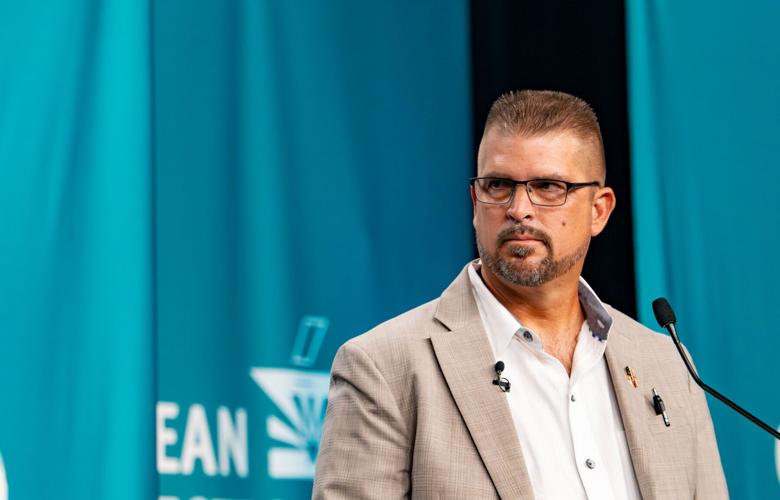
Scott Neely, shown here in the 2026 AZ Clean Elections governor primary debate held in June in Scottsdale, received $1.14 million in public funds for his gubernatorial campaign.
The funding, while a healthy seven figures, is unlikely to change U.S. Rep. Andy Biggs' status as front-runner for the GOP nomination in the July 21 primary.
But it is "an interesting wrinkle," said Paul Bentz, a longtime GOP consultant in the state and former Gov. Jan Brewer's 2010 campaign manager. Brewer ran with public funding that year.
People are also reading…
"We always talk about an October surprise," he said, referencing twists that can come just before November elections. "This is a little bit of a July surprise."
That check deposited into Neely's bank account rivaled or far exceeded the cash his better-known GOP rivals had on hand, giving him the financial backing to amplify his pitch to voters as early voting is underway.
"We're going to take an all-of-the-above approach to taking Biggs out," Neely said. He said he would use the campaign cash simply: "To attack, and to spread my message."
How Neely is spending $1.14 million
So far, it seems the attack is the top priority for the $1.14 million Neely received on June 11.
Neely has launched videos that label his opponent "Creepy Biggs" — using a red, dripping font straight from a horror film — over Biggs' vote against releasing the government's files tied to the disgraced financier Jeffrey Epstein. Biggs ultimately did support releasing the files, however.
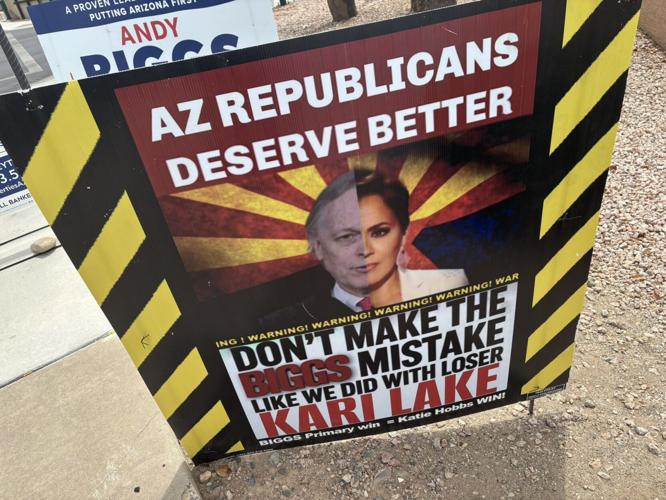
A street-corner Neely campaign sign mashes up half of Biggs' face with half of former candidate Kari Lake's face.
"Don't make the Biggs mistake like we did with loser Kari Lake," the sign reads.
Text messages, billboards, mailers, television, social media and radio ads are all on tap, Neely said. Already live is a website Neely dubbed the "Biggs files," highlighting Biggs' controversial votes during his nearly 25 years in elected office.

A campaign sign for Republican candidate for Arizona governor Scott Neely is displayed on a Phoenix street corner. Neely is the first Republican candidate for governor to qualify for public funding in a dozen years.
"It would be one thing if this was just ... putting out internet ads that were not reaching people, but if he has got money to put underneath it, it will be something that Biggs will need to address," Bentz said.
The funding could make him competitive with U.S. Rep. David Schweikert, who is also running and whose $86,000 cash on hand at the end of March raised questions about his ability to continue in the race. Schweikert is a distant second place to Biggs in public polls.
It's not easy to qualify for public funding from the Arizona Citizens Clean Elections Commission. Neely had to get 4,000 registered voters to give him $5 each, and those voters were verified by the secretary of state and county election officials, said Tom Collins, executive director of the commission.
Neely is not the only gubernatorial candidate to qualify this year. Green Party candidate Risa Lombardo also received the massive check, which could have a decisive effect in that much smaller and lower-profile contest. Lombardo, however, has faced accusations from the Arizona Green Party that her candidacy is a sham.
The Clean Elections Commission was created by a public vote in 1998. It is predominantly funded by those $5 contributions collected by candidates and a 10% surcharge on civil penalties and criminal fines. Candidates who choose to "run clean," as it is called, must forgo contributions from political action committees and parties.
The program is designed to break ties, or the perception of ties, between candidates and donors or special interests, Collins said. It also means "candidates who might not otherwise have a route to have their voice heard have the opportunity to run," he said. Arizona is one of 15 states to offer candidates some form of public funding, according to the National Conference of State Legislatures.
Why public financing for top races faded in Arizona
The last gubernatorial campaigns with Clean Elections funding were in 2014, when Republican Secretary of State Ken Bennett and former Maricopa County Attorney Andrew Thomas both qualified for public dollars. Both lost the primary to Gov. Doug Ducey after a bruising cycle infused with dark money.
It was significantly more common to "run clean" in the early 2000s and 2010s.
There are several reasons why candidates for Arizona's top office don't use public funding much anymore. Collins and Bentz both cited changes in 2011 and 2012 that eliminated a dollar-for-dollar match, which had meant that publicly funded candidates had as much to spend as their privately funded foes. The Legislature removed the match after the U.S. Supreme Court in 2011 ruled it burdened the free speech rights of privately funded candidates.
"They performed an amputation rather than a vascular surgery," Collins said of the law that followed the ruling.
The U.S. Supreme Court also lifted limits on corporate spending in elections, and in 2013, Brewer signed a bill into law that raised the amount individuals could donate to Arizona candidates, more than quadrupling the old maximum. More recently, Arizona's newfound status as a swing state has also meant more money pouring in.
Democratic Gov. Katie Hobbs' campaign shows how those factors can converge, and why some candidates wouldn't want to run with public funding. They simply can raise more elsewhere.
Hobbs' bid for a second term in November is expected to be one of the most competitive gubernatorial races in the nation — and she has raised nearly $13 million since Jan. 1, 2023, to help her win another four years in office.
But in a GOP primary that does not feature a standout fundraiser, public funding could make some noise.
"I think it's enough to put a dent," Neely said. "But do I think I can win an election with it? I don't know. I mean maybe, because Biggs doesn't have any money."
Biggs, at the end of March, had $1.12 million in the bank to spend. He had raised $2.8 million to date, campaign finance records show. Those numbers are somewhat dated, with new fundraising reports due on July 15.
Biggs' operation was unintimidated by Neely's war chest, however.
“Andy Biggs has a 56-point lead less than two weeks from Election Day because he’s been trusted by Arizona conservatives for decades to fight for their values, not because of what a finance report says," Biggs' senior adviser and spokesperson Drew Sexton said in a statement, citing a recent poll from right-of-center NextGen Polling. Neely pulled about 4% of GOP primary voters in that poll.
"Our campaign has raised millions of dollars since Andy entered the race, allowing us to build the staff and digital infrastructure necessary to beat Katie Hobbs in November," Sexton said.
Schweikert's campaign did not respond to a question for this story.
Who is Scott Neely?
Neely owns concrete businesses in Mesa and runs the shop Action Concrete Pumping Supply. He ran for governor in 2022, coming in fourth with 3% of the primary vote. Lake won the nomination that year and went on to lose to Hobbs.
In a June debate, Neely presented his blue-collar background as a relatable alternative to the longtime congressmen. His business has done work on the nation's border wall with Mexico — a red-meat Republican issue Neely highlights in social media posts.
Neely supports Republican President Donald Trump. But he has also been critical of Trump, in particular over the war in Iran and because Trump "puts Israel ahead of America."
Neely has promoted fringe theories, including that conservative activist and Turning Point USA co-founder Charlie Kirk was killed as part of a conspiracy, and not by a man who has been charged in the shooting.
"I think it's more like the JFK situation where multiple people were involved, and once again our government — CIA and FBI and all that's covering it up," he said.