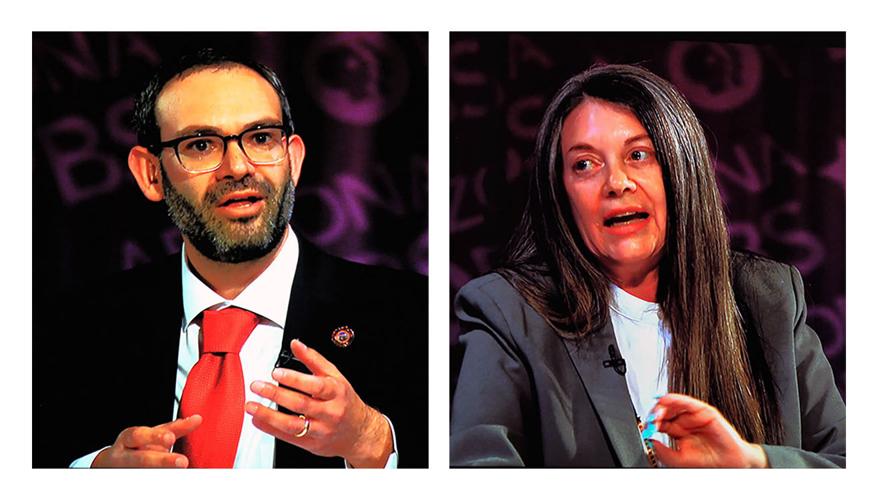
PHOENIX — Republican Alexander Kolodin is blasting Democratic Secretary of State Adrian Fontes for refusing to surrender the state's voter registration records to the Trump administration.
But Kolodin, in a debate Thursday night, sidestepped questions of whether he would turn them over if he becomes the Republican nominee to unseat Fontes in November, ultimately wins the general election, and is asked to do so by the U.S. Department of Justice.

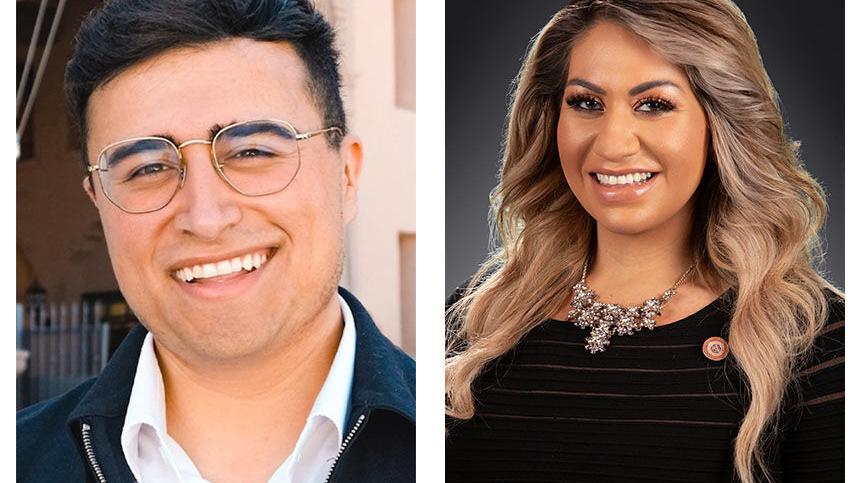
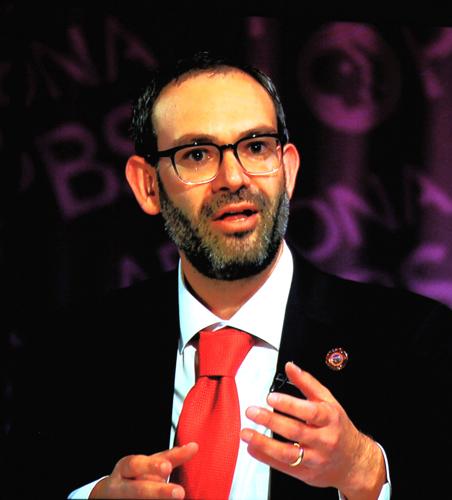
State Rep. Alexander Kolodin.
Gina Swoboda, Kolodin's foe in the GOP primary, had a different take.
"Not without a court order,'' she said during the half-hour joint appearance with Kolodin on KAET-TV, the Phoenix PBS affiliate.
A month ago, U.S. District Court Judge Susan Brnovich threw out a Trump administration bid to obtain not just the parts of voter registration records that are public — including names, addresses, and party affiliation — but other information considered confidential under state law. Those include any part of a voter's Social Security number, driver's license number, mother's maiden name, the state or county of birth, an email address, and signature.
People are also reading…
Brnovich, a Trump appointee, said the list "is not a document subject to request by the attorney general.''

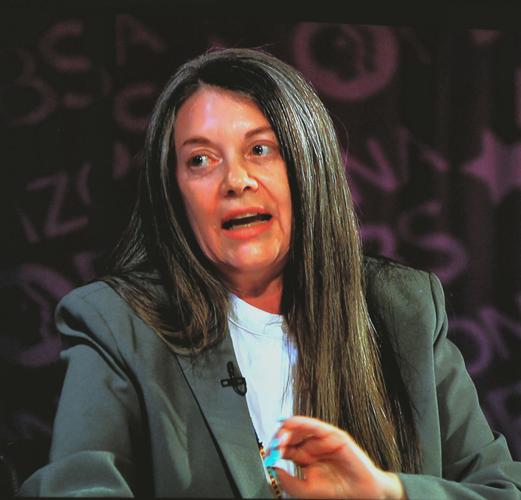
Gina Swoboda, former head of the Arizona Republican Party.
So far, there has been no appeal. Even if there is none, there is a question of what happens if Fontes is defeated, replaced by someone else, and the administration makes another request.
Kolodin, a state lawmaker from Scottsdale, refused to directly answer the question from debate host Ted Simons of whether voters should trust him with their personal data.
"The voters of this state demand that we only have U.S. citizens on our voter rolls,'' Kolodin said.
He accused Swoboda, former head of the Arizona Republican Party, of not supporting the federal SAVE Act, short for the Safeguard American Voter Eligibility Act, which would require documentary proof of citizenship to vote in federal elections. She denied his claim.
There is a 2004 voter-approved law in Arizona that requires such proof of citizenship.
But courts have noted there is a separate federal law that directed the Election Assistance Commission to design a single national voter-registration form to simplify the process. That form requests no proof of citizenship but only that those signing up swear, under penalty of perjury, they are eligible to vote.
The bottom line is that those who do not produce such proof remain eligible to register in Arizona — but only to vote for president and members of Congress. At last count, there were nearly 27,000 federal-only voters in Arizona out of 4.3 million registered voters.
The issue has remained at the fore of Republican concerns, especially since Democrat Joe Biden won Arizona in 2020 by just 10,457 votes.
Swoboda said it's not true that she opposes the SAVE Act. But her support is more nuanced. She said her concern is how any new federal law would be implemented — and what mandate it would create on county election officials.
"I do not want the federal government to usurp the authorities that the Constitution delegates to the states,'' she said. Swoboda said that means allowing state and local election officials to make the ultimate decision over whether someone is illegally registered and should be dropped from the voter registration rolls — and not have that dictated from Washington.
The pair also split over a Kolodin-crafted measure, HCR 2001, he wants to put on the November ballot.
Some of its provisions are already written into law, such as counting only ballots received by the close of polls on Election Day, and requiring anyone casting a ballot in person to provide identification.
But HCR 2001 would also require tabulation of ballots at each polling place instead of sending them to a central location. Kolodin said that will get quicker election results.
Swoboda countered, "It will crush mail voting in Arizona and will force the rural counties to do on-site tabulation on Election Day. They do not have that equipment,'' she said, noting there is nothing in the proposal, which has passed the Arizona House and awaits a Senate vote to be put on the ballot, to provide the money they will need.
Potentially more sweeping is a requirement that people who want to vote early would have to reverify their addresses every two years to continue to get a ballot in the mail. That means someone who does not return the postcard from county election officials will not get an early ballot — and potentially, will not know why.
"It does not crush mail voting,'' Kolodin said of his measure. "We're sensitive to the fact that Arizonans do value the convenience of voting. So we want to give them an improved process that does not inconvenience them or take any options away in any way.''
But there's something else in the proposal. It would amend the Arizona Constitution to say all qualified electors may be offered an opportunity to receive a mail-in ballot — but only to the extent mail-in voting is authorized by law, wording that leaves the legal door open to a future Legislature deciding it no longer wants that.
By contrast, an initiative drive being circulated proposes a different approach, putting in the state constitution that there is a "fundamental right'' to be able to vote early or to vote on Election Day. It also would guarantee that the right to vote early can be exercised "without providing a reason or excuse.''
Backers need to gather 383,923 valid signatures by July 2 to get the issue on the November ballot.
Of note is that Kolodin has opposed the alternative to his proposal.
Kolodin previously went to court to try to scale back early voting. Prior to becoming a state legislator, he filed a lawsuit on behalf of the Arizona Republican Party, arguing that the Arizona Constitution permits only in-person voting. That effort was unsuccessful.
Kolodin also reacted angrily when Simons questioned him about the fact that his status as an attorney was placed on probation for 18 months because of his role as the lawyer in three lawsuits challenging the results of the 2020 election, and in filing suit against a Democratic lawmaker for urging the FBI to investigate the activities of Republican lawmakers in and around the Jan. 6, 2021 riot at the U.S. Capitol.
"Look, Ted, I know that PBS is a liberal media outlet,'' Kolodin retorted.
"You want to spin things and twist things and take everybody back to 2020,'' he continued. "The voters of this state are tired about hearing about 2020.''
Kolodin said at the time he settled the complaints with the State Bar of Arizona to protect other lawyers in his office who worked on the cases. But Kolodin said he was a victim.
"It has been well documented that the people who filed these complaints are political activists,'' he said. "It is unfortunate that the Bar's effort to keep lawyers honest is being gamed by political operatives.''
Kolodin was ordered to complete five legal programs, most of them relating to the ethical requirements for lawyers, including one on the filing of "meritorius claims''and another on "fairness to opposing parties and counsel.''

Voting access was a big topic during a debate Thursday between Alexander Kolodin and Gina Swoboda, the Republican candidates for Arizona Secretary of State.
Howard Fischer is a veteran journalist who has been reporting since 1970 and covering state politics and the Legislature since 1982. Follow him on X, Bluesky and Threads at @azcapmedia or email azcapmedia@gmail.com.