In the weeks leading up to his college announcement last Tuesday, five-star Phoenix center Darius Wabbington was quoted as saying virtually the same things about both Indiana and Arizona.
He said he had an “amazing relationship” with the coaching staffs at both schools. He also said he liked the way both teams planned to use him, saying Arizona coaches told him they wanted to play through him, and that Indiana coaches “see the world” for him.
Then Wabbington chose Indiana.
Why? That much isn't known. It is true that top big men can command seven-figure compensation in college now, and a largely unregulated marketplace can foster dizzying competition for them, but it was also common to see the winds change for whatever reason back when collegians were considered amateurs.
“I think it just happens sometimes,” UA associate head coach Jack Murphy said, not specifically about Wabbington but recruitment changes in general. “The kids that we've recruited that we haven't gotten are really good players, and they're really good kids, but for some reason at the end of the day, they decided they wanted to go somewhere else.
People are also reading…

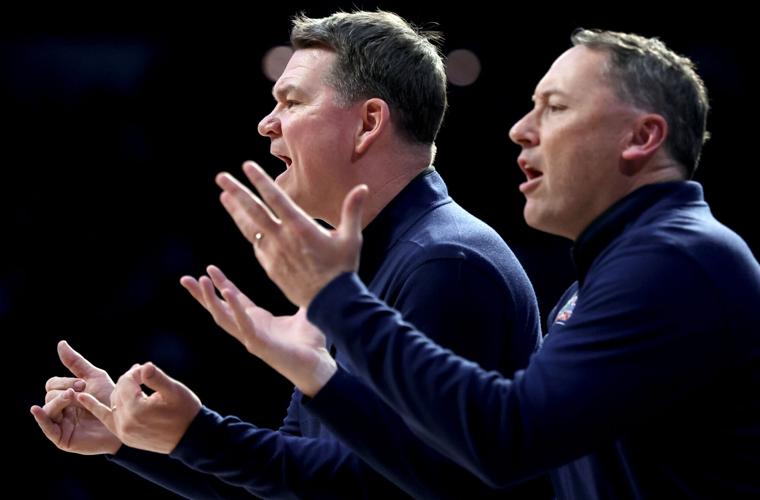
Arizona head coach Tommy Lloyd, left, and associate head coach Jack Murphy try to get the Wildcats over to the bench for a talk during a stoppage in the game against Cincinnati, Jan. 21, 2026, in Tucson.
“That’s OK. Because there’s times where we recruit a kid and we might take somebody else. It's just kind of is life.”
Still, it gets a little puzzling sometimes when the playing field appears to be otherwise equal. While UA’s basketball and training facilities no longer rank among the upper echelon in college basketball, and Indiana is known to have one of the richest roster budgets in the college game, the Wildcats were in early on Wabbington and had an obvious geographic advantage.
“It’s things that are ultimately out of our control” making the difference sometimes, UA assistant coach TJ Benson said. “Without diving into the details, whether it is NIL, or facilities, the bells and whistles — if those things are all equal, then usually the relationship matters the most at the end of the process because they're going to go where they feel they can trust the head coach and the coaching staff the most.”
So that's what UA coaches say they focus on the most: Developing relationships early with domestic players, their families, their coaches and, of course now, their agents.
“It’s still all connections,” UA assistant Evan Manning said. “You’ve still got to get to know the families and the kids, then obviously, there’s the agent piece that adds one more step to it. But our staff does a pretty good job of having great relationships, and learning about kids. At the end of the day, it’s getting to know people.”
The emphasis on building relationships, UA coaches say, not only helps create a tighter bond with top players — but also can tell them when to jump ship, saving everyone time.
UA head coach Tommy Lloyd typically only offers a handful of domestic players in each high school class, then fills holes as needed with international players and transfers in the spring.
Lloyd and his staff are known for international recruiting success, though international recruitments are typically quieter in part because college coaches fear risking the ire of European clubs if their interest becomes public. European clubs typically want to keep their top junior players and promote them to their senior teams instead of losing them to NCAA basketball.
With domestic and international targets alike, if the player’s personality or wishes don’t make him a potential fit, or it becomes clear the relationship is appearing transactional, UA staffers say they move on.
“We don’t recruit those types of kids,” Benson says. “We sniff that out early enough. That’s why you start when they’re young. There’s kids where ultimately, we know are not the right fit.
“We focus on a few, and then ultimately it's about the kid, it's about the family, and the relationship with them, so that you can talk through the whole process. It’s a lot easier to figure those things out when they're younger than it is to get to the very end of the process and have to navigate it.”

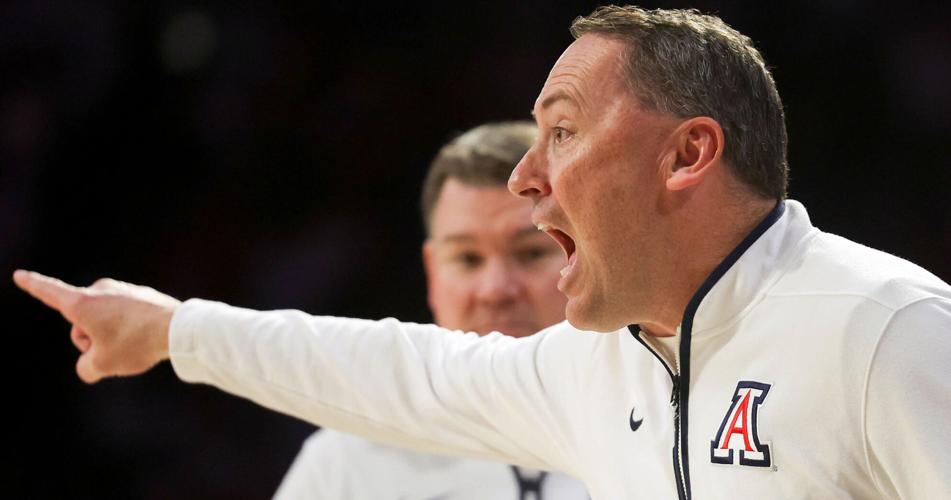
UA assistant coach TJ Benson, shown during the Wildcats' game against Canisius in November 2024, is a Tempe native who often spearheads the recruiting of in-state prospects.
Former UA forward Koa Peat might have been an ideal example, not only because he was an in-state target but also because his rise through high school coincided with the exploding world of NIL compensation.
Identified as a potential high-major player in junior high school, Peat was already being watched heavily by UA coaches when he joined Gilbert Perry High School to play in the June 2021 Section 7 showcase in Glendale — months before he even started taking classes as a high school freshman.
NIL was allowed starting in the summer of 2021, with resulting compensation schemes growing rapidly every year, while Peat racked up four Arizona state titles and four USA Basketball gold medals … while staying in touch with the Wildcats’ coaches the entire time.
“I’ve known Koa since he was in fifth grade. His brothers went to high school with my brother,” said Benson, a Tempe native who typically becomes heavily involved with in-state recruitments. “We went to Perry High School and talked to his high school coach. We talked to his AAU (club program) guys. And yeah, we talked to his agent.
“Then obviously you have the family and they all have their input. That’s just part of the process.”
But sometimes, maybe in the case of Wabbington and others, finances or other issues can block a recruitment that appears otherwise to be going well.
In case that happens, and a secondary domestic prospect isn't available, there's always the international marketplace. Murphy is known for jetting across the Atlantic to identify European prospects who can supplement or replace domestic targets.
“You’re always recruiting,” Murphy said, “and you’re always prepared if things don’t go your way.”

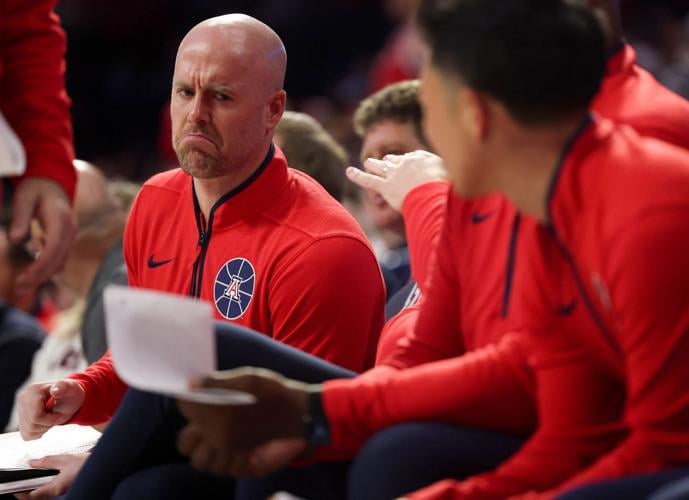
UA associate head coach Jack Murphy, shown giving instruction during a game against Houston in February 2025, also keeps an eye on international and domestic talent in order help the Wildcats' recruiting efforts.
Along the way, if money is the issue, or at least a question, UA assistant coaches have an out: They can just forward the call to Matt King, the program's general manager.
“I don’t even have those conversations. That’s Matt,” Benson says. “To be honest, the NIL stuff, the payroll, I don’t even deal with it. I’m happy I get to coach, develop, scout and recruit — but when they start talking about NIL, I’m like ‘Talk to Matt.’ ”
King was not available to comment for this story, but he has said in the past that UA was competitive in compensation packages.
What those packages are, exactly, is difficult to tell. All UA player financial agreements are not subject to public record due to an Arizona law passed in 2025, and UA has still not responded to the Star’s public records requests made in April 2025 and March 2026 over the athletic department’s 2025-26 revenue-share budgets for players.
Still, Arizona was believed to have a roster budget of over $10 million last season while The Athletic reported in July that the average roster budgets of Big 12 teams for 2026-27 were $13.8 million, according to a survey of head coaches’ estimates.
That’s the kind of money it takes to change with the times, to keep on the same playing field, to allow relationships to still matter.
“It’s no different from on the court,” UA assistant coach Brandon Chappell. “You have to just continue to be who you are. It's the same in recruiting. We value certain things in what we look for in recruits, and I don't see us changing that. The guys we have here are the guys we're supposed to have.
“It’s literally that simple and that comes even with the new landscape of everything.”
Contact sports reporter Bruce Pascoe at bpascoe@tucson.com. On X(Twitter): @brucepascoe
Bruce Pascoe
Reporter