The Diamondbacks’ Gabriel Moreno caught the pitch and held it there, presenting it to the umpire, waiting to hear the call. It was a ball. Moreno did not challenge. If he had, Tampa Bay Rays slugger Junior Caminero would have gone down on strikes.

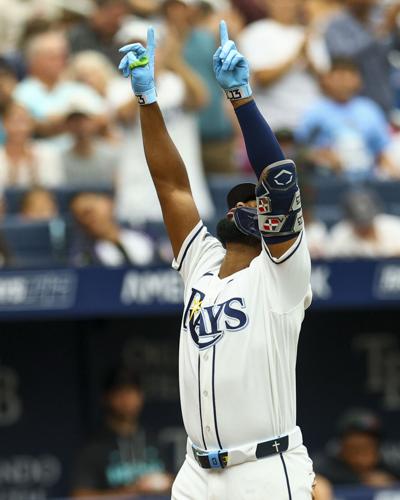
Tampa Bay Rays third baseman Junior Caminero (13) reacts after hitting a home run against the Arizona Diamondbacks in the fifth inning at Tropicana Field on June 28, 2026, in St. Petersburg, Florida.
Instead, Caminero was able to see another pitch from right-hander Zac Gallen, a fastball he blasted for a three-run homer.
It was the kind of sequence seen throughout baseball this season on an almost nightly basis, a whole new level of drama introduced into the majors with the advent of the automatic ball-strike (ABS) challenge system.
For more than a century, the home-plate umpire had final, incontrovertible say on the strike zone. That has changed this season. And it has made for a fascinating spectacle as pitchers, catchers, hitters and umpires have had to adapt.
People are also reading…
Just past the season’s halfway point, the ABS system, which grants two challenges to each team per game, seems to have mostly accomplished its goal of erasing egregious missed calls.
“I think it’s great for the game,” Diamondbacks pitcher Merrill Kelly said. “You want to get as many calls right as you can.”
But it has gotten there in somewhat unexpected ways. Entering the year, people around the game wondered if ABS would serve as a sort of daily source of embarrassment for umpires. Instead, it seems to have highlighted not just how good they are at their jobs, but how difficult it can be to differentiate between borderline pitches.
ABS decisions: truth, humility and regret
Mistakes are reversed every night, but much of the embarrassment seems to have been shared with players themselves.
For a stretch early in the season, the New York Yankees’ Jazz Chisholm Jr. wasted challenges on a weekly basis on pitches that turned out to be clear strikes.
Four times this year, batters have burned both of their team’s challenges in the same plate appearance. Most recently, Randy Arozarena did so two batters into the bottom of the first inning, forcing the Seattle Mariners to watch helplessly as slugger Cal Raleigh was hurt by a bad call in the bottom of the ninth.
The outcomes are representative of what the data has shown: Hitters are not as successful with ABS as catchers. Through games of July 6, hitters owned just a 47.8% success rate, well below catchers’ 58.8% success rate. Pitchers — who represent only 1.8% of all challenges issued — have been right only 36.2% of the time.
All told, challenges are successful only 53.3% of the time.
Moreno’s decision not to challenge the pitch to Caminero — which occurred in a 6-1 loss to the Rays on June 26 — might have been the highest-profile ABS-related moment of the Diamondbacks season to date.
The sequence serves as an example of both how difficult it can be even for catchers to challenge and how a team’s strategy of deploying challenges can factor into decision-making.
Revisiting the decision a week later, Moreno replayed the events in his mind. The Rays had runners on first and second. Gallen was ahead in the count, 1-2, against Caminero. The pitch, a slider down and away, barely nicked the bottom corner of the zone.
“I think,” Moreno said, “that was one of those tough challenges.”

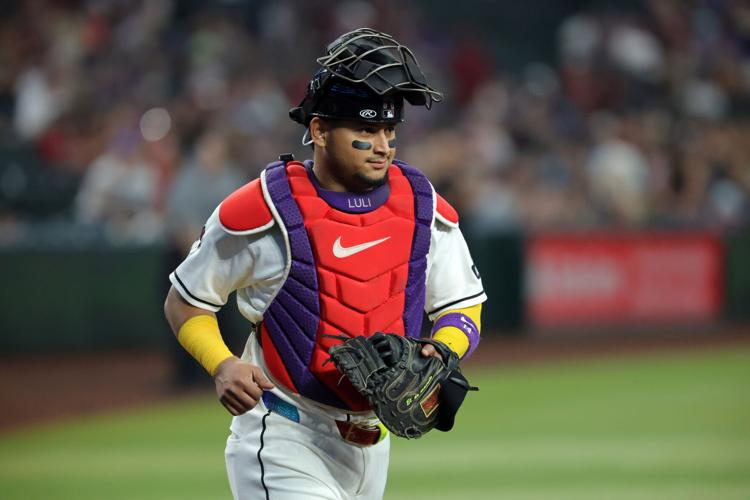
Arizona Diamondbacks catcher Gabriel Moreno against the Milwaukee Brewers at Chase Field on July 5, 2026, in Phoenix.
Moreno said he was worried during the at-bat about the runner on second base relaying pitch location to Caminero. To combat that, he had been setting up behind the plate just moments before Gallen delivered a pitch.
“In that moment, when the pitch was almost coming, I moved away and I felt like I moved too far away,” Moreno said. “I grabbed it good, but I feel like I grabbed it while I was moving away. I think if I had set up earlier there, I would have challenged. But with that late move, it was a tough challenge.”
Another aspect was the timing. The D-backs have taken the approach to ask their players not to challenge in the first five innings unless they are certain the call was wrong. The idea is to preserve challenges for the late innings when the game might be on the line.
“We viewed the introduction of this as a way to not have essentially what happened to (Geraldo) Perdomo in the WBC end a game and not have a mechanism to erase a mistake that’s going to get made,” Diamondbacks assistant general manager Mike Fitzgerald said.
Playing for the Dominican Republic in this year’s World Baseball Classic, the Diamondbacks' Perdomo took a called third strike on a pitch well below the zone. Because the WBC did not employ ABS, the call ended the Dominican Republic’s run in the tournament.
Fitzgerald described the Diamondbacks’ strategy as being more focused on win probability than on influencing run-value scales, which would call for more aggressive use of challenges with the knowledge that flipped counts — i.e., going from 1-2 to 2-1 — tend to produce far different results. Both approaches, he said, are open to debate.
“I don’t think anybody has a perfect answer for that,” he said.
Diamondbacks and the ABS world
The D-backs, through July 6, had the third-highest success rate (60.5%) in the majors, but they were tied for the fewest challenges issued (152). While Fitzgerald sees a comparison with a 3-point shooter in the NBA — “If he’s shooting 85%, he’s not taking enough shots,” he said — he also believes there are intangible drawbacks to issuing too many challenges.
“We don’t have any evidence to show this,” Fitzgerald said, “but I do believe that there is something to it where if you are deploying it like a chip at a blackjack table and you’re wrong, when you want to freely challenge or not challenge moving forward, negative feedback on your challenges, I think, has an impact. …
“In a world where we’re all robots, that’s easier to do. When the leverage swing is large enough, you should just fire, fire, fire. But I think if you take that approach and you run through a stretch of time where you’re incorrect quite often, it’s going to impact your willingness (to challenge again in the future).”
Not everyone is crazy about ABS — ironically, that includes Perdomo.
“I liked the old way,” Perdomo said. “I liked that identity of the game.”

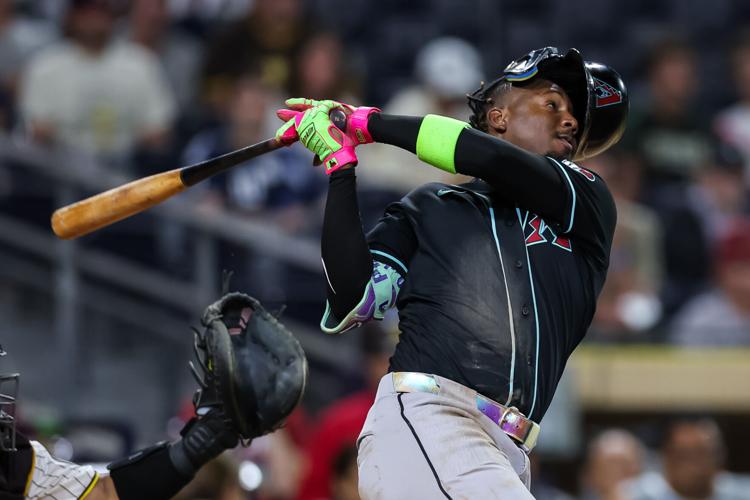
Arizona Diamondbacks shortstop Geraldo Perdomo (2) singles during the ninth inning against the San Diego Padres at Petco Park on July 6, 2026, in San Diego.
Prefacing his comments by saying he was not upset and isn’t complaining, Perdomo is not a fan of how things have changed. He believes that in previous years, pitches that barely grazed the edges of the zone — and were moving off the plate as they approached the catcher — were rarely called strikes. Now, he says, they are.
“You feel like you have to sometimes change your approach at the plate,” he said, “and swing at pitches you wouldn’t swing at before.”
Across the clubhouse, Gallen offered a pitcher’s perspective on the ABS — and, like Perdomo, he sounded as if he liked things the way they used to be. He noted that the league-wide walk rate is up — from 8.4% last year to 9% this year — and that hitters are swinging less often. He thinks most of the 50/50 calls on the edges are going in the hitters’ favor.
“There’s pitches that are challenged that are fully in the box, but it seems to me that the calling of balls and strikes is erring more on the side of, ‘Let’s call it a ball, and if they want to challenge it, they can challenge it,’” Gallen said. “But to say it’s forcing me in the zone — me, individually, I don’t know. But it just seems like hitters have that little bit of an edge now — literally and figuratively speaking — from the strike-zone standpoint.”

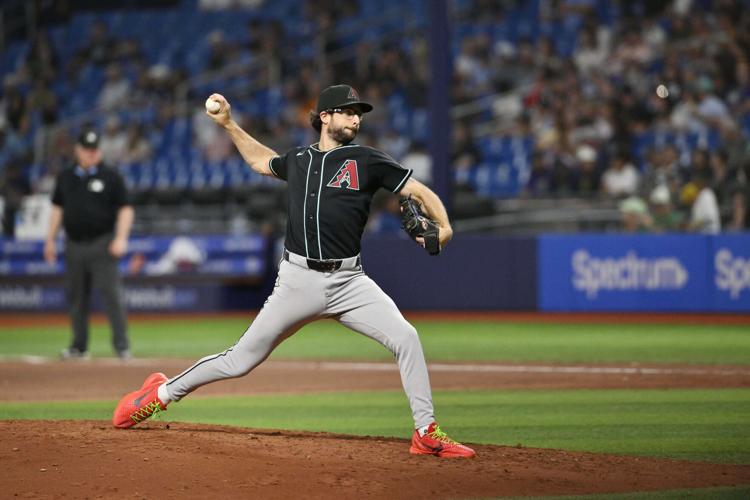
Arizona Diamondbacks' Zac Gallen (23) pitches during the seventh inning against Tampa Bay on June 26, 2026, in St. Petersburg, Florida.
Kelly echoed Gallen’s comments, saying it’s created a “new challenge” for him, though he stopped short of saying it has contributed to his struggles this season.
“I’ve always made my living on the edges, you know, the borderline calls that go my way obviously help me out,” Kelly said. “I think as a rule for the umpires, I feel like they’ve gotten tighter just because I think they’d rather make sure a ball is a ball, and if you want to challenge it, then it’s on us.”
There is little question that the game has changed because of ABS. Diamondbacks manager Torey Lovullo believes it has been for the better. He relayed an anecdote from his playing days of when umpire Dale Ford called strikes against him on pitches well off the plate.
“I said, ‘Dale, that ball was two balls off,'” Lovullo said. “He was like, ‘You’re right, it was.’ I said, ‘Well, that’s a ball. It’s supposed to cross the plate.’ He said, ‘It’s not a strike on Junior.’ I was playing with Ken Griffey Jr. He goes, ‘Let’s get one thing straight, man. Every time I look up there, no matter what team you’re on, you’re hitting .220. It’s a strike every time.’
"That’s the space I lived in. That’s why I think it’s great this is happening.”


 The Mount Rushmore of Arizona Wildcats softball players