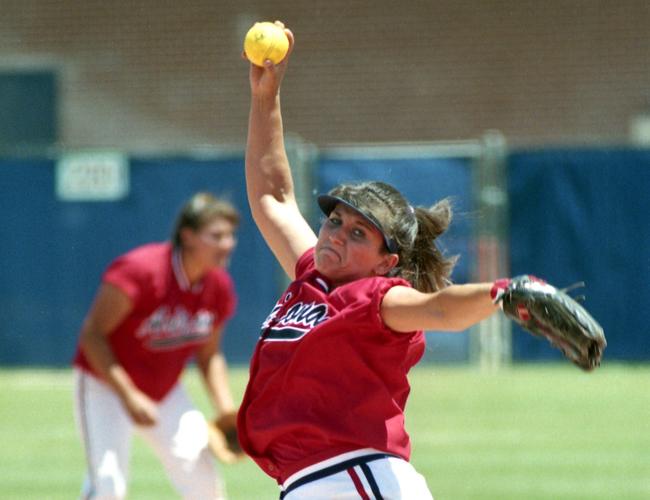
Susie Parra and Jennie Finch haven’t played competitive softball in a long time.
They’re nowhere near done giving back to the game they love.
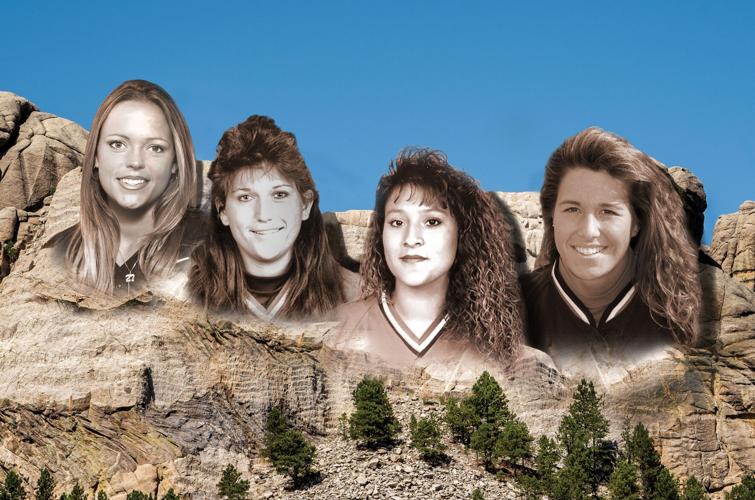
Their greatness on the field is the primary reason Parra and Finch form half of our Mount Rushmore of Arizona softball players. Two position players comprise the other half: the 1990s double-play combo of Jenny Dalton and Laura Espinoza.
People are also reading…

Mount Rushmore of Arizona softball players, from left: Jennie Finch, Susie Parra, Laura Espinoza and Jenny Dalton.
But having a lasting impact on the sport is what makes one truly Mount Rushmore-worthy. Parra and Finch — among many other former Wildcats — continue to spread the gospel of softball.
Parra, a three-time national champion and the 1994 National Player of the Year, is a full-time softball instructor in Southern California. She teaches little girls, high school hopefuls and current college players how to pitch — and how to navigate life as a young softball player.
Finch — a one-time national champ, two-time Player of the Year and arguably the most famous softball player of all time — is part of the advisory board for the AUSL and has served as MLB’s youth softball ambassador since 2017.
“The game's given us so much,” Finch said. “I know how the game can impact a life and so many other lives.”
Finch also hosts the Jennie Finch World Series in her adopted hometown of Sulphur, Louisiana. The annual event draws 120 travel-ball teams from across the country.
“It's been amazing to bring families and teams in and just give them a week of fun,” Finch said. “I remember traveling around and making lifelong memories doing so, playing the game that I love.
“To be able to touch so many different lives and see these girls come in year in and year out — and now many of them are playing college ball — it's just so fun to be a small part of their journey.”
Finch played a small but meaningful role in the journey of a recent UA standout. She returned to Tucson in the spring — hiding in the training room during the game to preserve the surprise — to present an AUSL “Golden Ticket” to Arizona catcher Sydney Stewart.
“To be able to pass the torch to Sydney, (it was) really, really cool to be able to celebrate the next generation and where we're at,” Finch said. “It was a an honor and a super special moment. It's always special to be back, but when you get to do something like that, it's even better.”
Parra preceded Finch in the circle for the Wildcats. Parra was a freshman in 1991 when Arizona won the first of its eight national championships under Mike Candrea.
Parra hasn’t forgotten the coaches and relatives who helped her along the way. When asked what inspires her to help others today, Parra says it’s “the opportunities that were given to me.”
“I wasn't well off growing up,” Parra said. “But I had people, (such as) my pitching coach, that would pick me up and take me to the park.
“It was always somebody helping me and teaching me. ... My uncle was picking me up from practice. My grandma, my grandpa. I never knew who was going to get me, but somebody was going to get me.

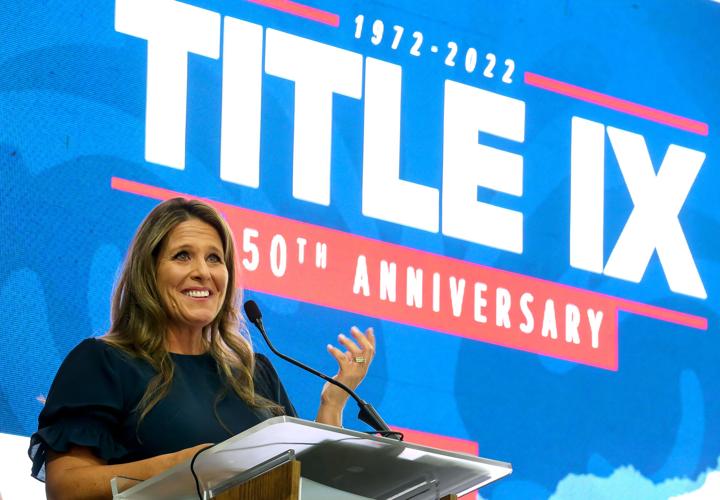
Former Arizona softball star Jenny Dalton-Hill gets a little emotional while talking about former coach Mike Candrea’s impact on her career during her speech for the university’s 50th anniversary celebration of Title IX at the Cole and Jeannie Davis Sports Center on June 23, 2022.
“So there was this family that was helping me get to places. It takes a village.”
The UA softball family runs deep. Dozens of players are deserving of Mount Rushmore recognition.
“We need more mountains,” Parra joked.
It was a near-impossible task to narrow it down to four. So many standouts just missed the cut, from all-time UA batting champ Alison McCutcheon to center fielder extraordinaire Caitlin Lowe (who’s giving back as Arizona’s current head coach) to dominant hurlers Nancy Evans, Alicia Hollowell and Taryne Mowatt.
Here are the numbers, achievements and legacies that made our four selections stand out in a crowded field of Mount Rushmore candidates:
Jenny Dalton
Years at Arizona: 1993-96
What she did: Dalton, a second baseman, earned three first-team All-American nods from 1994-96 and played on three national-championship squads during her career.
Dalton was the Pac-10 Player of the Year and the National Player of the Year in 1996, when she batted .469 with 25 home runs and 109 RBIs — second most in a single season in UA history.
Dalton ranks seventh in UA annals in career batting average (.412), sixth in home runs (76) and first in RBIs (328) and runs scored (293). No one has driven in more runs in NCAA Division I history.
She could pick it in the field, too.
“She was actually my idol at practice,” Parra said. “Her work ethic, watching her take groundballs at second base.
“She had athletic-induced asthma. ... She's breathing (heavily) and she's running and covering first. She's running and covering second. She's diving for the ball. She's not letting anything get past her.
“I knew from practice that when the ball’s hit to the right side, if I had two outs, I literally started walking off the field. I didn't even look. It was like, ‘She's got this.’”
Dalton became Jenny Dalton-Hill after marrying Marc Hill, a former strength coach at Arizona who has worked in the Kentucky athletic department for nearly 30 years. Dalton-Hill is a softball analyst for ESPN.
Laura Espinoza
Years at Arizona: 1992-95
What she did: The “optic yellow” softball was introduced in 1993, and no one took greater advantage of its liveliness than Arizona’s slugging shortstop.
Espinoza blasted 85 home runs as a Wildcat, the most in school history when her UA career ended. (She’s currently tied for fourth with Leah Braatz behind Katiyana Mauga, Jessie Harper and Stacie Chambers.)
Espinoza twice hit 30-plus homers in a season — 30 in 1994 and 37 in '95. The latter stood as an NCAA Division I record until this past season, when UCLA’s Megan Grant hit 42 bombs.
“Any record that lasts that long is just absolutely incredible,” Finch said.
“That’s insane,” Parra added.
Both pitchers had issues with the record being toppled, citing further attempts to artificially boost offense, including bouncier bats and an ever-shrinking strike zone.
“There needs to be an asterisk by it because it was a different time, a different game,” Finch said. “You can mishit a ball (today) and it's going out. Back in the day, you had to smash the ball to get it out.”

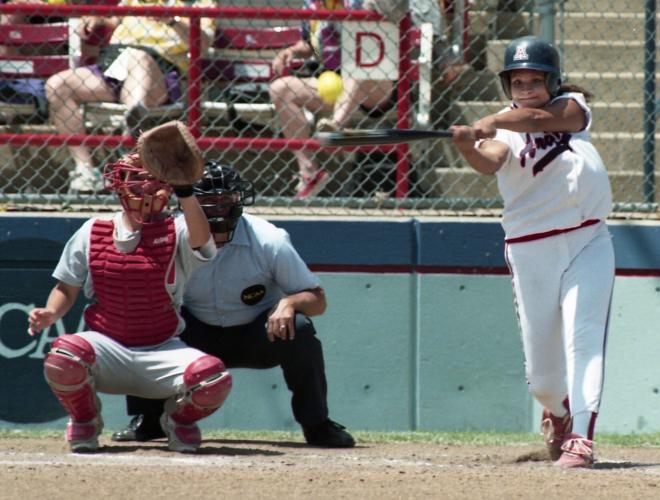
Arizona's Laura Espinoza hits against UNLV in the 1995 Women's College World Series in Oklahoma City.
Added Parra: “I honestly don't think it would have been broken. (But) this year ... they squeezed the pitchers to death. They wanted home runs. They wanted ratings.”
Espinoza still holds the NCAA single-season RBI record of 128, also set in 1995. Her 314 career RBIs rank third on Arizona’s all-time leaderboard.
Espinoza spent much of her post-playing career as a coach, including at Amphitheater High School. She married former Arizona offensive lineman David Watson. Their son, David Watson Jr., also played offensive line for the Wildcats. Espinoza-Watson’s daughter, Kristiana, played college softball at Arizona State, Duke and New Mexico State. David Jr. and Kristiana attended Amphi.
Jennie Finch
Years at Arizona: 1999-2002
What she did: What didn’t she do?
Finch is Arizona’s only two-time National Player of the Year.
When the Wildcats won it all in 2001, Finch’s junior year, she had a record of 32-0.
She had an NCAA-record 60-game winning streak — yes, 60 — from April 29, 2000, to April 6, 2002.
Her career winning percentage of .881 ranks third among Wildcats behind Evans (.939) and Parra (.918) and fifth in NCAA Division I.
Finch’s 1.09 career ERA ranks 10th in UA history, but she and Hollowell (0.87, sixth) are the only two in the top 10 who pitched entirely in the yellow-ball era.
Finch and Parra are tied for second in Arizona annals with eight no-hitters, trailing only Hollowell (16).
With the popularity of the sport rising — and Finch playing twice for Team USA in the Olympics — she essentially became the face of softball.

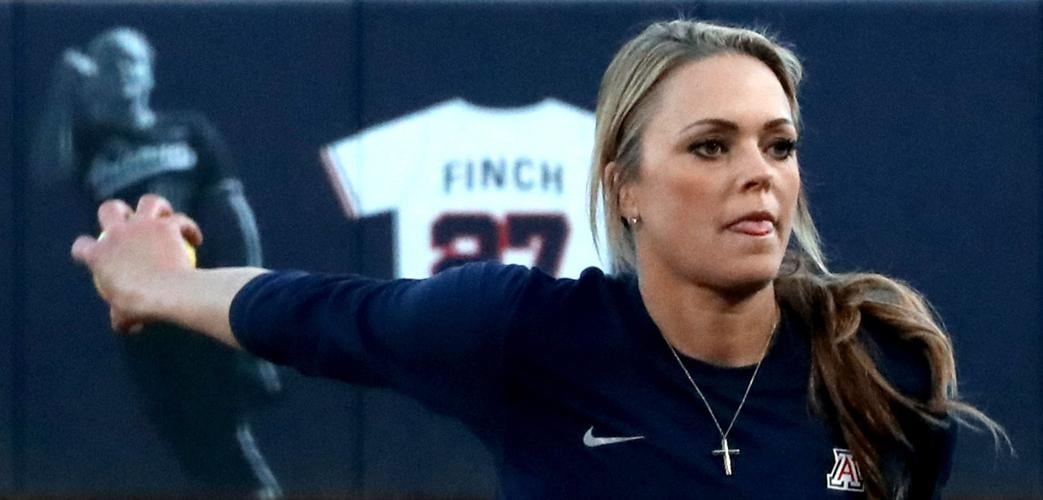
Former Wildcat ace Jennie Finch throws batting practice for Team USA as they warm up to face Arizona in an exhibition game at Hillenbrand Stadium, Feb. 18, 2020.
“The things that she's done in the sport (are) amazing,” Parra said. “And she continues to do it and bring happiness to people.”
Thinking back to her time in Tucson almost brought Finch to tears.
“I couldn't have dreamed of a better four years,” she said. “I couldn't have dreamt to play for a better coach, a better program — and, I think, too, just the Tucson community. They gave us all the dream and vision of what softball could be. Every weekend, every night, we came out to a full stadium. I can't tell you how much that meant. ... I'm so grateful.”
Finch married former Diamondbacks pitcher Casey Daigle, and the couple have three children.
Susie Parra
Years at Arizona: 1991-94
What she did: Parra was a trailblazing ace and a bridge between eras.
Her time at Arizona coincided with the switch in softballs and the opening of Hillenbrand Stadium in 1993.
No matter the ball or the venue, Parra dominated.
She posted a career ERA of 0.63, including a school-record 0.30 mark in 1992.
Parra went 28-3 with three saves and an ERA of 0.63 in 1993, when Arizona won its second national championship. She went 33-1 in 1994, including three appearances in the Women’s College World Series without allowing an earned run.
“I love just the presence that she had,” Finch said. “I think the presence came from her dominance.”
Parra wasn’t the ace from the outset. In 1991, her freshman year, Parra served as Debby Day’s apprentice.

Susie Parra was named the Honda Softball Player of the Year as the Wildcats won the national title and went 64-3 in 1994.
Parra pitched well (14-3, 0.43) but spent most of that season learning from Day and Candrea — lessons that Parra is proud to pass along to future generations of ballplayers.
“I learned what to do, what not to do, real quick,” Parra said. “It was very structured. It was very strict.
“I loved it. I was learning, I was just watching and learning from the upperclassmen — what we can do, what to expect.
“I was 100% buying into the program and everything that was happening. And ... if I got pulled (I would) work harder, do something different, fix the problem.”
Years later, the student became the teacher. Decades later, the lessons still ring true.
Contact sports reporter/columnist Michael Lev at mlev@tucson.com. On X (Twitter): @michaeljlev. On Bluesky: @michaeljlev.bsky.social
Michael Lev
Sports Reporter/Columnist


 Greg Hansen's picks for Mount Rushmore of Arizona softball | Greg Hansen's notebook