PHOENIX — Unable to work out a deal with educators and Democrats for some reforms to the school vouchers program, Republican legislators decided to put a measure of their own on the November ballot, one with a poison pill that would kill anything else about vouchers that voters approve.
House Republican leaders had offered to impose some new limits on how taxpayer dollars for the Empowerment Scholarship Accounts could be used. That came after news reports of purchases of everything from trips to amusement parks to jewelry and even lingerie.
In exchange, the legislative leaders asked the Arizona Education Association to drop its ballot initiative that would impose stricter controls and disqualify any family earning more than $150,000 from receiving vouchers.
But that faltered when Save Our Schools, another partner in the initiative drive, called it a bad deal.
People are also reading…
Senate Democrats combined with two Republicans to kill the deal Friday.
Republicans responded by quickly crafting a new ballot measure designed to guarantee that children of military families can continue to bank any of the voucher dollars they do not use in any year. Such banking is already allowed by law; House Concurrent Resolution 2048 would put it into the Constitution.
By contrast, the education initiative is designed to eliminate that banking provision for all children who get vouchers. Put simply, any unused dollars would have to be returned to the state.
But HCR 2048 also has a poison pill. It says that even if voters also approve the Protect Arizona Education initiative — which includes the ban on banking — the entire initiative would be voided and all of the reforms with it.
More to the point, HCR 2048 is written as an amendment to the Arizona Constitution. So even if the voucher reform initiative is approved, along with the House proposal, it would falter — even if it gets more votes than the legislative measure — simply because constitutional measures always trump state laws, even those approved at the ballot box.
Sen. Wendy Rogers, R-Flagstaff, said the measure is about protecting military families. But Sen. Lauren Kuby, D-Tempe, said that was being disingenuous and that the military families are "being used as pawns'' in the efforts by Republicans to protect universal vouchers.
"It's a trick,'' said Sen. Catherine Miranda. The Laveen Democrat said the Republicans are putting up the idea of protecting military families — something likely to get voter sympathy — but with the real goal of finding a way to surreptitiously kill an otherwise popular initiative.
Senate Majority Leader John Kavanagh effectively conceded that the decision to put HCR 2048 on the ballot was a direct result of Democrats rejecting the GOP offer of a compromise.
"That's the reason why we're running this,'' said the Fountain Hills Republican.
Details of the rejected deal
The deal offered by the majority Republicans would have imposed some new limits on how voucher dollars could be spent. Most significantly, it would have included a specific list of services, travel and products that could not be purchased by parents with the approximately $7,500 per student they receive to be able to send their children to private or parochial schools or to teach them at home.
That list closely mirrored what's in the Protect Arizona Education initiative being circulated by public education supporters. Having it enacted by legislators would eliminate the need to take the issue directly to voters.
In exchange for avoiding a ballot fight, though, the Republicans told the Arizona Education Association it would have to give up another key provision in its initiative: denying vouchers to families with more than $150,000 in income.
As an additional carrot, GOP leaders also said they would drop their own previously proposed ballot measure that would impose new restrictions on the AEA's ability to organize.
Republican House Speaker Steve Montenegro said Friday that AEA officials had agreed to the deal, though there was no formal confirmation from the union.
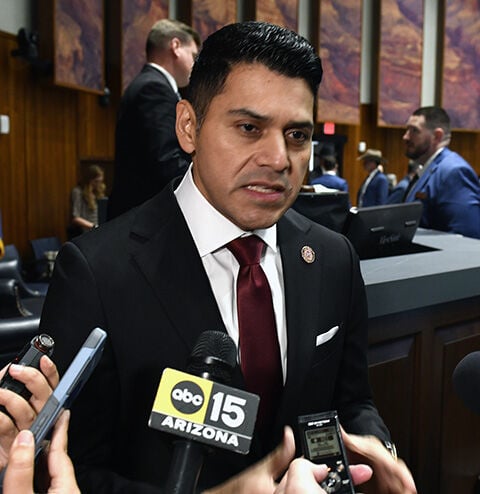
Montenegro
'A joke'
But it all fell apart when the compromise language was defeated by the Senate, with all Democrats voting against it. Kuby called it "a joke.''
Beth Lewis agreed. She is executive director of Save Our Schools, a statewide organization at the forefront of promoting public education and pushing for more public funding.
What makes her views relevant is that Save Our Schools is part of the partnership that was involved in crafting the educators' initiative to rein in the universal voucher program. But Save Our Schools was not part of the legislative negotiations.
Lewis called what Republicans offered a "bad deal.''
She said initiative supporters actually have the upper hand. The key, she said, is the provision to put income caps on voucher families, something GOP lawmakers have repeatedly said is unacceptable.
"They're terrified of having ESA vouchers on the ballot,'' Lewis said of the Republican legislators. She opined that they were so fearful the initiative would be approved that they would have been willing to offer far more than they did, including additional money for K-12 education, just to make the initiative go away.
Montenegro, however, would not say that the fear of a voter-approved plan — one that lawmakers could never alter — provided a driving force for seeking a deal.
"As Republicans, we always want to look at every angle at protecting taxpayer dollars,'' he said.
"So if there is a narrative out there that provides uncertainty to the taxpayer, we're willing to address it,'' Montenegro said. "We're not afraid to address being accountable and making sure we are showing parents we will fight for them, and we will also fight for taxpayer dollars to be protected.''
But there also is something else that could drive voter support to curb Arizona's universal voucher program, which has ballooned from 12,000 students in 2022 to more than a million today, with a price tag exceeding $1 billion a year.
State law already restricts spending of voucher dollars to what are supposed to be bona fide educational purposes, such as curriculum, textbooks and educational field trips.
But extensive reporting by KPNX has found the Arizona Department of Education has been reimbursing some parents for highly questionable expenditures.
Montenegro dismissed those news reports, claiming they come from "activist journalists'' and are misleading. But the Goodyear Republican did not deny that those stories have affected public perception of the vouchers.
Measure to restrict union organizing also headed to ballot
Republicans also responded in other ways to the failure to reach a deal.
Most notably, they resurrected House Concurrent Resolution 2040 — a measure that had been sidelined — and voted to put it on the November ballot. That's the one that would impose restrictions on the ability of the Arizona Education Association to conduct union activities on school time — the one the House GOP leaders had said they would not send to voters if the educators would drop their initiative.
The votes by Republicans to put the two measures on the ballot guarantee they will be there. They are not subject to gubernatorial signature or veto.
That could dilute efforts by supporters of the Protect Arizona Education effort to gather support for their initiative. They will now need to spend money on not just a campaign to convince voters to support their measure — assuming it gets the signatures — but wage separate campaigns to urge voters to defeat the other two proposals, particularly the one with the poison pill that would overrule the initiative.
Backers have said they are well on their way to getting more than the 255,949 valid signatures needed by July 2 to qualify for the ballot.
There is a further complicating factor.
Another group called Fortify AZ is gathering signatures to put its own voucher reform measure on the ballot, one that is similar to the AEA/Save Our Schools plan but without an income cap. Having two similar measures on the same ballot could prove confusing.
Vouchers were first approved by lawmakers in 2012. Proponents said they provided an important alternative for the parents of children with special needs who could not get required services in public schools.
Since then, there were incremental additions, with vouchers made available to groups as diverse as foster children and the children of military to those attending schools rated D or F.
But the real explosion came in 2022 when Republican Gov. Doug Ducey signed legislation saying any student could get a voucher. That grew the program from about 12,000 students to more than 100,000, with the $1 billion price tag.
At least part of the reason for the sharp growth is that the change made vouchers available to students who already were in private and parochial schools with their parents picking up the tab, or were home-schooled and now could get vouchers to pay for educational supplies.
That change also led to something else, with some parents of home-schooled children taking the voucher money and banking it for college while spending their own money on supplies.
Under the Protect Arizona Education proposal, that kind of banking would become illegal for all voucher recipients — not just those from military families, who are the ones that HCR 2048 is being advertised as protecting.
Howard Fischer is a veteran journalist who has been reporting since 1970 and covering state politics and the Legislature since 1982. Follow him on X, formerly known as Twitter, Bluesky, and Threads at @azcapmedia or email azcapmedia@gmail.com.