PHOENIX — Backers of a comprehensive plan to reform school vouchers are asking a judge to block a last-minute move by Republican lawmakers to offer another plan to voters in November that would essentially nullify their own initiative.
Attorneys for Protect Education Act are attacking HCR 2048, a measure referred to the ballot on the last night of the legislative session. It is promoted as protecting the state from "confiscating'' funds from any scholarship account of children of military families.
The lawsuit filed Wednesday does not raise legal objections to that by itself.
People are also reading…
But Danny Adelman of the Center for Law in the Public Interest is telling a judge that it was illegal for the Republican-controlled Legislature to insert a provision that says if voters approve this constitutional measure, it would entirely void any other measure — at any point in the future — that would enact any reforms of vouchers for all of the 1 million students now in the program.
Adelman said the Arizona Constitution spells out that measures presented to voters must ask them to approve or reject a single subject.
What is impermissible, he said, is linking two issues together in a way to get voters to adopt something they may not want — in this case, permanent constitutional protection of what are known as Empowerment Scholarship Accounts from future reforms — with something likely to be more popular, like protecting scholarships of the children of military families.
Adelman said there is no doubt the plan is to use the friendlier-sounding protection of military families as a carrot: The measure has a clause that says if it passes, a judge must void all future voter-enacted voucher restrictions.
That would override all the provisions in the Protect Education Act initiative, he told the judge, ranging from limits on how voucher dollars can be spent, to a cap on parental income to get the $7,500-a-year vouchers of state tax dollars for private, parochial and home schooling.
"Using military families as a ruse, HCR 2048's purpose and effect are to both void the pending citizens' initiative to reform Arizona's ESA program and to impede future reform of the ESA program by the people or by the Legislature,'' Adelman told Maricopa County Superior Court Judge Joseph Kreamer.
Initiative measure includes income limits
Backers of the Protect Education Act have until July 2 to gather more than 255,949 valid signatures to put their plan — complete with income restrictions on vouchers — on the November ballot.
All this is fallout from what has been an unabashed intent by legislative Republicans to protect vouchers.
The ESA program got a modest start in 2012 with a program to allow children with special needs to get a voucher of state dollars to get services at private or parochial schools, or through tutoring and homeschooling. After that, voucher supporters added foster children, children from military families, children living on reservations, and students attending public schools rated D or F to the eligibility list.
But the real explosion came in 2022 when GOP lawmakers approved universal vouchers. Enrollment ballooned from about 12,000 to more than 100,000 with a price tag exceeding $1 billion a year. Some of that cost was due to the fact that parents who had been paying for their children to attend private schools were now getting state aid.
At the same time, there were media reports of parents using voucher money for expenses that were questionable at best as being for educational purposes, ranging from trips to out-of-state amusement parks to lingerie and jewelry.
And the Auditor General's Office found the system used by the Arizona Department of Education to approve expenses allowed for many to go through without consistent review.
The proposed ballot initiative, put together by the Arizona Education Association and Save Our Schools Arizona, includes a specific list of what could not be purchased with voucher dollars, adds some requirements for fingerprinting and background checks of employees at private schools, and would require the State Board of Education to adopt safety rules at participating private schools.
It also includes limits on how much unspent voucher money students could set aside and accumulate for college.
But what has caused the most heartburn for voucher supporters is a provision denying vouchers to children in families earning more than $150,000 a year.
Legislative maneuvering
Republican House Speaker Steve Montenegro attempted to negotiate a deal to have lawmakers directly enact some reforms — but not the income cap — if the education groups would drop their initiative. But that deal fell apart at the end of the legislative session amid questions from Democrats.
"It's a trick,'' said Sen. Catherine Miranda, D-Laveen.
So Republican lawmakers crafted and rushed through HCR 2048 as a constitutional amendment in the name of protecting scholarships for students in military families, saying it would prevent the confiscation, at least for military families, of unused voucher funds that some families set aside for college.
But they did not hide that their motive was to find a way of killing the voucher initiative, even if voters approve it.
"That's the reason we're running this,'' said Senate Majority Leader John Kavanagh, R-Fountain Hills.

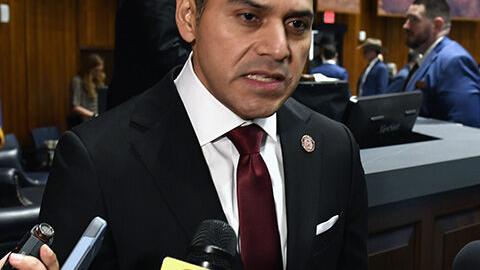
Montenegro
Now the question for the judge is whether the Republican plan to offer up a constitutional protection for military families and combine that with a poison pill to kill the broader initiative is legal.
Adelman said the legislative proposal ignores what the Constitution itself says is necessary to send proposed amendments to voters.
"Each distinct change must be presented for a separate, independent vote, so that no citizen is constrained to adopt measures of which in reality they disapprove, in order to secure the enactment of others they earnestly desire,'' he told the judge. "The framers enshrined this rule to stamp out the pernicious practice of 'logrolling' — tying a controversial measure to a popular one to drag it across the finish line on borrowed support.''
Adelman has another argument, as well.
He cited another constitutional provision that says all legislative acts — including those putting a measure on the ballot — must have a title that is clear enough so that lawmakers and the public know what to expect in its content and not be surprised.
In this case, Adelman said, the official title says only that the proposed constitutional amendment is "relating to education scholarships.'' Lawmakers also gave it an unofficial title of the "Military Families College Savings and Scholarship Protection Act.''
What isn't disclosed in the titles, he said, is the provision that, under the name of protecting military families, it also would preclude any future changes to the overall voucher program.
There was no immediate response from Montenegro to the lawsuit.
Howard Fischer is a veteran journalist who has been reporting since 1970 and covering state politics and the Legislature since 1982. Follow him on X, Bluesky and Threads at @azcapmedia or email azcapmedia@gmail.com.



 Political Notebook: Three candidates to seek county treasurer's seat