As Arizona's election season heats up, three of the state's top statewide elected officials are featured in government-funded advertising campaigns that critics say also serve a political purpose.
State Treasurer Kimberly Yee, a Republican running for state school superintendent, has been running TV ads from the Treasurer's Office about the state's college savings program that feature her face and name.
Tom Horne, the Republican school superintendent fighting to keep Yee from taking his job, has also run TV ads in the days before the July 21 primary election. The ads are about the state's private school voucher program but prominently feature Horne at the end.
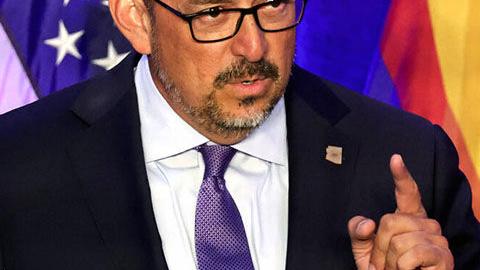
Adrian Fontes, the Democratic secretary of state, just started a new campaign with text, TV and internet ads that feature him to promote a state voter site called BallotTrax. He hopes to be reelected in November's general election.
People are also reading…
The elected officials or their spokespeople say they're just promoting Arizona programs. They deny they're using their offices for political purposes, an unlawful activity that would potentially subject them to thousands of dollars in civil penalties.
Not everyone's convinced their actions aren't dual-purpose: disseminating important information from their offices as well as burnishing their name identification as political candidates.
"It's a tale as old as campaigns themselves," said Republican political consultant Barrett Marson. "Find a way for taxpayers to foot the bill to increase name ID and show voters you are doing the job — and what a coincidence, just before ballots are due."
Horne relaunches ESA ads
In a story that made headlines in 2023, Horne announced on The Arizona Republic’s Gaggle podcast that state Sen. Janae Shamp had given the state Department of Education $10 million to run ads to promote the state's school voucher program.
The agency saved some of that money and has recently launched a new series of TV ads, even as he told state lawmakers in June he needed more funds to help manage the program.
"My job is to further improve Arizona's already excellent public schools, but if your school's not meeting your child's needs, you have choices," Horne says in an ad that ran on a local news show June 30.
News about the state's Empowerment Scholarship Account program has exploded in recent weeks as Republican lawmakers tried hard-boiled deal-making to stop a ballot measure that could gut it. The Arizona Education Association turned in over 420,000 signatures for its measure, the Protect Education Act, on July 2.
Horne told The Republic his staff chose when to run the latest batch of ads, not him, and that's when he found out about the "leftover" funds.
"If we didn't spend this, we would have been violation with the Legislature," he said. "I was under very clear instructions."
The ads will continue after the primary election, he said.
"If the ads were designed to help me politically, we would have gotten them all out before the primary," Horne said.
Yee has criticized Horne's use of state funds for ads on the campaign trail and at debates. Horne told The Republic she had no valid reason to do that, given that's what the money was for.
He is among the critics of TV ads Yee has been airing for a college savings program, saying he's been getting emails from people who don't like them.
Horne also sent 88,000 certificates of "high achievement" with his name on them to top-scoring public-school students in late June, spending $180,000 in federal funds.
Treasurer's Office airs ads, sends letter to families
The state's college savings plan, based on Section 529 of federal tax law, gives tax deductions for contributions to an account that doesn't tax investment gains. Yee's office "is pretty much always running" TV ads for the savings program, said office spokesperson Marlen Uribe Ceniceros. But the ads and interviews of Yee on local news shows are "hyped up" around National 529 Day, which is May 29, and a "new Arizona Diamondbacks partnership" have also helped promote the program, she said.
The ads "exist solely to inform Arizona families" about the program "are planned and executed the same way very year," and are "unrelated to the political calendar," Uribe Ceniceros said. Funding for the ads came from the program itself and its financial partners, she added.
Sam Buffington, a Democrat and retired CPA who lives in Sun City West, wrote to The Arizona Republic to question whether the ads violate "at least the spirit of" federal equal time regulations for political ads.
"Seeing her face and name on TV constantly, in a promotion of a seemingly positive aspect of school funding, would likely have some impact on the viewers," he said.
Yee also decided to email a letter on June 29 to tens of thousands of families who take part in the ESA program, which she would oversee if she wins the primary.
In the letter, Yee reminded parents that Channel 12 News sued her in September 2025 for certain ESA records, and that she will keep fighting the lawsuit to protect student privacy.
The email was "part of our governmental functions regarding legal updates," Yee told The Republic. "Alternatively, Tom Horne has continued to misuse taxpayer funds for his political benefit by running ESA commercials on multiple channels, all using taxpayer money."
Fontes promotes BallotTrax
Fontes in 2024 announced the statewide implementation of BallotTrax, an official state site to "track, view, and receive messages about the status of your early ballot."
On July 2, 2026, he launched a series of public service ads to remind Arizonans they can sign up for it.
Calli Jones, Fontes' spokesperson, said the site creates "peace of mind to every voter in Arizona that their vote is counted," and that his name and/or image is in the ads because he's the "sitting chief elections officer for the state."
"He is not running currently in a contested primary and has no reason other than voter confidence to send out these messages," she said.
The ads and recent work on the site cost about $1 million, she said.
"That's the advantage of incumbency," said Gina Swoboda, a Republican who hopes to challenge Fontes in November if she can beat her primary competitor, Rep. Alex Kolodin, on July 21. "It's life in the big city."
State official urges caution with ads
State law prohibits the use of public resources to influence elections. Without evidence that candidates knowingly timed their ads to help their election chances, such potential violations are tough to enforce.
Tom Collins, executive director for the Arizona Citizens Clean Election Commission, said he wouldn't call the issue a "gray area" that can't be fairly scrutinized.
"There are a number of factors that go into determining whether or not a political official who is also a candidate for office is using resources of their office for a political purpose," Collins said.
Related laws requiring candidates to report political ads or activity on their state campaign finance forms could also apply, he added.
The commission has the power to initiate enforcement for alleged campaign finance violations.
Collins said he’s unsure at this point if BallotTrax ads with Fontes would be scrutinized by the commission, but indicated it’s possible.
"There are some considerations, some questions, that could warrant some additional explanation, and if that is appropriately for commission staff to undertake, we'll undertake that," he said.