Arizona wide receivers Giovanni Richardson and Chris Hunter were upgraded to probable in the latest availability report.
Three Wildcats are listed as questionable: running back Ismail Mahdi and linebacker Max Harris — who are in a legal battle for eligibility — and running back Antwan Roberts.
Arizona cornerback Jay'Vion Cole is out with a leg injury and will be replaced by Dwight Bootle. Arizona defensive tackle Kevin Moorer and tight end Shane King are also out.
UA defensive back Dajon Hinton, who suffered a knee injury in his first start against SMU in the Holiday Bowl, is listed as probable for Saturday.
Richardson and Hunter, who have both been out the last two games for leg injuries, are trending towards returning to the lineup when No. 22 Arizona squares off with 13th-ranked Texas Tech at Galaxy Stadium in Lubbock.
People are also reading…
Including Tre Spivey, who suffered a season-ending foot injury against Cincinnati, the Wildcats have played the last two games without their starting three wide receivers and tight end, Cole Rusk, who's listed as doubtful for this week.
Richardson was on pace to become Arizona's top receiver this season until he suffered a hamstring injury in the first quarter against BYU. Richardson returned three weeks later for the Big 12 home opener against Cincinnati and exited the game for the same injury. Richardson has 16 catches for 187 yards this season.
Richardson and Hunter both missed Arizona's wins over West Virginia and Iowa State. With Arizona down three starters at wide receiver, second-year Orlando native Isaiah Mizell and in-state product Brandon Phelps, among others, have emerged in Arizona's offense.

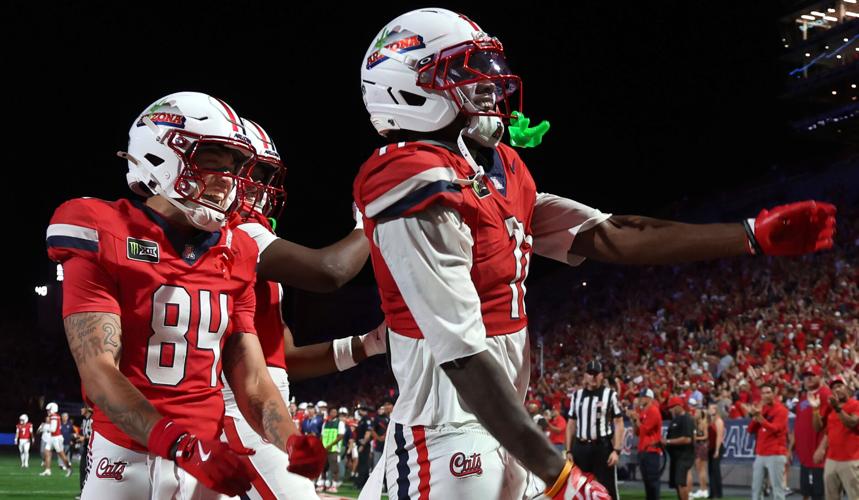
Arizona wide receiver Chris Hunter, right, gets to dance in the end zone after a catch-and-run touchdown against Northern Illinois on Saturday, Sept. 19, 2026, in Tucson.
In Arizona's win over Iowa State last week, Mizell had eight catches for 134 yards and a 71-yard touchdown. He had five catches for 105 yards in the first half alone. Mizell — who had six catches for 183 yards and two touchdowns against West Virginia — is the first UA receiver to have back-to-back 100-yard games since Kris Hutson in 2025.
Returning Richardson and Hunter, with other receivers ascending, could give the Wildcats some extra firepower on Saturday.
Mahdi and Harris, after missing the last three games for being ineligible, could return as early as this week against Texas Tech.
The lawyers representing Mahdi and Harris filed for an emergency motion for relief to the Pima County Superior Court on Wednesday following several “five-for-five” players being granted eligibility through federal court rulings in multiple states across the U.S.
In court documents obtained by the Star, more than 50 cases in 24 states around the U.S. are in favor of athletes gaining eligibility to compete this season.
Mahdi and Harris are represented by Ryan Downton of Texas Trial Group and Tucson-based Farhang and Medcoff, LLC. The Star's Justin Spears hosts a radio show with Farhang and Medcoff's Ali Farhang on ESPN Tucson.
Earlier this month, after filing for a temporary restraining order against the NCAA in the Pima County Superior Court, Judge Randi L. Burnett denied the order that would prohibit the NCAA from making them ineligible to compete this season.
The preliminary ruling was made four days after Mahdi, Harris and several other “five-for-five” athletes were in a one-hour Order to Show Cause hearing at the Pima County Superior Court.

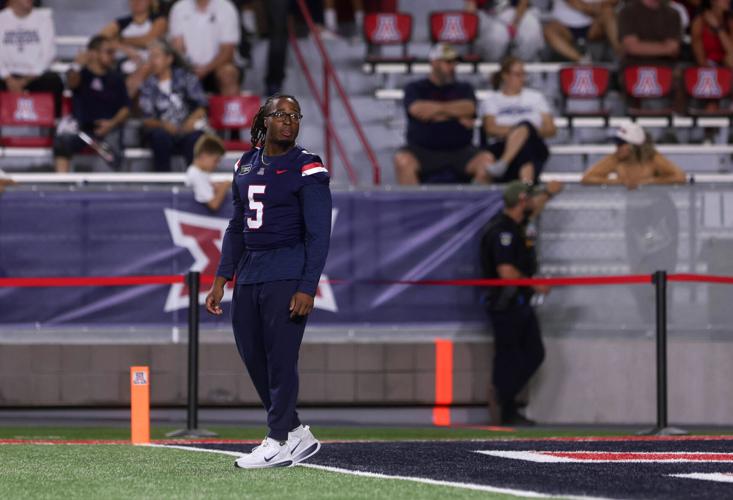
Arizona linebacker Max Harris watches his teammates warm up before their match against Cincinnati at Casino Del Sol Stadium, Oct. 3, 2026.
In August, the United States Court of Appeals for the Tenth Circuit granted a stay request in the Wisne v. NCAA class-action lawsuit in Colorado, pausing the preliminary injunction that allows high school athletes from the 2022 recruiting class — like Mahdi and Harris — the ability to participate as five-for-five players.
The stay temporarily paused Harris and Mahdi’s eligibility to play in games this upcoming season, along with other athletes nationwide.
U.S. District Court Judge Charlotte Sweeney’s federal ruling in Colorado in August allowed class of 2022 student-athletes, who weren’t grandfathered in the NCAA’s new five-for-five rule, to compete in the upcoming 2026-27 sports season.
The five-for-five rule allows student-athletes to use up their eligibility in five years — with their eligibility clock starting upon their freshman year in college or after their 19th birthday. Several 2022 athletes competed in four years, but weren’t granted an additional year of eligibility until the federal ruling in Colorado last month allowed them to return.
Mahdi and Harris did not participate in Arizona's season-opening win over NAU, but became active starting Week 2 against No. 15 BYU after filing for a temporary restraining order against the NCAA in September.
Harris recorded 10 tackles in three games at linebacker for the Wildcats and played in 108 defensive snaps. Mahdi, who was Arizona's leading rusher last season, has 12 carries for 72 yards in two games for the Wildcats — 63 yards were against Washington State last week, including 43 in the fourth quarter.
The TRO filed last month said language regarding the 2022 class being excluded from the “five-for-five” rule doesn’t exist in the 2026-27 NCAA Division I manual, meaning the NCAA can't prohibit the plaintiffs from competing this season.

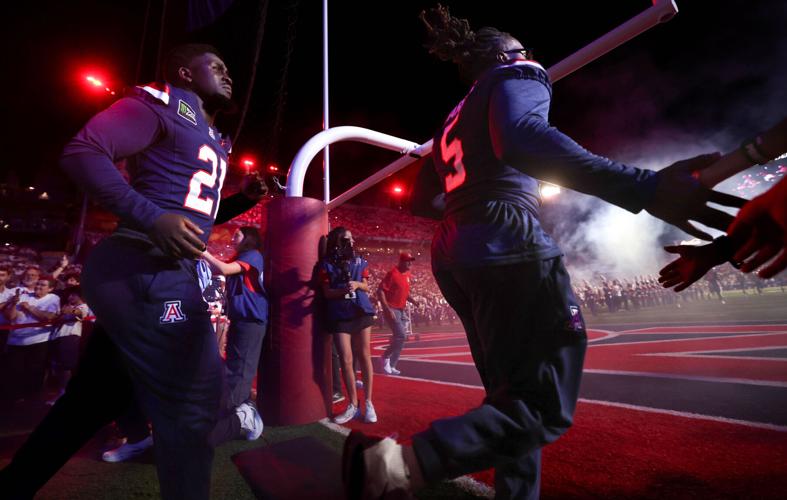
Ineligible players Max Harris (5) and Ismail Mahdi (21) walk out with their team before the Wildcats face the Cincinnati Bearcats at Casino Del Sol Stadium, Oct. 3, 2026.
NCAA Rule 12.6, which was printed in the new NCAA Division I manual that came out in August, states: “The regular academic term (semester or quarter) of an academic year in which the individual enrolls in a collegiate institution (domestic or foreign; see Bylaw 14.02.4) in a minimum full-time program of studies and attends a class in that term while enrolled full time; or the beginning of the regular academic year immediately after the individual’s 19th birthday.”
“That's been our main argument, but then we found out more that the NCAA finally published the 2026-27 bylaws, which contain the new five-year rule,” Downton said. “They told us for the last two months that the five-year rule excludes the class of 2022.
“Well, now we have the text. And it doesn't. It explicitly says they can play. They're still within five years of graduating high school and going to college. They're still within five years of their 19th birthday. Under the rule, they can play.
“It's easy for the judge to look at the plain text and say, ‘There's no exclusion here, so, NCAA, you are breaching your contract if you don't let them play.’ ... All of these guys should be eligible now. The NCAA should drop these lawsuits and stop spending tens of millions of dollars to fight against their own bylaws that they passed.”
Arizona's upcoming opponent in Texas Tech has a five-for-five player, quarterback Thomas Castellanos, who was just given eligibility through a court ruling in Kentucky.
Castellanos is expected to play against the Wildcats on Saturday — and he transferred from Florida State, whereas Mahdi and Harris haven't entered the transfer portal.
The lawyers representing Mahdi and Harris have requested the NCAA to respond by Friday afternoon. For the latest on Mahdi and Harris' eligibility, check on Tucson.com and The Wildcaster mobile app.
Contact Justin Spears, the Star's Arizona football beat reporter, at jspears@tucson.com. On X(Twitter): @JustinESports

Justin Spears
Sports Reporter


 On Arizona’s narrow path to the Playoff and other Big 12 thoughts | Michael Lev