Britney Gilles parked and got her daughter's stroller out of the car, then looked around the St. Mary's food pantry in Surprise. She didn’t know where to go, so she asked a security guard, who directed her to line up at a window on the side of the building.
It was her first time at a food pantry.
After waiting in a line for a while, she was given a shopping cart filled with food — pastries, hot dogs, lettuce, cans of beans and peanut butter.
Gilles is a special education teacher. She’s taught in both the Dysart and Peoria school districts, although now she teaches special needs kids at their homes.
Gilles said she never thought she’d be in the position to need a food bank.
“When you were in high school, you sat in a classroom with your teacher that made nothing. And your teacher probably did not want to come into a food bank because it's shameful," Gilles said. "It feels that way."
People are also reading…
Until October 2025, Gilles was receiving benefits through the Supplemental Nutrition Assistance Program, or SNAP. She received $350 a month, which helped her feed her four kids, two of whom are hungry, athletic teenagers.
After the government shutdown in October, her SNAP benefits stopped. She’s been trying to reapply since then, with no success.

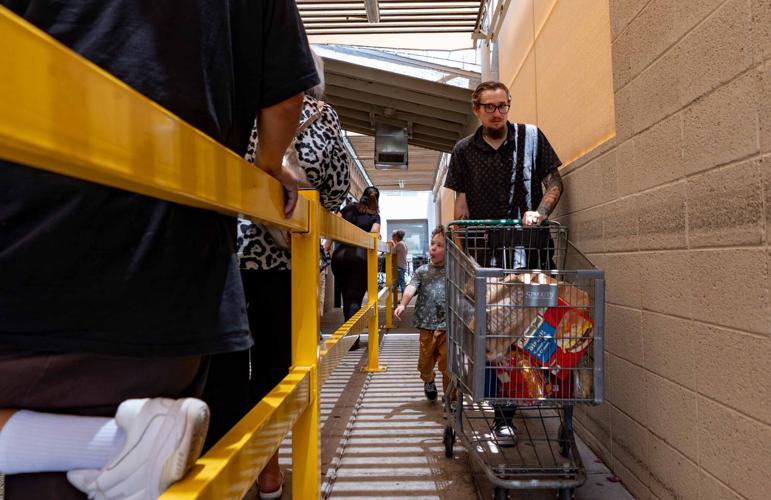
Brett Kovac and his son, Nico Kovac, walk back to their car after receiving food at St. Mary's Food Bank in Surprise.
She couldn’t reach any workers from Arizona's Department of Economic Security, which administers SNAP. With school out for the summer, she finally had time to go to a DES office. When she did, she waited in line for 45 minutes to be told the agency would call her back.
While she waits, she has turned to food banks to help feed her family.
“This is something that's hard to do," Gilles said. “But if you don’t have enough money to put food on the table, you don’t have that. So where else are you going to go?”
Hundreds of thousands of Arizonans lost SNAP
Gilles is one of the nearly half a million Arizonans who have dropped off the SNAP rolls since July 2025, when Trump signed the One Big Beautiful Bill Act, known formally as H.R. 1.
Arizona dropped over half of its participants in the SNAP program between July 2025 and March 2026. The next closest state was Florida, which saw a decline of 17%, according to the nonpartisan Center on Budget and Policy Priorities.
The reason why is complex.
The easiest explanation, and one supported by Republican politicians, is that DES started implementing new eligibility requirements created by H.R. 1. The hundreds of thousands of people no longer on SNAP, the logic goes, were removed because they were no longer eligible for benefits.
Among other changes, veterans, people experiencing homelessness, and anyone aged 54 to 63 must now work or volunteer 20 hours a week to receive SNAP, whereas before they were exempt. People caring for children over age 14 must also work (parents used to be exempt for kids up to 17). Refugees can no longer receive SNAP.
“When we began doing SNAP food stamp checks, eligibility went down, enrollment went down 47% that tells me that that system was rife with people who shouldn't have been on it in the first place,” state Sen. John Kavanagh said while discussing a Republican budget bill in April.
However, the number of Arizonans purged from the program was over three times the number of people that Arizona DES itself estimated would be impacted by the change in work requirements. DES estimated 140,000 individuals would be impacted, according to a proposed budget for fiscal year 2027. In reality, 430,657 people have left the program as of May 2026.
Using those numbers, close to 70% of the people who dropped off the SNAP rolls were not because of direct changes to eligibility from H.R. 1. So what happened?
Speaking to the people impacted revealed a different answer.
The Arizona Republic interviewed over a dozen people at food banks across metro Phoenix and at a DES office. Rather than deal with long wait times and the uncertainty of ever getting ahold of someone on the phones, they are giving up, they say. That means a significant number of Arizonans who might still be eligible under federal law and are legally entitled to benefits are no longer receiving SNAP.
'Every time I call, the lines are busy'
The line wound around the lobby of the Chandler DES office. It concluded at a row of desks where DES employees sat. They’re the first stop. Next, a person would take a seat in the rows of chairs set up in the back of the room and wait to see an eligibility worker.
A TV displayed the current longest wait time for people hoping to meet with a caseworker. Three hours and 41 minutes, a number that would tick steadily higher as the line progressed.
Stephen Mills, 62, leaned on the thin metal post marking out the line. The woman in front of him moved up a foot, and he shuffled to the next metal support.
A former chef for the Army, Mills was injured in 2017 when a forklift rammed into his side. Since then, he hasn’t been able to stand for long periods of time without his knee and back hurting. His SNAP benefits have gone from $185 to $35 a month, and he’s been trying to figure out why.
Mills sighed. He looked around at the giant, cavernous room. The T-shirt of the man behind him, a picture of rapper Nipsey Hussle, caught his eye. “I like your shirt, buddy,” Mills said.

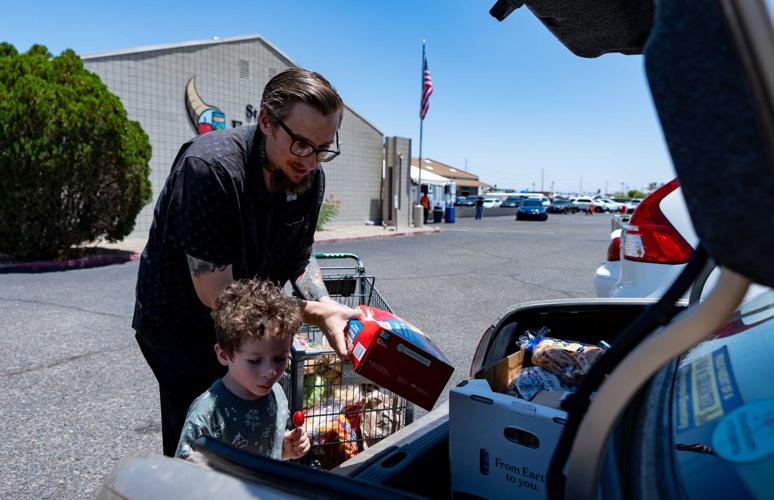
Brett Kovac and his son, Nico Kovac, store food in the trunk of their car at St. Mary's Food Bank in Surprise.
The two started chatting. Anthony Wilson, 30, had been receiving SNAP for three years. When it came time for his yearly renewal interview this year, he couldn’t get through and he missed the deadline.
“Every time I call, the lines are busy,” Wilson said.
Since his SNAP benefits lapsed, he had to reapply. He went to the office, despite the fact that he knows that DES doesn’t do interviews there, hoping to get on a list to be called by someone.
A little girl ran by, braids flying. Wilson smiled, watching her. He has a baby son.
The line inched forward. An hour had already gone by.
A man came in, wearing a work apron. A mom joined the line with two children in a double stroller. Angel Bright, 37, stood at the back of the line, talking with two other women about how hard it’s been to reach anyone from DES.
A single mother with three kids, she took time off from her job at a health insurance company to come to the office. Like Wilson, her benefits lapsed after she couldn’t get in contact with DES to do a renewal interview in time.
“We don’t have the time to keep coming back up here,” Bright said.
When asked about wait times, DES spokesperson Brett Bazio said the agency was "timely" in handling close to 80% of cases in May 2026 compared with 95% a year earlier.
Back at the front of the line, Wilson and Mills had almost reached the line of desks with DES employees. In the hour and a half they’d been in line, they’d exchanged numbers. Wilson promised to order food from Mills’ food truck, We Ain’t Jokin We Smokin.
An employee motioned for Mills to come to his cubicle. Mills sat down and began explaining that he had documents on his phone to show why his SNAP allotment shouldn’t have been decreased.
The employee helped Mills reupload the documents to his account, but told him that if he wanted to see an eligibility worker, he’d have to come back another day. The wait had crept up to over four hours — too long for him to even attempt to join the queue.
The new law means more documentation
H.R. 1 didn’t just change who was exempt from SNAP work requirements. It also included another stipulation, one that is responsible for much of the chaos behind the SNAP program in Arizona.
The SNAP payment error rate measures whether households received the correct benefit they were allotted under eligibility rules. It measures under- and overpayments. It does not measure intentional fraud.
Under H.R. 1, if the payment error rate is over 6%, then states have to pay up to 15% of the cost of the benefits themselves. In the worst-case scenario, that would cost DES an extra $302.2 million per year, according to the proposed budget for fiscal year 2027.
In 2025, the error rate was 10.8%, which could result in $208 million in penalties if the agency does not lower the rate.
Since July, Arizona DES has launched a “comprehensive strategy” to reduce the payment error rate, which included requiring more documentation from applicants to prove the accuracy of their income, Bazio said in a statement to The Republic.
However, despite more requirements for DES workers to review, DES has fewer eligible workers than ever. The agency laid off about 500 workers in June 2025, citing the elimination of federal grants. Since then, the agency has added back 140 positions, according to Bazio.
"Indirectly, the introduction of stricter verification policies aimed at lowering our error rate has led to a slower application process. However, by addressing the PER, we are ensuring the continuation of the program," Bazio said.
The payment error rate does not measure who is getting SNAP that actually needs it, said Anna Walther, an incoming assistant professor of social work at Arizona State University.
SNAP is an entitlement program, meaning that anyone who qualifies is legally entitled to benefits, Walther explained. That’s in contrast to other assistance programs that have a set amount of money given out on a first-come, first-serve basis, like the Temporary Assistance for Needy Families.
“It does not include the people who say, 'I’m not even going to try,'” Walther said.
A couple struggling to feed their children
Paige Kovac, 30, a mom of two in Wickenburg, is one of those people.
Paige first applied for SNAP in 2016, when she was pregnant with her first son. She was approved for several hundred dollars, which helped support her and her young baby.
“Back then it was like no problem whatsoever,” Paige said.
Paige has received SNAP on and off since then, but her benefits ended early this year.
In April, the family was really struggling, so they decided to reapply. The family subsists on her husband Brett’s disability income, which is about $1,600 a month.
Neither was able to work. Paige slipped and hurt her back while playing with her two sons, leaving her bedbound. Brett, 33, has a disability that makes it difficult for him to work consistently.
Paige struggled with all of the application requirements. DES asked her mother-in-law to write a note stating that she would no longer send the couple gifts of money or food.
DES required her mother-in-law to rewrite the letter six different times because it wasn’t formatted correctly, according to photos Paige shared with The Republic. When DES asked her to send a written, itemized statement for every time her brother had sent her money, it was the last straw.
“That's when I was like, this is ridiculous,” Paige said. “That was the first time I was ever asked to be as specific as that.”
The stress and the uncertainty were too much. So she gave up.
“I just — I gave up and I was like all right I'm gonna let it go and just let God handle this," Paige said.
Paige isn’t the only person to face inquiries like this. A May NBC article cited a woman who was asked to provide a statement from her father that the money he sent her was a gift and not a recurring payment.
'It’s a constant worry of, is my son going to eat this?'
The couple has turned to food banks to help feed their two kids, Isaac, 9, and Nico, 5. Nico has autism, which makes him sensitive to certain foods. The family has had to adapt to whatever is available in the food boxes they receive from food pantries. Because the food boxes often contain packets of tuna, for example, the whole family celebrated when Nico started being able to eat spaghetti with tuna.
“That was a big step for him,” Paige said. “It’s a constant worry of, is my son going to eat this? I don’t want him to go hungry.”
Brett does all the cooking for the family, since Paige is still mostly bedbound. Some nights, he’ll eat cans of beans with vegetables.
“I just eat what no one else will eat just because they're my family. They need it more than I do,” Brett said.
'Food banks just ain’t gonna cut it'
In the long term, food banks are no substitute for SNAP.
St. Mary’s Food Bank is one of four large food banks covering Arizona. It serves two-thirds of the state.
Through its own pantries and its roughly 700 partners, it distributes about $250 million in food every year, said Milton Liu, St. Mary’s president. For comparison, DES gave out $1.83 billion in SNAP benefits in fiscal year 2025.
“We could never replace all the losses of SNAP benefits,” Liu said. “Food banks don’t have that much food."
Around 20% of St. Mary’s food has historically been funded by federal money, but that funding has also decreased. The food bank is meeting demand, which has grown steadily at 15% every year, by dipping into its savings, Liu said.
“It’s not sustainable,” Liu said. “We can’t do this forever.”
At Tempe Community Action Agency, manager Philip Cornes said the number of households they've served has risen by 40% since this time last year.
“Without SNAP, we are just not meant to meet that demand," Cornes said. "Yeah, food banks just ain’t gonna cut it."
A glimmer of hope in SNAP caseloads
Despite the turmoil, the process is still working for some people. Arizona’s SNAP caseload went up in May 2026 for the first time since H.R. 1 was passed, gaining 16,566 people, according to DES data.
At the Chandler DES office, Yulissa Mendez had made it out of the line and was sitting in a chair, bouncing her baby girl on her lap. Her other daughter sat next to her, playing a game on her mom’s phone.
Two weeks after applying, Mendez was approved for $400 in SNAP benefits and had come to pick up her Electronic Benefit Transfer card.
“I’m really grateful because it’s just crazy out there right now,” Mendez said. “Everything is so expensive.”
Her first purchase with the money will probably be meat, Mendez said. She wants to make her girls hamburgers.
“It’s going to be a big help,” Mendez said.
As for Gilles, the mom of four and special education teacher, three weeks after that first visit to the food bank, she's still waiting to hear back about her SNAP benefits.
A trip to St. Mary's
Holding Nico’s hand, Brett got in line at the St. Mary’s food pantry in Surprise. He pulled a lollipop from his pocket and gave it to Nico, who stuck it in his cheek before singing out, "Hello!" at a person passing by with a cart full of groceries.
Since discovering that the Surprise location gives out more food than the food bank in Wickenburg, he’s started making the 45-minute drive about once a week. He carpools with two of his neighbors to save on gas costs.
With whatever they received that day, Brett planned to make a simple Father's Day dinner to eat with Paige and the kids. Paige was getting surgery on her back the next day, and Brett was excited to spend some family time all together.
And maybe, Brett said, looking down at Nico, they'd have a little extra money to buy ice cream on the way home.