The funny thing about the Arizona men’s tennis team’s run to the Elite Eight is that the biggest believer in what the program was capable of didn’t see it coming.
“If you had told me a year ago that we'd be in this position,” Wildcats coach Clancy Shields said, “I would have laughed in your face.”
After reaching the Sweet 16 for the fourth time in five years last spring, Arizona lost Colton Smith — arguably the greatest player in UA history. Many members of the projected roster were relatively green.
“You see the kids where they were ... these young guys and their level at the time,” Shields said. “I have to give our team so much credit. They went (out) in the summer and they all played. It was the first time in my coaching career that I've had every single guy on our team play eight to 10 tournaments over the summer.
People are also reading…

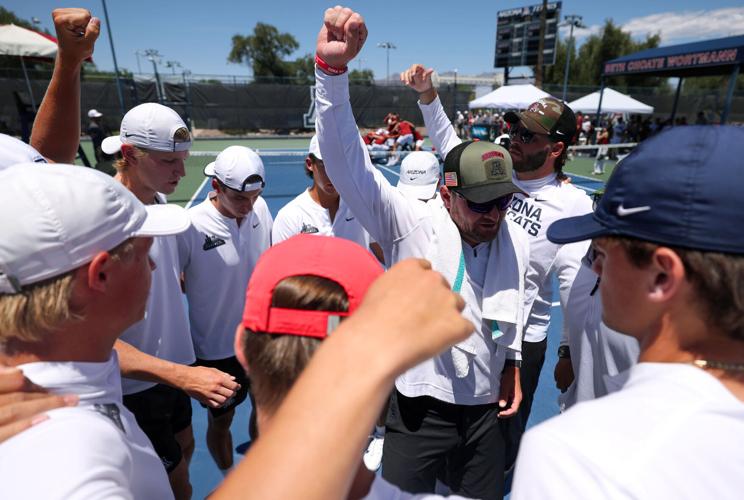
Arizona head coach Clancy Shields leads his team in a chant before the Wildcats faced Oklahoma in a Sweet 16 match at LaNelle Robson Tennis Center, May 9, 2026.
“From when they left last May to when they showed up on campus in August, it was like a totally different team.”
That team has gone where no UA squad has gone before. No. 8 seed Arizona takes on No. 1 seed and defending national champion Wake Forest at 1 p.m. Thursday at the Dan Magill Tennis Complex in Athens, Georgia. The winner will face No. 4 Virginia or No. 5 Mississippi State in the semifinals Saturday.
While acknowledging that Arizona is playing with house money at this point — “There's no stress on our shoulders,” Shields said — the 10th-year head coach emphasized that the Wildcats’ mission isn’t over yet.
“The first message I told the guys on Monday (was), ‘We're winning this freaking thing. I don't want you to think that the job's done,’” Shields said. “We're gonna do everything that we can preparation-wise. At practice (Tuesday), I was screaming at the guys the whole time like any other day because, if you want to be elite, you gotta be a little bit of a perfectionist.
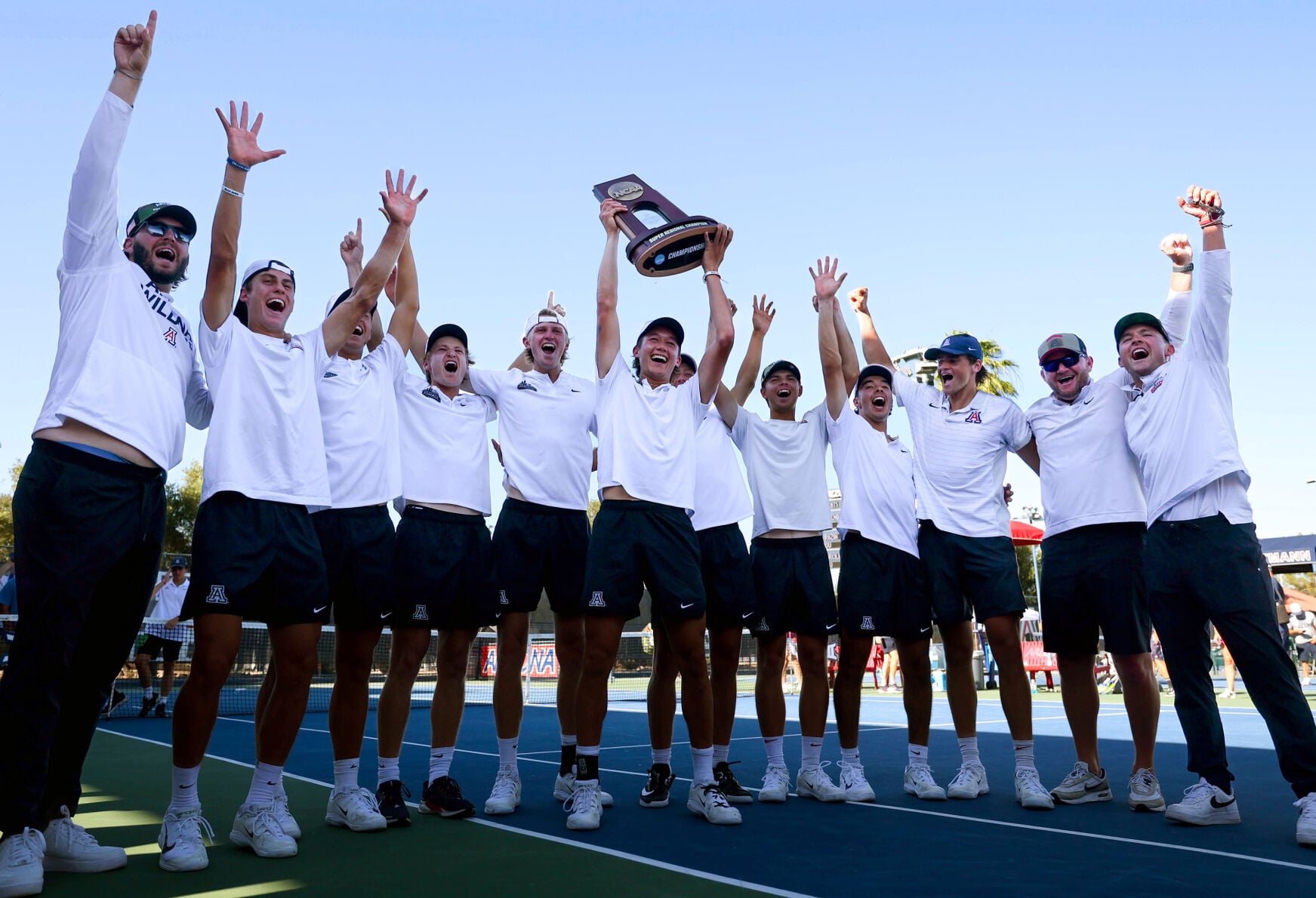
The Wildcats hold their trophy high after winning their Sweet 16 match against Oklahoma at LaNelle Robson Tennis Center, May 9, 2026.
“I don't know what's going to happen — who knows? — on Thursday. But I will say that we're going to prepare like we're preparing for the most important match of our life and that we can do this.
“House money, sure, but in the same sense, if we got this far, dang it, why not have the belief and confidence that we can actually go win it?
“Half the battle — and I learned this my first couple years here — if you don't have that inner belief that you can do something, it's not going to happen.”
Shields talked about instilling that sense of belief — which helped Arizona pull off an improbable comeback in the Sweet 16 — the state of college tennis and other topics in an appearance this week on The Wildcast podcast. A portion of that conversation can be found below. It has been lightly edited for clarity and brevity.
You guys finally got over the hump Saturday vs. Oklahoma. How would you describe what that scene was like at the LaNelle Robson Tennis Center?
A: “The last 20 minutes of the match was madness, because you had three stories coming down to the finish line and we needed to win all three to win the match. ... Then, all of a sudden, you snap your fingers and it was 3-3.
“It came down to Jay Friend, our senior, our captain, our ‘why’ for the season, playing one of the better players in the SEC (Luis Alvarez), who was ranked 25 in the country at the time, so no slouch.

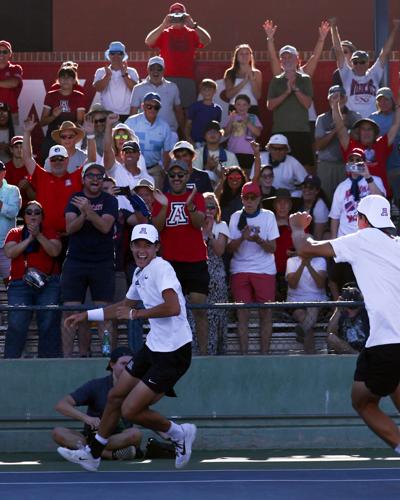
Arizona fans cheer on senior Jay Friend after he won his singles match against Oklahoma to send the Wildcats to the Elite Eight at the LaNelle Robson Tennis Center, May 9, 2026.
“When it was coming down to Jay's court, I'm like, ‘This is destiny. This was supposed to be. This is the way it was supposed to be written.’ And then he won 6-0 in the third in front of a packed house, hundreds of people there. ...
“It was really a celebration of tennis in Tucson, having (Arizona athletic director) Desireé (Reed-Francois) there and President (Suresh) Garimella and so many of the (people) who supported our program when we were the bottom feeders of the Pac-12.
“Not a lot of people know this, but I lost my first 18 matches in the Pac-12. (But) there were so many people behind the scenes just encouraging you: ‘Hey, you can make this happen here. Just keep putting your head down and keep working ... just keep believing in your vision for what this place could be.’ Come eight or nine years later, you're living that dream that you pitched to the guys, the vision that you told the guys.”
This is an interesting time for college tennis. While you’re having your breakthrough, many schools, including Arkansas, are cutting the sport, citing the costs to support football, basketball, etc. What have the conversations been like in your community about that?
A: “That's my No. 1 job — to grow the sport and to continue to make college tennis relevant. We know what's going on right now in college athletics, but it's great for the president and the AD to see, ‘OK, this is a pretty cool. Maybe there's opportunity to grow rather than everyone's just trying to survive.’ ...
“My brother (Luke) was the head coach at Fresno State when they cut their men's program during COVID, and I remember just having many conversations with him. ‘What was that like? How'd you tell your players?’

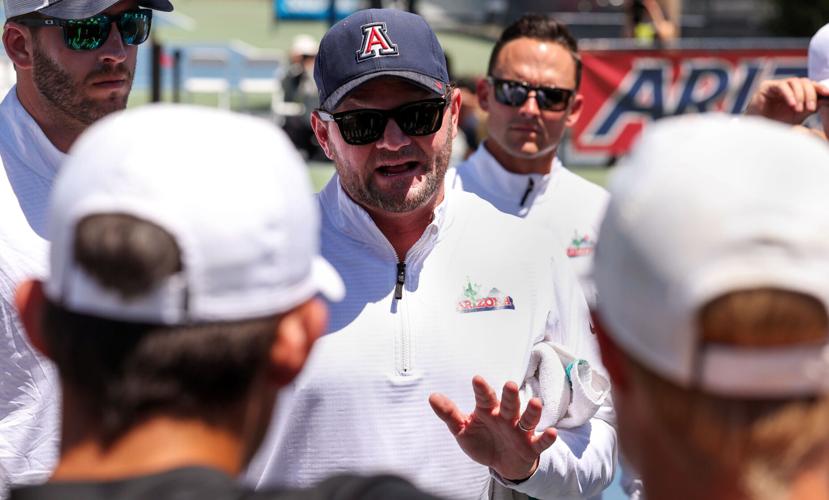
Arizona head coach Clancy Shields talks to his team before the Wildcats faced Denver in the NCAA Tournament on May 2, 2025.
“I do think the landscape is changing, and I understand there's tough decisions that are being made, much higher than where I sit. But I look at this holistically: What is this experience going to do for these kids as they go on to the next part of their life?
“I think we are shaping (young men) for the future, not just (for) our sport, but for contributing members of society. I believe the work that we do here isn't just about hitting tennis balls, it's about shaping these young men the rest of their life.
“We are a very international squad. We can take nine to 12 different players from all over the world, and you can put them on a team, and they all can start working towards one goal together. It doesn't matter if you're from Ukraine, if you're from Spain, you're from Japan, New Zealand, when you get here and you're part of this team, you’re family. This is your family. This is where you're supposed to be.
“And honestly, that's given me a lot of hope that as a global society, we all can work together and that we all can do something as a collective unit to make life better and more meaningful and impactful. ...
“I think the work we're doing is impactful. It's my life's calling. It's under attack a little bit when I hear that we're chopping these opportunities.”
What has been the most enjoyable part about building something special here? What joy do you get out of building what you've built?
A: “Before I came to Arizona, I was at (Utah State). They hired a 26-year-old young guy who knew nothing, and I turned around a program there. Having that experience helped me at Arizona, because it was the same thing. They were the bottom feeder of the WAC. Then they moved to a new conference in the Mountain West, and, by the time I left, we'd won a championship.

Arizona head coach Clancy Shields celebrates his No. 1 doubles team’s win against Auburn in a second-round match of the NCAA Men’s Tennis Tournament on the UA campus on May 4, 2024.
“I made so many mistakes as a 26-year-old head coach. Who wouldn’t? You don't know anything.
“I made a ton of mistakes in those first couple years (at Arizona). I remember even the guys telling me, ‘Coach, are we the tennis team or the cross-country team? Because it feels like all we do is run.’ And I remember telling them, ‘Well, guys, look, we may not win on talent, but we are definitely going to be the most fit team in the conference.’ We just had to start with little things that we knew that we could do in our program.
“It was so cool to come to Arizona and to read the story of Lute Olson and how he did it. I remember being fascinated. I was reading in my office, because I was sleeping in my office the first two weeks. I didn't have a place to stay; I was just recruiting nonstop. I remember reading this Lute Olson story about how he started the program here and got it going. He was talking about how much running they did and the physical fitness and paying the price to be an elite program.
“When you put your blood, sweat and tears into this place, you'll fight for it. ... We were really talking to kids about a vision. We were saying, ‘Hey, the history books at Arizona, they're empty. There's nothing in here. Trust me. Come to Arizona and help me write the history books here. Let's go fill it up.’

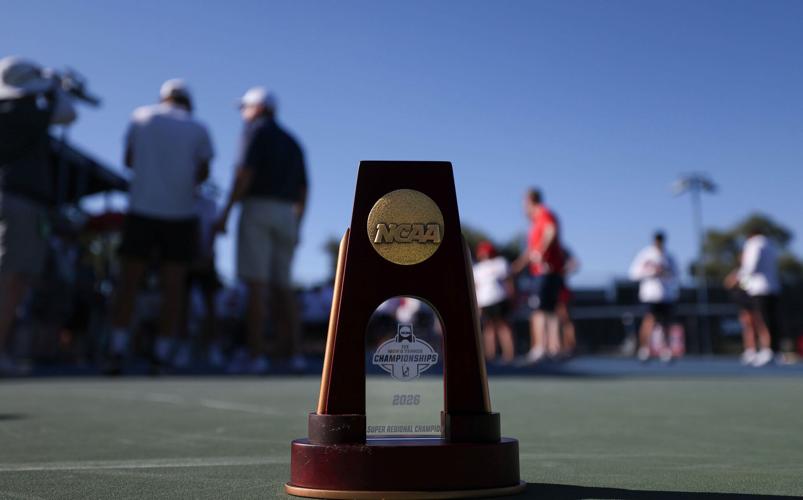
Each Arizona player earned his own D1 men’s tennis 2026 super regional champions trophy after taking down Oklahoma at the LaNelle Robson Tennis Center, May 9, 2026.
“Luckily, we just had some players who trusted the vision and came in here and just kept elevating it. Now we're at the point where we're in those recruiting battles with the top kids, and we're able to recruit at a higher level. But also, we never want to lose what we're trying to do here — ‘culture wins,’ trying to get the right character kids.
“We haven't done this NIL space that all these other teams (are doing). I can promise you, every team here in Athens, they're paying $300,000-$500,000 in NIL. For us to feel like we're doing it with less scholarships, that we're doing it with no NIL, I'm tickled. We've been able to do it when the odds are stacked against us.
“It was such a quick transition to ... throwing bags of cash at players. But I've worked so hard (at) building this culture. If you're motivated by money, it's the antithesis of everything that I've built here — playing for each other, playing for the ‘A,’ playing for Tucson, the love of the program.”
Contact sports reporter/columnist Michael Lev at mlev@tucson.com. On X (Twitter): @michaeljlev. On Bluesky: @michaeljlev.bsky.social
Michael Lev
Sports Reporter/Columnist


 On Tommy Lloyd’s big-man plan, Becky Burke’s recruiting, men’s tennis’ moment | Michael Lev