

Arizona’s visit to Washington State on Saturday conjures memories of the late, great Mike Leach, who coached the Cougars from 2012-19.
Leach was a pioneer and advocate of the “Air Raid” offense, which helped his WSU quarterbacks put up prolific numbers, often against the Wildcats. It’s a version of the spread offense, and it’s very much a pass-heavy scheme.

Current UA offensive coordinator Seth Doege is a Leach protégé. Doege’s offense doesn’t look like Leach’s. But a particular trend this year is unquestionably Leach-esque.
Arizona isn’t running the ball very often. The Wildcats are last in the Big 12 in rushing attempts — and last in rushing yards. That’s not a coincidence.
Why has Arizona skewed so much toward the pass so far this season? What’s really going on here? That’s what we’re going to explore in this week’s “Cats Stats.”
People are also reading…

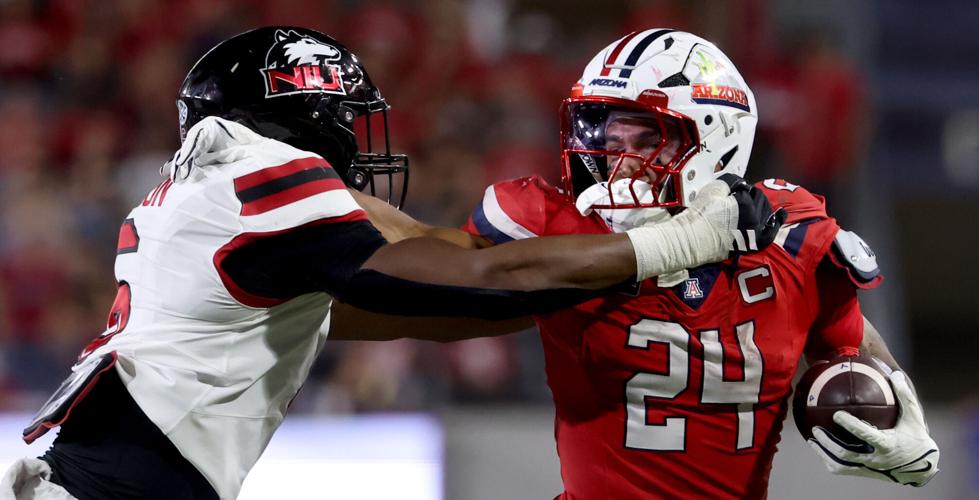
Arizona running back Quincy Craig tries to fight off Northern Illinois linebacker Jashawn Nelson on a run in the third quarter of their game, Sept. 19, 2026, in Tucson.
We’ll start with the most important number — Arizona’s percentage of designed run plays. You can’t calculate that figure by simply looking at a team’s listed rushing and passing attempts. You have to move some pieces around. So we did just that.
The first move was shifting sacks to the pass-attempts column. For reasons that remain unclear, sacks count against team rushing totals in NCAA football. So that lowers Arizona’s rushing attempts through three games from 92 to 83.
Step two is to shift scrambles to the pass-attempts column. Fortunately, our colleagues at Pro Football Focus break out quarterback scrambles into their own category, differentiating them from designed QB runs.

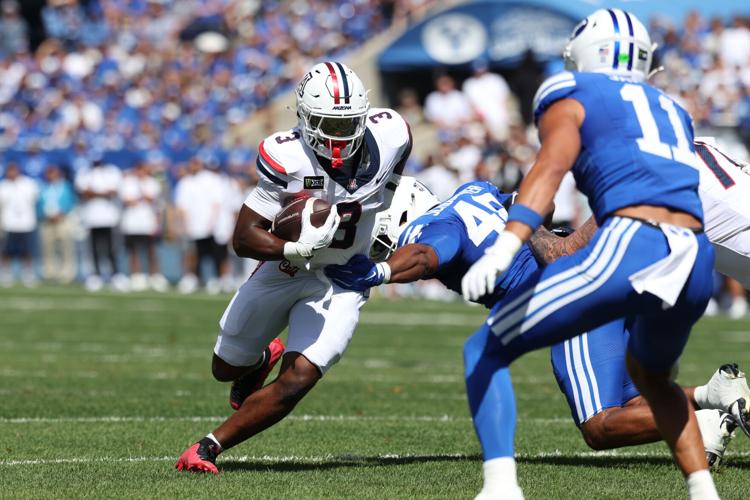
Arizona running back Kedrick Reescano runs the ball against BYU defensive end Viliami Po'uha (45) and safety Faletau Satuala (11) during the first quarter at LaVell Edwards Stadium on Sept. 12, 2026, in Provo, Utah.
Arizona has had 10 scrambles this season, per PFF, lowering its true rushing attempts to 73. That’s an average of 24.33 per game — compared to 41.67 true passing attempts per contest.
Arizona’s true rushing rate is just 36.9% — easily the lowest in the Big 12. The next lowest is Oklahoma State at 45.9%.
Three teams in the league have a true rushing rate of over 60%: BYU (61.5%), Iowa State (62.4%) and West Virginia (75.2%).
(The Mountaineers are clearly making a statement: Rich Rodriguez is going to run the ball until you stop it.)
Arizona was near the bottom of the Big 12 in true run rate last season — Doege’s first as offensive coordinator — but the ratio wasn’t as extreme. The Wildcats had a 43.7% run rate, which was fourth lowest in the conference. Baylor had the lowest at 40.4%. Utah was the highest at 55.9%.
The latter provides a bigger sample size — although it’s not always an apples-to-apples comparison because many teams have changed coordinators and schemes.
That’s not the case with Arizona. Same play-caller, same system. Many of the main characters on that side of the ball haven’t changed either.
Context clues
So what accounts for the drop in run rate — which, in theory, should have trended the other way given that Arizona has had two blowout victories over NAU and NIU?
Doege cited context. In the Week 2 game against BYU, for example, the Wildcats were frequently “behind the chains” in the second half because of penalties and other issues. Adjusting for sacks, Arizona had 13 pass attempts and seven rushes after halftime. In the first half, the Wildcats had perfect balance — 21 of each.

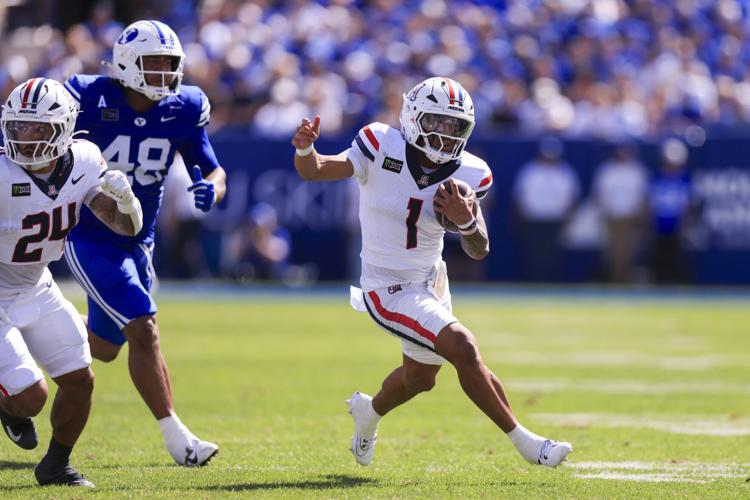
Arizona quarterback Noah Fifita runs the ball against BYU during the second quarter at LaVell Edwards Stadium on Sept. 12, 2026.
“We got behind the sticks in the second half, and really, our run game consisted of getting back on track,” Doege said. “I would call quarterback runs just to get us in a third-and-manageable situation.”
Last week against Northern Illinois, Arizona had just 23 rushing attempts and 41 passing attempts (both adjusted for sacks). That wasn’t necessarily the plan so much as Doege trying to take what the Huskies were giving.
“We're getting pressure, two-man pressure game,” Doege said. “They're bringing six or seven to the box every play. Well, there's people wide open. There's tons of space. That's why Noah (Fifita) was 31 of 34 ... there's people just completely cut free.
“So in my mind, I'm like, ‘OK, yeah, we can run it — or we can just throw it every play because there's going to be somebody open. We gotta handle all this movement, all this pressure, just to get 5 yards on (a) counter (run).
“To me, it was more efficient just to call a quick game and spit it out in space, spit a hitch, and get 7 (yards).”
‘Not the standard’
That being said, Doege feels the same way about the run game as we do: It’s both underutilized and underperforming.
The raw totals show Arizona at 123.3 rushing yards per game — 39 behind 15th-place Baylor in the Big 12 and 29 behind last season’s Wildcats. Adjusting for sacks, Arizona’s 2026 rushing average rises to 143.7 yards per game, while the gap between last place and 15th place (still Baylor) shrinks to 30 yards. It’s a wide margin either way.
The Wildcats’ sack-adjusted average per attempt of 5.19 yards isn’t bad but ranks just 11th in the conference. Six teams are above 6 yards.

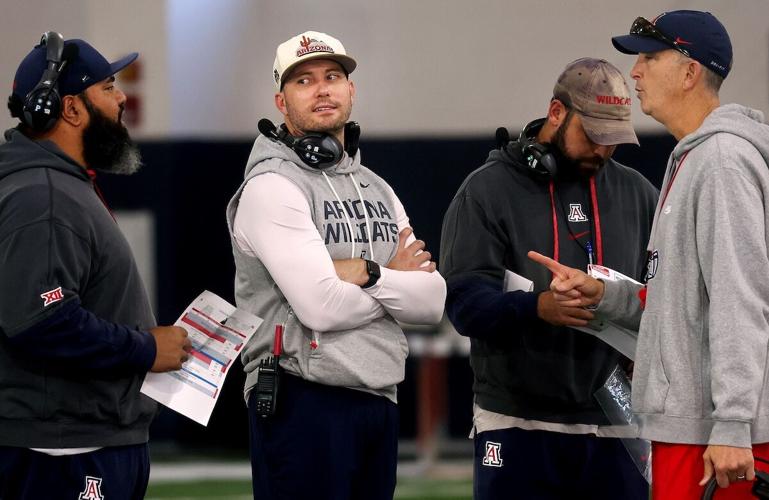
Seth Doege, offensive coordinator/QB coach, second from left, stands with other coaches and Brent Brennan, far right, during an Arizona football morning practice session on Dec. 16, 2025, before the team heads to the 2026 Holiday Bowl.
“It's not the standard right now,” Doege said. “We should be better at running the football, and it starts with me. I don't think it has anything to do with our personnel. I don't think it has anything to do with our plan. I think I gotta do a better job adjusting and calling better runs in games.”
Running the ball more — and better — would take pressure off Fifita. It would make play-action passes more effective. It would help the offensive line establish its physicality. It would help the Wildcats wear down opponents in the fourth quarter.
“I would like us to be a little bit more efficient there,” Doege said. “I do think we're capable of that. I don't think it's an issue right now. But it is something we're being intentional about and we want to fix.”
Contact sports reporter/columnist Michael Lev at mlev@tucson.com. On X (Twitter): @michaeljlev. On Bluesky: @michaeljlev.bsky.social
Michael Lev
Sports Reporter/Columnist


 5 takeaways from Arizona football’s 42-17 victory over Northern Illinois | Michael Lev