Arizona volleyball standout Journey Tucker is named after the actress Jurnee Smollett.
But the person who named her believes there’s more to it than that.

Michael Lev is a senior writer/columnist for the Arizona Daily Star, Tucson.com and The Wildcaster.
“We name our kids,” said Journey’s mother, Candi Crudder, “but I really feel like their names are ordained by God or a higher power because her whole life and everything that she has experienced, it really has been a journey.”
Journey has experienced a journey like no other.
Halfway through her junior year at Verrado High School in Buckeye, doctors discovered that Journey had a brain tumor. It was the same type of tumor that had taken the life of her older sister.
Imagine what it must have been like for Crudder to lose a child. Then imagine it happening again. No word is strong enough to describe that nightmare.
People are also reading…

Arizona middle blocker Journey Tucker watches her block drop on the Bowling Green side of the net in the second set of the championship game of the NIVC, Dec. 18, 2024, at McKale Center.
“There was shock, disbelief,” Crudder said. “The first thing I'm thinking is, ‘Oh no, not again.’ But I went into mama-bear mode since I did have previous experience with it, letting the doctors know right away that there was some type of familial history.
“So the medical course of action started moving very quickly after they found that out. I was very grateful for that.”
Through a fortuitous set of circumstances that we’ll detail shortly, Journey survived. Surgeons were able to minimize the tumor. She was able to return to school, resume her budding volleyball career and earn a scholarship at Arizona.
A 6-foot-2 middle blocker, Journey is about to enter her senior year as a Wildcat. Earlier in her UA career, she received the Inspiration Award at The Catsys. Earlier this year, she was one of five recipients of the Wilma Rudolph Student-Athlete Achievement Award, which “honors student-athletes who have overcome significant personal, academic and/or emotional challenges to achieve academic success while competing in intercollegiate athletics.”

Arizona middle blocker Journey Tucker goes to the net to defend a UTEP attack in Game 1 of their match Sept. 16, 2025, at McKale Center.
Journey had to submit a personal essay as part of the application. The theme: perseverance.
“I don't really see it as a sob story or something to be sad about,” she said. “I just look at it as a story of being able to overcome a setback and not let that setback define me.”
Shock to the system
In January 2022, Journey was traveling with a teammate and her parents to a club tournament in Nashville, Tennessee. During a layover, Journey fell asleep. Then she had a seizure.
“I dozed off before the flight took off,” she said. “Then the next thing I remember, I'm in a wheelchair.”
Journey was surprised to learn that she’d had a seizure — although, as she and her mom started to put all the pieces together, it actually made sense.

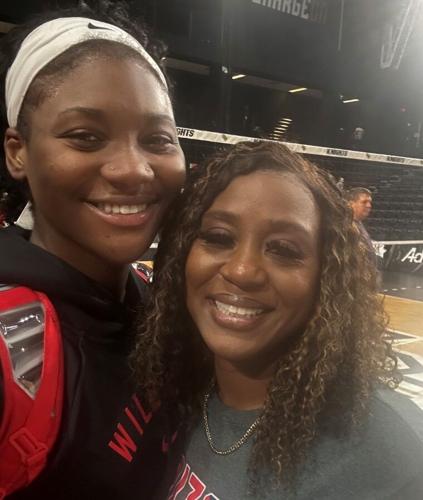
Arizona volleyball player Journey Tucker, left, and her mother, Candi Crudder, pose for a picture after a match.
She was taken to an emergency room for imaging. A mass was found on the left side of her brain.
“I was just really confused and shocked and scared,” she recalled. “I wasn't with my mom. I wasn't with any family. I was with a close friend, and her parents and my mom were very close. But it still wasn't family, and I still really didn't have a full understanding as to what was going on.”
Journey eventually would learn that she had a pilocytic astrocytoma, which is a “typically benign and slow-growing brain tumor that primarily affects children and young adults,” according to a National Institutes of Health report.
Pilocytic astrocytoma is the most common brain tumor in children and adolescents, per the same NIH report. But overall it’s rare, affecting about eight in 1 million individuals.

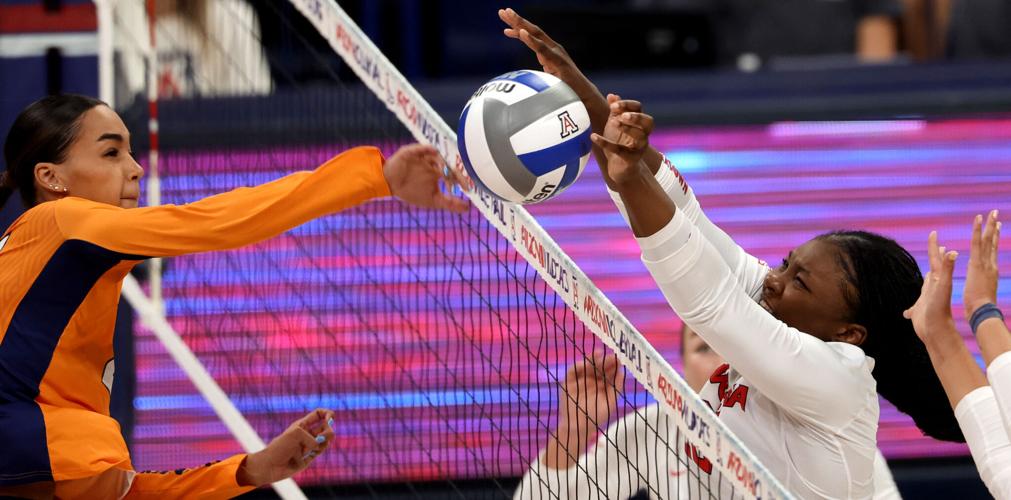
Arizona middle blocker Journey Tucker gets the shot off between UTEP outside hitter Landry Braziel, left, and middle blocker Kaya Weaver, right, Sept. 16, 2025, at McKale Center.
Journey’s older sister Aleya had a pilocytic astrocytoma. She died in January 2014 after suffering a brain aneurysm. She was 13 years old.
It was thought to have been an isolated event. When doctors found the same type of tumor latched to Journey’s brain, questions arose.
“When it happened to me, that's when my mom took me to do genetic testing,” she said. “They didn't find any correlation.”
It was an unfathomably cruel coincidence. But thanks to earlier intervention — which might not have happened if she hadn’t fallen asleep on that plane — Journey had a chance.
That public nap just might have saved her life. It turned out that Journey had in fact suffered seizures before. But she’d always been asleep.
“One night I remember hearing her bed shaking, and I didn't know what it was,” Crudder said. “I thought maybe she was just tossing and turning. Then come to find out later that she had been having seizures, and she only would have these seizures when she was sleeping.
“Hindsight is 20/20. When I started looking back at certain things ... one night she woke up and her tongue was bleeding, and she didn't know why. It was because she had bit her tongue in her sleep.”
Aleya had different symptoms, including “extreme behavioral changes,” her mother said. Journey was a thriving student-athlete whose future suddenly was in doubt.
Building confidence
In March 2022, Journey had successful surgery — a minimally invasive procedure called a laser ablation. Less than six months later, she was back on the court. No more seizures. No more splitting headaches.

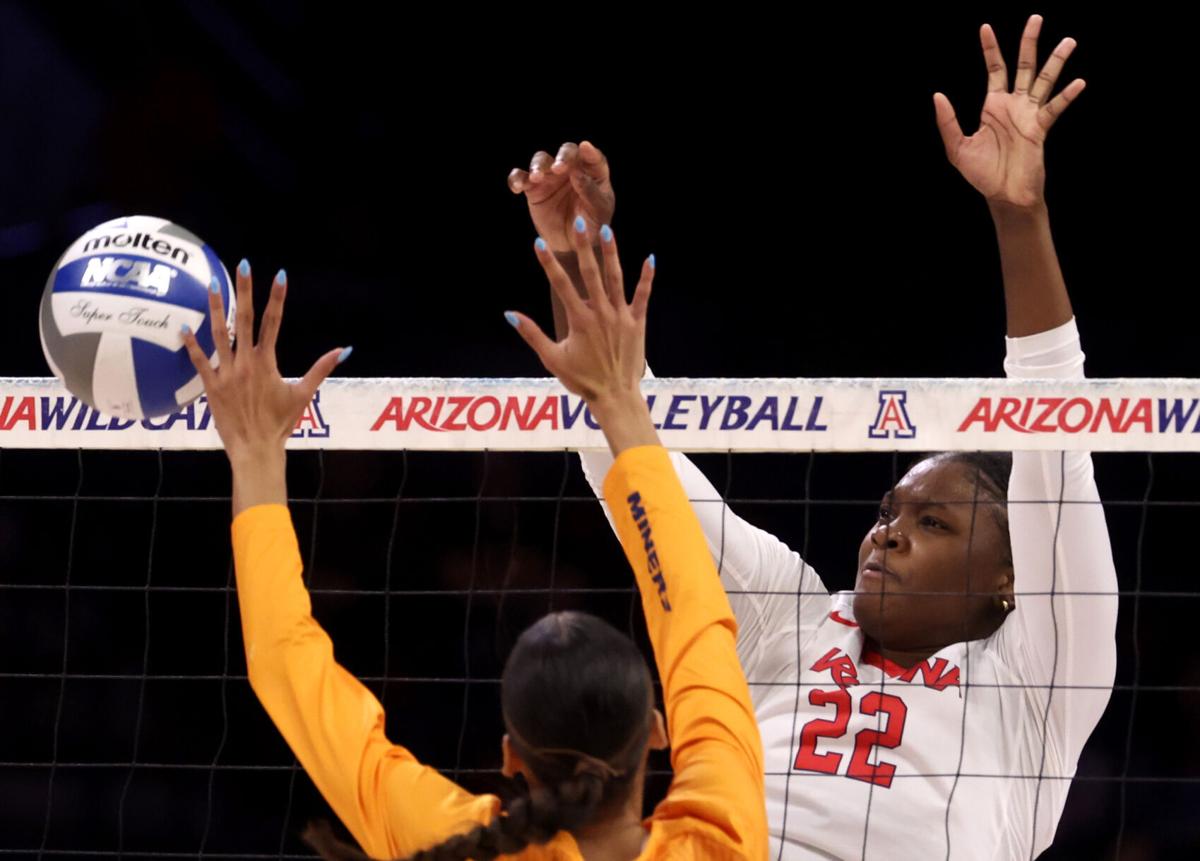
Arizona middle blocker Journey Tucker (22) gets the block on a spike from UTEP middle blocker Kaya Weaver (25) in the second game of their match, Sept. 16, 2025, at McKale Center.
Journey considered herself blessed. Blessed to have recovered. Blessed to have had widespread community support, including a meal train and a GoFundMe that raised nearly $20,000 to pay for medical bills and other expenses.
“If we didn't have that support,” Journey said, “we wouldn't know where we would be.”
Still, the early part of 2022 was difficult for Journey and her mother. Crudder missed so much work caring for her daughter that she lost her job as a behavioral-health nurse.
Journey was determined to land an athletic scholarship and get a degree so that her mother wouldn’t have to worry about taking care of her in the future.
“She's my No. 1 supporter,” Journey said. “She's my favorite person in the world. I just want to do the best that I can for her.”
Journey was a latecomer to volleyball; she didn’t start playing seriously until her freshman year of high school. She had signed up to play basketball, a winter sport, and was looking for something to do during the fall. She was leaning toward badminton, but the Verrado volleyball coaches saw how tall she was and convinced her otherwise.
With relatively limited exposure on the club circuit, Journey viewed her junior year as “crucial” when it came to finding her future school. Then half the year got wiped out. Journey had to focus on her recovery.
Arizona entered the picture during the following club season, when Journey was a senior. Then-UA coach Dave Rubio saw her play. Then-assistant coach Charita Stubbs offered Journey a scholarship. She accepted that same night.

Arizona middle blocker Journey Tucker pushes an attack over Northern Colorado setter Syd Cole at the net in their semifinal match of the NIVC, Dec. 12, 2024, at McKale Center.
“I’m very thankful that Coach Rubio and Rita decided to take a chance on me,” she said, “because they didn't have to.”
Journey lacked confidence when she arrived in Tucson.
“When she first came, she didn't believe she was good enough or that she necessarily belonged because she didn't have the pedigree that the other players had,” Stubbs said. “I kept telling everyone ... once Journey believes in herself and she realizes she can do it and that she belongs — which didn't take very long, by the way — she's gonna get you guys.”
Journey didn’t play much as a freshman, but she steadily improved. As a sophomore, she had a team-high 96 blocks. She ranked second on the team as a junior with 69 after missing the first two weeks of the season because of injury.
Stubbs expects Journey to expand her game as a senior, to become as much of an offensive attacker as she is a defensive fortress. “To be the best version of her as possible,” Stubbs said.
That prospect was uncertain just a few years ago. But Journey lived to achieve her goals and tell her story.
She isn’t the type to draw attention to herself for her achievements or what she’s overcome.
“She doesn't want people to feel sorry for her,” her mother said. “But I encourage her to share her story because she might help somebody else.”
Everyone’s journey is unique. But if someone out there is experiencing symptoms they can’t explain and seeks help after reading this, Journey’s willingness to share will have been well worth it.
Contact sports reporter/columnist Michael Lev at mlev@tucson.com. On X (Twitter): @michaeljlev. On Bluesky: @michaeljlev.bsky.social

Michael Lev
Sports Reporter/Columnist


 The Mount Rushmore of Arizona Wildcats baseball players