

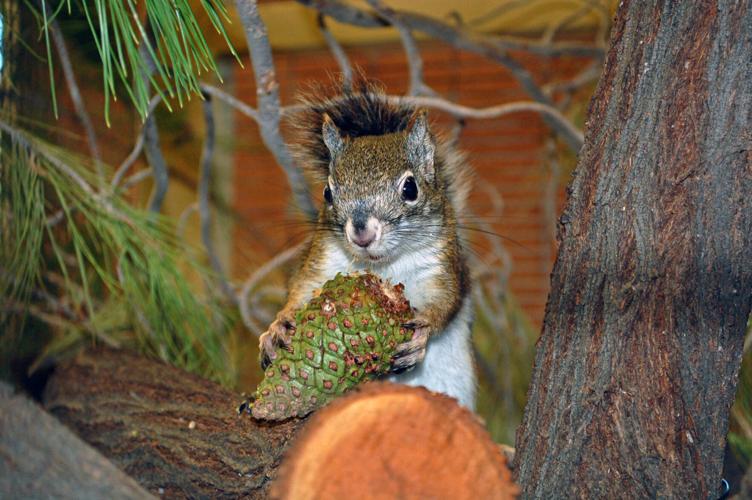
It could take a century and cost more than $24.5 million to save the Mount Graham red squirrel, according to a revised recovery plan for the endangered Southern Arizona rodent.
To get the squirrel off of the endangered species list will require improving and expanding its high-elevation forest habitat and establishing a captive breeding program, among other actions.
The draft plan just released by the U.S. Fish and Wildlife Service estimates it will take “at least 60 to 100 years” to plant, regrow and manage the proper mix of trees needed to support a viable population in the only place on Earth where the animals are found.
People are also reading…
“Mount Graham red squirrels can respond quickly to changes in food availability and can exploit pulses in food resources, resulting in population-level responses to boomer (high-yield) cone crop years,” write the multi-agency authors of the plan. “Therefore, we estimate time to recovery based on anticipated forest regrowth.”
The revised recovery plan also sets specific criteria to eventually downlist and then delist the rare subspecies of red squirrel.
Downlisting it from endangered to threatened would require a dispersed population of at least 400 squirrels over a 9-year period, with habitat conditions that provide sufficient connectivity and protection from high-intensity forest fires.
The squirrel could be removed from the federal list altogether with a growing and self-sustaining population of at least 600 over 9 years and “a mosaic of heterogenous forest habitat” that gives the species a 90% chance of survival.
The Mount Graham red squirrel weighs just half a pound and measures about 14 inches in length, including its long fluffy tail. It was thought to be extinct in the 1950s, but the animal was found again in small numbers in the 1970s. It was listed as endangered in 1987 with an estimated population of less than 400.
Its numbers peaked at about 550 in the late 1990s, then plummeted to just 35 after the lightning-sparked Frye Fire in 2017 burned through 48,000 acres of the Pinaleño Mountains, 150 miles east of Tucson.
The population has since rebounded to 232, according to the latest estimate by the Fish and Wildlife Service, the Coronado National Forest and the Arizona Game and Fish Department.
The squirrels depend on a habitat of mixed conifer and spruce-fir forest, where large, cone-bearing trees provide food and nesting sites but can take 40 years or more to reach productive age.
Threats to its survival include habitat loss and fragmentation from wildfires, insect outbreaks and other impacts of climate change, human development, predation and competition from non-native Abert’s squirrels.
The Tucson-based environmental group Center for Biological Diversity has called the squirrel "the most endangered terrestrial animal in the United States," after a significant portion of its critical habitat burned or was disturbed for the construction of three research telescopes atop Mount Graham.
The only place in the world where the squirrels are kept in captivity is the Arizona Center for Nature Conservation — better known as the Phoenix Zoo — which has been caring for and studying a handful of the animals since 2014.
So far, the zoo’s pilot breeding program has not produced any offspring, but it has provided a wealth of previously undocumented insights about the subspecies and dispelled a few myths about violent territorial fights and the females only being open to breeding one day a year.
The zoo currently has four adult Mount Graham red squirrels, two males and two females.
“We’re in the middle of the squirrels’ breeding season and are seeing positive indicators of reproductive readiness, but (we) won’t know for some time whether there has been any successful breeding,” said Tara Harris, director of conservation and science for the Phoenix Zoo, in an email on Friday.
This marks the second revision of the recovery strategy for the Mount Graham red squirrel since the original plan was adopted in 1993. It was last revised in 2011.
The Fish and Wildlife Service described the plan as a road map for recovery work and cooperation, not a regulatory document that requires specific actions under the Endangered Species Act.
The agency will accept public input on the draft revision through July 2.
The document can be reviewed or downloaded for free by going to Fish and Wildlife’s ECOSphere Environmental Conservation Online System at ecos.fws.gov/ecp/ and searching for “Mount Graham red squirrel.”
Comments on the plan can be emailed to incomingAZcorr@fws.gov or sent by mail to the Arizona Ecological Services Field Office, 9828 North 31st Avenue, Suite C3, Phoenix, AZ 85051.



 Rescue plan in works for tiny endangered turtle in path of second Arizona border wall