PHOENIX — With no head-to-head gubernatorial debate happening, Gov. Katie Hobbs and US Rep. Andy Biggs used the opening of a trade office to trade political barbs.
Biggs, the Republican candidate for governor, told an audience of dignitaries from Taiwan, Taiwanese nationals, immigrants living in Arizona, and business leaders who have been boosting trade with Taiwan that Arizona has become the leader in semiconductor manufacturing.
"We couldn't do it without our partnership with the great nation of Taiwan,'' he said.
"And I do say 'nation of Taiwan'. And that's how I recognize it,'' Biggs said to cheers from the crowd at Monday's opening of the Taipai Economic and Cultural Office in Phoenix.
People are also reading…

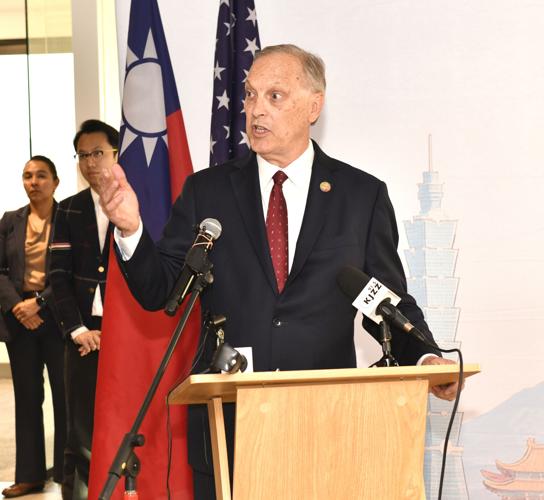
U.S. Rep. and GOP gubernatorial candidate Andy Biggs speaks Monday at the opening of a Taiwan trade office in Phoenix.
Hobbs, who had already made her presentation Monday by the time Biggs gave his remarks, sidestepped questions afterward about what she believes is the legal status of the island.
"I will continue to support our relationship with Taiwan and continue to grow the economic partnership that we have that has been instrumental to Arizona's success,'' the Democratic governor said.
She said the work being done in Arizona by TSMC — Taiwan Semiconductor Manufacturing Co. — is "incredibly important to our national security.''

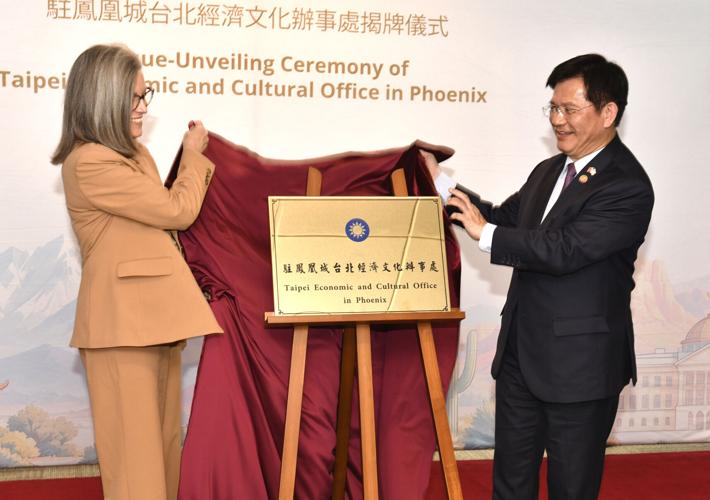
Gov. Katie Hobbs and Lin Chia-lung, Taiwan foreign affairs minister, unveil a plaque Monday announcing Taiwan's first trade office in Arizona.
Sparring about roles
Hobbs then turned the tables on Biggs, who had talked extensively during his presentation about the economic ties between Arizona and Taiwan "and the coming of TSMC.'' He also credited the Trump administration, which he said "facilitated and encouraged that kind of foreign investment.''
Hobbs chided Biggs for taking some credit for TSMC opening a fabrication plant in Arizona.
She pointed out that, as a member of Congress, Biggs did not support the 2022 CHIPS and Science Act, which allocated about $280 billion to boost domestic research and manufacturing of semiconductors in this country. TSMC benefited from that act with $6.6 billion in direct funding and another $5 billion in low-cost financing.
Biggs has never denied being one of the 187 House members who voted against the 2022 law. He wasn't alone: Most Republicans also were opposed, though enough crossed party lines to provide the margin of victory.
In a written statement after Monday's event, Biggs questioned whether the law was necessary to attract semiconductor manufacturers to Arizona.
"I worked with Govs. Brewer and Ducey to help create an attractive business environment for TSMC to come to our state long before federal legislation came along,'' he said. Brewer led a business delegation to Taiwan in 2013 along with Sandra Watson — then, and now, chief executive of the Arizona Commerce Authority — to promote Arizona as a site for expansion.
And TSMC announced a $12 billion investment in Phoenix in 2020, before the CHIPS Act.
In his Monday statement, Biggs said the 2020 law had "far too much waste for any fiscal conservative to vote for.''
Hobbs said it's not just about landing TSMC.
"Our relationship with Taiwan is not about one company,'' she said. "It's about decades of mutual partnership.''
Hobbs also said that relationship goes beyond semiconductors.
"We talk about bioscience, we talk about aerospace and defense,'' she said. "And this (trade) center right here is going to help Taiwanese companies that come to do business in Arizona have a place to go and get their questions answered.''
Arizona opened a trade office in Taiwan in 2023, with Hobbs leading a trade delegation there in 2023 and meeting with its then-president Tsai Ing-wen. Another trip in 2025 resulted in another meeting between Hobbs and Lai Ching-te, who remains Taiwan's president.
The result is that Taiwan is the state's No. 2 trading partner, with the most recent numbers showing $16.7 billion in imports and $4.5 billion in exports. Only Mexico does more business with the state.
China response to trade office
But the ties — which go back long before Hobbs was governor — have provoked a diplomatic response from the People's Republic of China, which continues to insist that Taiwan is simply a break-away province.
A July letter to Hobbs from the Chinese consulate in Los Angeles, obtained by KJZZ Radio, said the consulate had "serious concern'' about the announcement by Taiwan officials about "the upcoming opening of its so-called 'representative office' in Phoenix.''
"China firmly opposes any attempt to advocate 'Taiwan independence' and challenge the one-China Principle,'' the letter went on. "We request the State of Arizona to refuse such an attempt by the Taiwan authorities and stop any gimmicks to harm the friendship and cooperation between China and the State of Arizona.''
Gubernatorial press aide Christian Slater said Hobbs has "no second thoughts'' about going ahead with the trade office.
"The governor will continue pursuing the mutually beneficial relationship with Taiwan and will not be deterred by the letters,'' he said.
Biggs, for his part, pointed out Monday he is a member of what has become known as the "House Taiwan Caucus.'' It consists of 130 members, also including fellow Arizona Republicans David Schweikert and Paul Gosar, as well as Arizona Democratic Rep. Greg Stanton.
"We have a firm commitment in the United States Congress that Taiwan should have our support and our friendship,'' Biggs said.
Its goals, however, as stated by members, stop short of calling for the US to recognize Taiwan as a separate nation. Instead, the focus — at least as far as the island's future — centers on issues like ensuring there are arms sales to Taiwan to enable the government there to defend itself.
Hobbs won't debate on stage
Monday's joint appearance by Hobbs and Biggs will have to do for Arizonans who want a debate between the two main contenders for governor, because Hobbs refuses to debate. Instead, she said she has gone out to talk directly with Arizonans, though most of these events have been campaign gatherings with supporters.
"I believe face-to-face interactions are more effective than a stage that is designed for nothing but political soundbites and theater,'' Hobbs said.
It's not a new position: the last time Hobbs faced an opponent in a debate was in 2018, when, as a state senator, she was running to be elected secretary of state and faced off against Republican Steve Gaynor.
In her 2022 gubernatorial run, she would not debate former Nogales Marco Lopez in the Democratic primary nor Kari Lake, her Republican foe in the general election.
Thorny international question
Hobbs wouldn't be the first to refuse to take a firm stand on whether Taiwan is independent from China.
US administrations for decades have tried to juggle the thorny political question of how to deal with the political reality that the Communist Party took over mainland China in 1949, sending Chiang Kai-shek and his supporters fleeing to the island.
There was a slow but increasing recognition that ignoring China was not an option, with Republican President Richard Nixon — someone known for his anti-Communist rhetoric — traveling there in 1972. The US formally recognized the government in Beijing in 1978, with Congress passing a separate act to maintain unofficial cultural, commercial and defense relations with Taiwan.
In his summit with Chinese President Xi Jinping last month, President Donald Trump did nothing to back away from that position. But there has been concern that Trump, interested in making deals with Xi, might not be willing to send US troops to defend Taiwan. That follows a claim by David Perdue, the US ambassador to China, that Trump asked Xi if he wanted to buy American weapons. The White House later denied that claim.
Howard Fischer is a veteran journalist who has been reporting since 1970 and covering state politics and the Legislature since 1982. Follow him on X, Bluesky and Threads at @azcapmedia or email azcapmedia@gmail.com.