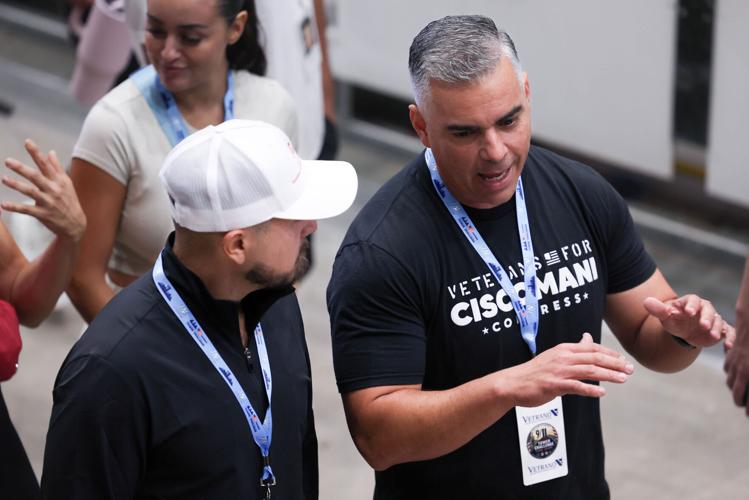
On the 25th anniversary of the Sept. 11, 2001 terrorist attacks, two-term Republican Juan Ciscomani and his team spent the morning climbing the commemorative 110 flights of stairs at the Tucson Convention Center, wearing red shirts with “Team Ciscomani” emblazoned on the back.
In the midst of a competitive House race, he agreed to a “walk and talk” interview with the Star as he climbed, joking that his answers might get harder to understand as the number of flights of stairs increased. He said he attends the climb every year to honor first responders, and made the trek back down to Tucson from Scottsdale the previous evening, where he participated in the one and only debate with his Democratic challenger JoAnna Mendoza.
In a few short weeks, voters in Arizona’s Sixth Congressional District will make a choice between Ciscomani and Mendoza in one of the closest-watched races in the country, identified by national Democrats nearly two years ago as a seat that could potentially flip control of the House of Representatives in their favor. CD6 leans slightly Republican, but is roughly split into thirds between registered Democrats, Republicans, and Independents, according to data from the Secretary of State’s Office.
People are also reading…

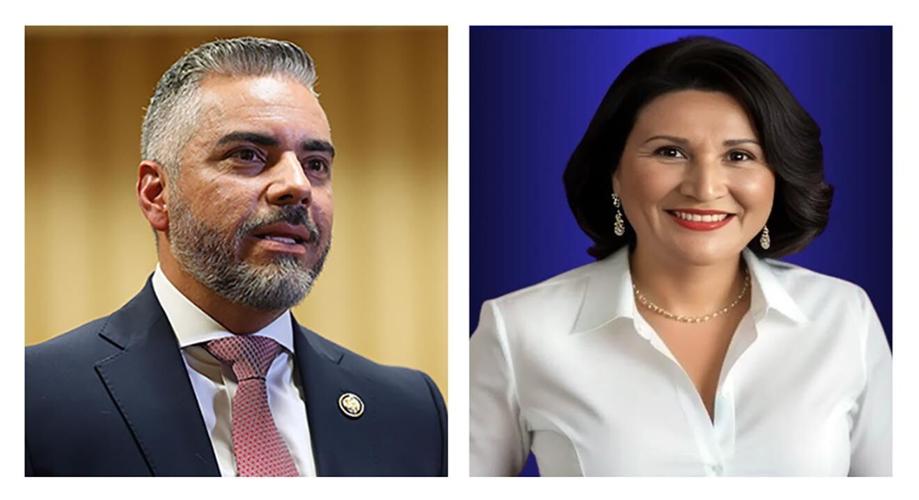
Incumbent Rep. Juan Ciscomani faces Democratic challenger JoAnna Mendoza in November.
Like many races across the country in this midterm cycle, the candidates represent either an endorsement or a rejection of the Trump Administration’s status quo laid out in the One Big Beautiful Bill Act passed last summer. Ciscomani has consistently highlighted his support of OBBBA in is campaign. His support has become the main criticism by Mendoza.
If voters don’t know they are in a competitive swing district, they have surely noticed the dozens of TV ads from both sides. According to Federal Election Commission data, their combined fundraising total tops $13.5 million. Mendoza has raised about $1.2 million more than Ciscomani as of the last filing period. In early October, Mendoza’s campaign said she had raised a record $3.3 million between July and the end of September, but official FEC reports have not yet been released.

Republican Rep. Juan Ciscomani participated in the 9/11 Tower Challenge at Tucson Convention Center. The incumbent congressman facing a challenge from Democrat JoAnna Mendoza says the U.S. is on the right track when it comes to improving the economy, a major issue among voters.
Immigrant spirit and resiliency
A car ride and a suit change later, Ciscomani attended a naturalization ceremony, where he spoke to 30 people who had just taken their oath of citizenship.
In a courtroom packed with families and several babbling babies, he told the rows of new citizens he understood what they had all been through to get there. Sept. 18 would be the 20th anniversary of the day he became a citizen himself, he said.
“It's not easy… It took my family over 13 years to be able to earn it,” he said.
He makes it a point to attend as many ceremonies as he can, Ciscomani said, because they remind him of his father, a bus driver from Mexico who taught him the immigrant spirit means being resilient.
“No matter how terrible things get, I’m glad I’m here,” he said, speaking of the country in general in the lobby of the federal courthouse building in downtown Tucson.
A long military career
The Star spoke to Mendoza over Zoom, as a late-campaign hurdle in the form of a COVID-19 infection caused her to cancel a few days of canvassing with her team.
She grew up in a farming family in Eloy, roughly halfway between Phoenix and Tucson. In the summers, she worked in the fields with her parents starting when she was 10 years old. Her favorite part of Eloy is the small-town character and the Super Fries from Nico’s Mexican Food, she said.
“Everybody knows everybody,” she said. “I think it keeps me grounded and it keeps me humble.”

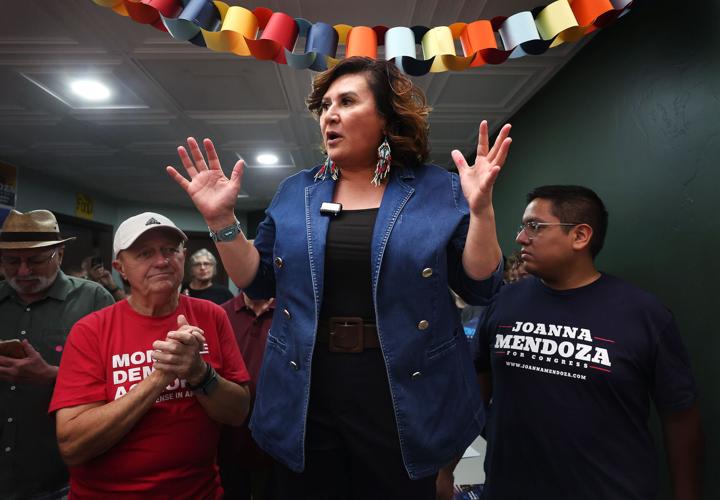
Democratic candidate JoAnna Mendoza makes a speech last month during the opening of her field office on East Grant Road. Mendoza often cites incumbent Republican Juan Ciscomani's support of President Trump and the One Big Beautiful Bill Act.
Mendoza’s speeches and anecdotes are full of military-isms gathered from a 20-year military career central to her candidate identity. She enlisted in the Navy at 17 and later joined the Marine Corps, working her way up the ranks to eventually become a drill instructor.
“I know what you're thinking. She was a Marine Corps drill instructor? Yes, I was. Not as lean, not as mean, but still a Marine,” she told a crowd at a September rally.
She told the Star that campaigning as a single mom has forced her to “embrace the suck.”
“There were times where my son was strapped to my leg, you know, as I’m giving a stump speech . . . but I really do think that this is an experience that will benefit him for his entire life because I think he’ll understand how important it is to fight for our democracy and be civically involved,” Mendoza said.
Affordability
About 84% of registered voters surveyed by PEW Research Center said the economy is very important to their midterm vote, according to an Oct. 8 report.
During a speed round on the debate stage, Ciscomani said affordability is the one issue he would work across the aisle with Democrats to solve.
But the country is on the right track, Ciscomani said, claiming Trump’s tax cuts are helping people keep more of their money, and the reason prices haven’t dropped quickly is that the country inherited record inflation from the Biden Administration, he said, echoing a similar claim frequently repeated by President Trump.
“Not taxing people on overtime, not taxing people on their social security, extending the child tax credit, these are all things that put more money in people’s pockets instead of the government spending more,” Ciscomani told the Star.
Mendoza said she also supports these economic policies.
Although inflation peaked at the highest level since the 1980s under Biden, the rate of inflation Trump inherited was about 3%, far from record levels, according to a fact-check of a recent interview Trump gave to TIME Magazine.
An analysis of the combined effects of Trump’s tax policies, price increases, and the loss of expanded health insurance tax credits found every income group is paying more in taxes and consumer costs except the richest 1%. The poorest 20% face the largest increase relative to their income, equivalent to 5.7% of income, according to the Institute on Taxation and Economic Policy.
On the other side, Mendoza called for reversing what Ciscomani has applauded about the One Big Beautiful Bill; revoking tariffs, reversing tax cuts on the wealthy, and reinstating social welfare programs that have taken a big hit.
“We reinstate programs like SNAP, programs that I used as a young child growing up,” she said.
SNAP and Healthcare
As the OBBBA was being hammered out in the spring of 2025, Ciscomani and 12 other Republicans wrote a letter to House Speaker Mike Johnson saying they supported healthcare reforms, but would not support a bill that included any reduction in Medicaid coverage for vulnerable populations. He ultimately voted for it, despite his initial hesitation.
Over a year later, Arizona is preparing for huge changes to the Arizona Healthcare Cost Containment System, or AHCCCS, with new work requirements and eligibility checks going into effect Jan. 1. More than 400,000 AHCCCS members could be impacted, the Arizona Republic reported.
Nearly half of Arizona's SNAP participants lost access to benefits over the past year, the steepest decline in the country, according to Reuters.
Ciscomani has defended the new requirements, saying the OBBBA vote has protected Medicaid and SNAP benefits for those who most need them while preventing abuse.
“If people that are not supposed to be getting those benefits are getting them, that is what threatens the social safety net,” he said. “We're a generous, benevolent country. We want to make sure that we have that safety net for people to get it on on their toughest days.”
If Arizonans who should still be eligible for food assistance have lost benefits, as the New York Times reported in July, Ciscomani said they should call his office.
“That’s wrong, that should not have happened. They should call our office, and we can definitely help them with it,” he said.
At an August appearance for the Cancer Action Network, Mendoza said she supports expanding Medicaid access. Voters have told her they want the “dignity” of work, but opportunities for jobs in rural communities are limited.
“People need to be healthy so they can work. If they can’t work, they can’t pay bills, and if they can’t pay bills, then they end up homeless. It’s all linked together,” she said.
Town Halls
Ciscomani faces frequent criticism for inaccessibility, especially from groups of protestors that have frequented his district office on North Swan Road since the beginning of the second Trump administration. He repeated what he had said on the debate stage the night before: that he is constantly accessible during community events and through his time coaching his middle-school-aged kids’ football teams.
“Right now, you see this? Anybody can come up to me and talk to me,” he told the Star at the 9/11 climb.
Ciscomani said coaching on a congressional schedule means blocking off an hour and a half three times a week for practice.
“It’s the only time of day that I actually turn my phone off, put it in my bag,” he said.
If Mendoza wins, she plans to bring back her own version of former Congresswoman Gabby Giffords’ Congress on Your Corner events, and implement mobile office hours. She also wants to open a congressional district office in her hometown of Eloy.
“We need to modernize a way for people to contact their government,” she said.

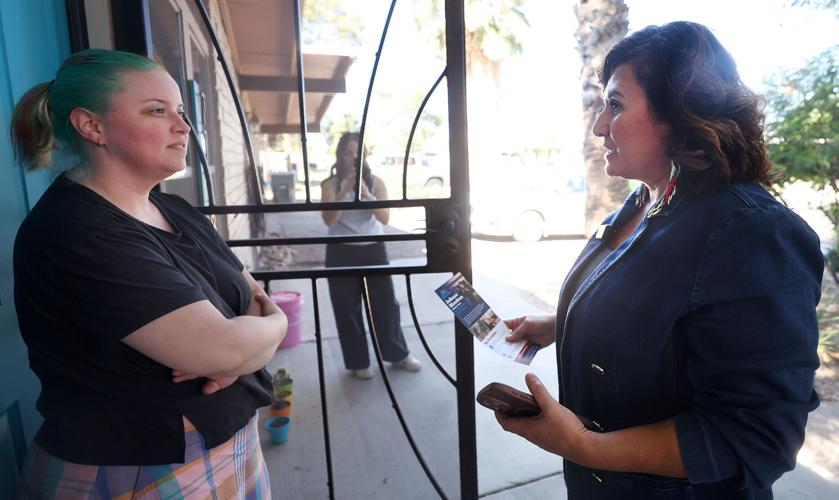
Democratic candidate JoAnna Mendoza, right, talks with Courtney Hart while campaigning door-to-door last month in a midtown Tucson neighborhood.
Immigration
The Star spoke to Mendoza the day after the Arizona Republic published an article about social media posts Mendoza made in 2020, during her first campaign for an Arizona Senate seat.
Mendoza’s since-deleted tweets show what the article characterized as peak “pandemic-era progressivism,” including support for police reform and pro-LGBTQ+ issues, and acknowledging systemic racism.
Her support for police reform has not extended as far as defunding the police, even since a 2020 candidate forum cited in the Republic article. Still, Ciscomani’s attacks have focused on painting her past comments about limiting police budgets as too extreme, especially on immigration and safety.
In comparing Mendoza to neighboring Congressional District 7, where the Democrat incumbent Adelita Grijalva supports abolishing Immigration and Customs Enforcement, Mendoza does not.
“There are some areas where a wall makes sense,” she said of the southern border wall in the CD6 debate, but opposed its encroachment into tribal territories.
She also defended her support for border patrol.
“For him to say that I don't care about border security or national security is just very dishonest,” she said of Ciscomani’s attack in the debate.

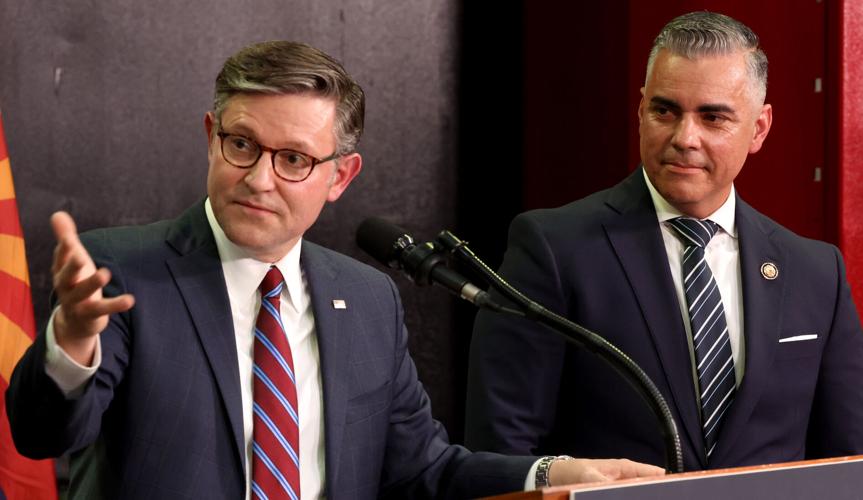
Speaker Of the House Mike Johnson, left, made a campaign stop for Rep. Juan Ciscomani in August at the PepsiCo Frito-Lay facility in Casa Grande.
On the other side, Ciscomani applauded Trump’s immigration enforcement policies for bringing southern border crossings to historic lows.
“We need to codify a lot of this into law to prevent another Joe Biden coming into office,” he said at the Sept. 10 debate.
Mendoza called the Republic article a “smear campaign.”
“All of these laundry lists of things that should be talked about, and instead they’re talking about something that is very common practice,” she said.
Mendoza doesn’t dispute the characterization as a moderate Democrat, but said she doesn’t like labels in general.
“Our government, I consider it to be like a living ecosystem, and it's out of whack right now because if you're too far to the right, you're too far to the left, nothing can get done. I do believe that having conversations with people who you may not agree with to try to find some common ground,” she said. “Whether or not that paints me as a moderate, well, so be it.”
The Republic article says many candidates clean up their online presence as their audiences change. Mendoza’s situation is reminiscent of a national conversation among progressives, perhaps epitomized by the term “Woke 1,” an internet term referring to 2020’s signature flavor of progressive policies and societal discussions. Many Democrats in this year’s election are trying to figure out how to walk back or reframe ideas for a more 2026 audience.
When asked about how the Democrats have changed since 2020, she said her own party had a tendency to use complex terms that turn people away from politics.
“We should be making it easier for people to understand how the policies Washington is passing are impacting our everyday lives,” she said. “Frankly, I have no time for some of the culture war stuff that both sides are engaging in. It’s about lowering costs, it’s about making sure communities are safe,” she said.
Hannah Cree covers local government for the Star. Reach her at hcree@tucson.com

Hannah Cree
Government Reporter