Cesar Salazar will be a coach someday. Whenever that time comes, he will be a positive addition to whatever organization he joins.
But first things first: Salazar is still playing baseball. He believes he has a lot of quality ball left in him.
His next opportunity will come Friday in a familiar place. Salazar will be suiting up for Naranjeros de Hermosillo in the inaugural “Sonoran Series” exhibition game against the University of Arizona at Hi Corbett Field.
The two teams faced each other last week in the Mexican Baseball Fiesta. Salazar hadn’t rejoined Hermosillo, his hometown team, at that point. He’s back now — and ready to serve in whatever capacity he can.
“If you're helping others, you have a purpose,” said Salazar, who played for Arizona from 2016-18. “You have a purpose bigger than yourself. That's what makes me happy, man. Whether I'm serving your readers, my teammates, my family, my friends, that's what fulfills me.”
People are also reading…

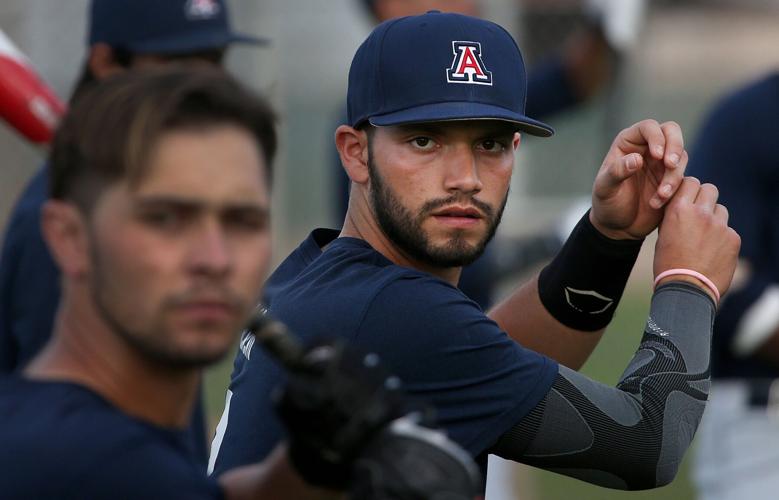
Catcher Cesar Salazar doesn't need an actual bat to picture a pitch during Arizona Wildcats baseball practice at Hi Corbett Field on Feb. 13, 2018, in Tucson.
Salazar always was wise beyond his years; he served as the primary catcher as a freshman for a team that finished as the national runner-up.
Now, at age 30, he has the benefit of experience. He’s been on a journey of self-discovery and self-improvement while navigating the ups and downs of professional baseball.
“If you see yourself as a failure or as somebody that succeeded, that's being outcome-based,” Salazar said. “It's a roller coaster of emotions.
“It's very hard for us to not identify ourselves as baseball (players). But we have to believe that we're playing for something bigger than that. That we are something more — we're a son, we're a boyfriend, we're a friend.”

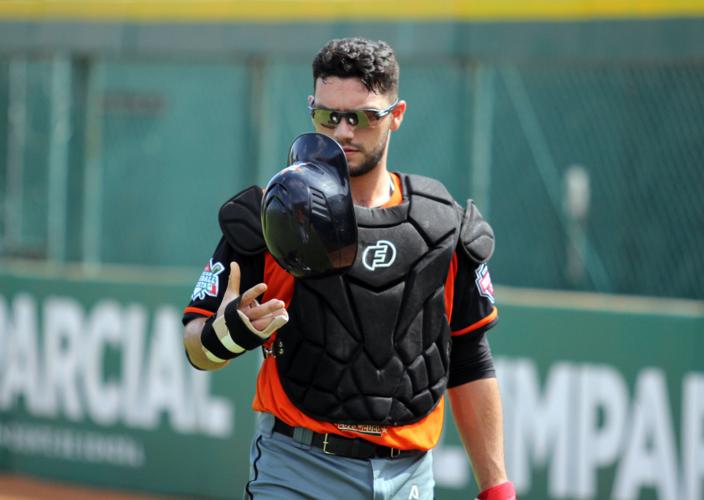
Catcher Cesar Salazar tosses his helmet while suited up for Naranjeros de Hermosillo.
“Baseball is not everything in life,” added Salazar, who’s pursuing his UA degree through the CATS Forever program. “But we sure sometimes make it more than life.”
Salazar put undue pressure on himself in his pursuit of a spot in the major leagues — and even after he got there.
The Houston Astros’ seventh-round pick in the 2018 MLB Draft after his junior year at the UA, Salazar made it to the majors in ’23. He bounced between the big-league club and the triple-A Sugar Land Space Cowboys over the next four seasons. He’s set to become a free agent this fall amid a time of uncertainty for MLB with a potential lockout looming.
Salazar began working with a sports psychologist, and that helped him deal with the roller-coaster ride.
Salazar discussed that investment in himself, his impending free agency, his return to Hi Corbett Field, his disdain for Arizona State and other topics in a phone interview with the Star. The conversation has been lightly edited for clarity and brevity.
It’s hard to believe you’re 30 years old.
A: “Thirty years young. Basically, I feel better than when I was 25, 26 years old, so that's a positive.”
Why is that?
A: “I’ve just been taking better care of my body. Obviously there's a balance, right? I still enjoy myself. But I prioritize nutrition, sleep, recovery ... over other things.”

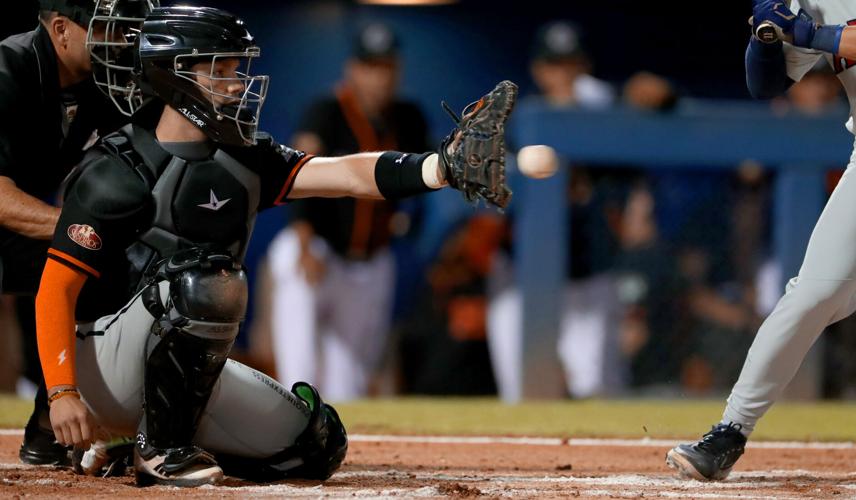
Former Arizona Wildcat Cesar Salazar gloves a strike as he faces his old Arizona team while suited up and behind the dish for the Naranjeros de Hermosillo professional baseball club on Oct. 6, 2022. Hermosillo took on the UA as part of the 2022 Mexican Baseball Fiesta at Kino Veterans Memorial Stadium.
You’re about to become a free agent. How does that make you feel?
A: “I would say a little nervous. I've never been a free agent before. Obviously, change is a little scary sometimes. But I think I’m ready for a new challenge. I think I put myself in a spot to get a contract and not be a free agent for a while.
“I still think I have a lot of good game left in my career. So I'm excited. Nervous, but excited.”
The last time we spoke, you hadn’t made it to the majors yet. Now you have. What was that experience like?
A: “I think my brain is wired to (where) I want even more, and that created a lot of stress, especially early in my big-league career. I wanted to play to earn playing time. And my attention wasn't the next pitch. I was thinking about the future too much. I put a lot of stress (on) myself, and I wasn't able to perform my first year.
“Second year, I took a different approach, which I've been taking since then: I'm just gonna play this pitch and whatever happens, happens. I put myself in the best spot for me to succeed, and I can live with the result.
“It's been hard. We as athletes, we want results. We're wired to be result-oriented, and, obviously, our jobs depend on that. But I think if we can take that pressure away from us, it makes it way easier for us to perform.”
How did you figure all that out?
A: “I got help with that. It's a great investment, seeking external help. ... It's different when you try to learn it by yourself than when you have somebody guiding you.”

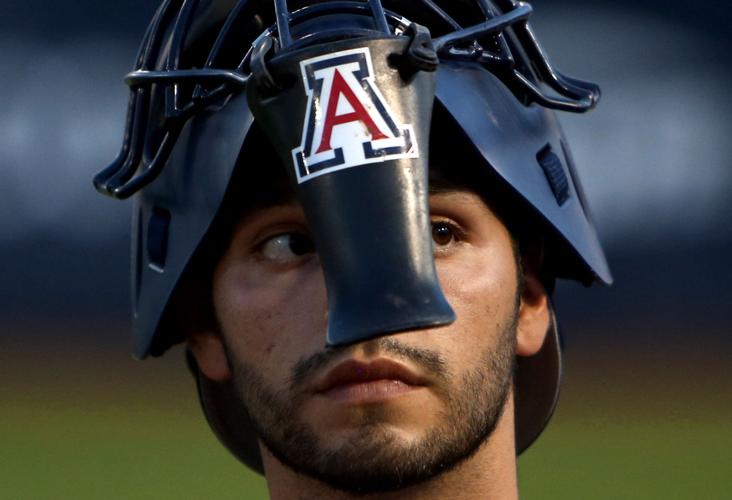
Arizona catcher Cesar Salazar (12) makes his way to the dugout after warming up starter JC Cloney (27) before the Wildcats face Washington at Hi Corbett Field, May 5, 2017, in Tucson.
So much of the game is mental.
A: “Correct. ... The people who are able to be present or get back to the present the quickest, those are the people that succeed more consistently.”
That sounds like something your former coach, Jay Johnson, would say. What do you think makes him an effective leader?
A: “He makes you believe you can beat anybody. He makes you believe in yourself better than anybody that I've ever been around, honestly. It's crazy.
“I saw a lot of people with bad mechanics. But because Johnson made them believe in themselves and their abilities, they were able to perform. Part of it is that they were very present and they were just focused on the pitch. A lot of people get too caught up on trying to be perfect physically, mechanically, and that gets them away from the present moment.”
When you reflect upon your time at the U of A, what comes to mind?
A: “First, the relationships that I've made. I made lifelong friends, lifelong good relationships. I was just with Jay at LSU, and we spent a lot of great, quality time.
“But going back to it, it was just a great teacher. Before, I used to look at my career starting with success because we made it to the World Series, but then I failed the next two years because we (didn’t). But I started to see things a little bit different once I got older.
“Now I try to look at things with no judgment. If I hit a double, I don't consider that I succeeded that at-bat. I got my pitch, and I executed. And if I strike out, I don't consider myself as a failure. I just see things how they are. Maybe I had an approach, and the pitcher took a different approach, but I put myself in a spot to execute.”

Arizona’s Cesar Salazar looks back to the bench after slashing a double in the second inning against Oklahoma State in their College World Series game at TD Ameritrade Park, June 24, 2016, in Omaha, Neb.
Even though you didn’t have the same kind of postseason success your final two seasons, you had a strong career and you impacted the program.
A: “I impacted the people around me, which is what fulfills me now. Obviously, being in the big leagues or getting a big hit, those things make me happy. But I think my purpose now, and I saw it with Coach Johnson this last week, my calling is to help other people, and it's gonna happen once my playing career is over.
“It's funny, because all the advice that I give to the people that seek my help, it's kind of like I'm telling that advice to myself. It just happens that I'm helping other people. So that makes me remember things that are important: ‘Next pitch, be present, control what you can control.’”
When was the last time you set foot in Hi Corbett Field?
A: “I honestly go there pretty regularly, especially during the offseason, because my hitting coach/mentor, Luis Venezuela, lives here in Tucson. Sometimes we use Hi Corbett, the batting cages.
“But I'm really excited to play at Hi Corbett again. The last memory I have of Hi Corbett Field is me crying at home plate because it was my last game.”
Besides that, are there any particular games or memories of Hi Corbett that put a smile on your face?
A: “I think maybe my freshman year. So, funny story. When I was growing up, I always wanted to go to ASU. When the recruiting time happened, ASU didn't show any love. It ended up working out.
“Then my freshman year, we played ASU (on a) Friday night. I remember the place was packed. I think that was the first very emotional game that I had. I honestly had really good games against ASU my whole career. I was playing with a chip on my shoulder.

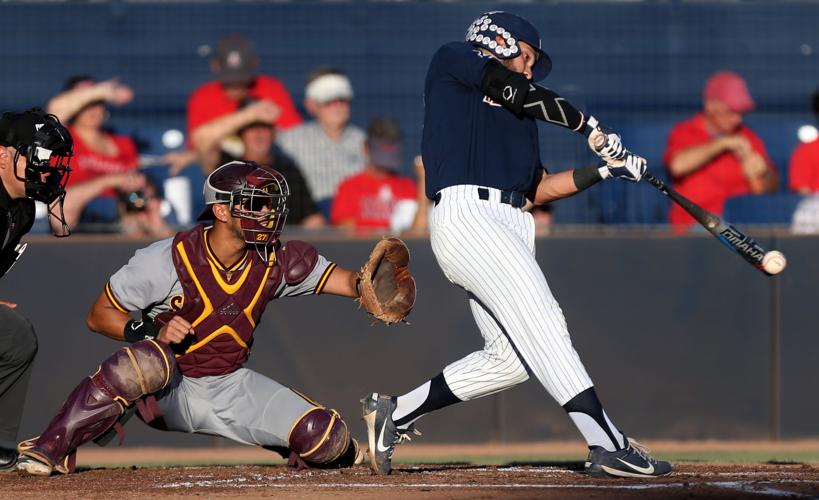
Arizona catcher Cesar Salazar barrels up a ball during the first inning against Arizona State on May 17, 2018, at Hi Corbett Field.
“I remember being at home plate, listening to the national anthem, seeing all the people in the stands, and I'm like, ‘Whoa, this is D1 baseball. This is the real deal.’ ”
You guys lost that series against ASU. And the next one at Oregon. But you won your last six games, including a sweep at Hawaii, and the rest was history.
A: “Hawaii was the turning point of our season. What's funny, and hopefully Jay doesn't read this, but in Hawaii, we were at the beach before going to the field. We were snorkeling; we were having fun.
“This is the mental game in a nutshell. ... We were not focusing on making it or not to the regionals. We were just having fun and enjoying being in Hawaii. And it just so happened that we went there and we took care of business. We played probably our best baseball, and that's the momentum that we needed to take us to the finals.”
Contact sports reporter/columnist Michael Lev at mlev@tucson.com. On X (Twitter): @michaeljlev. On Bluesky: @michaeljlev.bsky.social
Michael Lev
Sports Reporter/Columnist


 Cats Stats: Arizona’s Week 6 foe, West Virginia, is a classic RichRod production