After revamping her inherited roster, dealing with injuries to eight players, diving into the ACC and winning all of nine games in her first season at SMU in 2025-26, Adia Barnes had reason to be discouraged.
“It was one of the hardest years I’ve ever had in my career,” she said.
Still, Barnes was upbeat about the future, and her track record says why.
She already helped grow the Arizona women’s basketball program from nothing much into a national contender.
People are also reading…
Twice, in fact: As a player and as a coach.
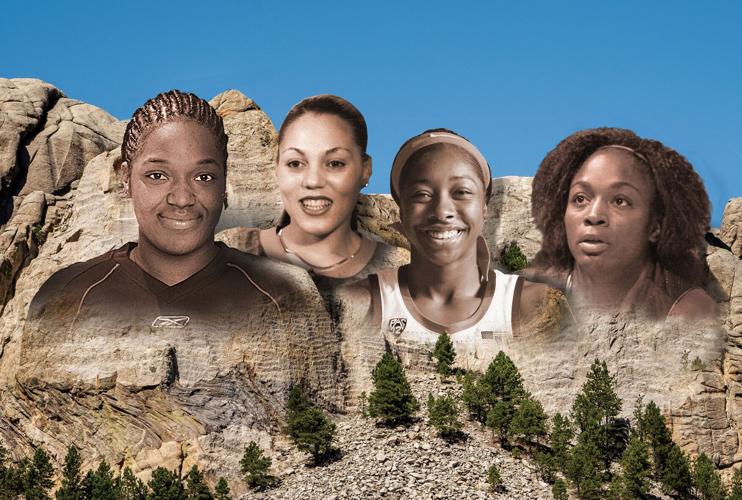
While also becoming an impactful coach at Arizona, leading the Wildcats into the 2021 NCAA title game, Barnes earned a place on the Arizona Daily Star's Mount Rushmore of UA women's basketball players because she played a starring role in the program's initial rise under coach Joan Bonvicini in the 1990s.
It was an ideal match from the start. Bonvicini won 82% of her games over 12 seasons at Long Beach State starting in 1979 and then, as high-major programs began pouring money into women’s basketball, struck out for Arizona in 1991.
Three years later, she pulled in a player she said was an “undersized post” who flew under the national recruiting radar yet had standout potential.
A San Diego resident who had seen what Bonvicini did up the coast at Long Beach State, Barnes jumped at the chance to join Bonvicini in Tucson.
“I did not have a lot of big offers,” Barnes said. “I was very undersized and under recruited, and I didn't play all the AAU and stuff. We just didn't really have a lot of that in San Diego. The other thing was that she really believed in me and thought I could be really good, so that also attracted me.”
They hit it off quickly. Barnes said she found out at one point that Bonvicini had the same birthday as her mother and that both women were Italian.
“There’s a lot of similarities in the way they approach things,” Barnes said.
It wasn’t long before Barnes grew into the player Bonvicini expected. Barnes averaged 15.5 points and 7.8 rebounds as a freshman in 1994-95, and most of her stats jumped in efficiency and output every season, no matter what defenses threw at her.
The Wildcats grew with her, winning the 1996 WNIT with a strong core of sophomores, then making their first-ever NCAA Tournament appearance during Barnes’ junior year of 1996-97.
UA then broke through to the Sweet 16 during Barnes’ senior year of 1997-98, when Barnes became the Pac-10’s Player of the Year and a third-team AP All-American.

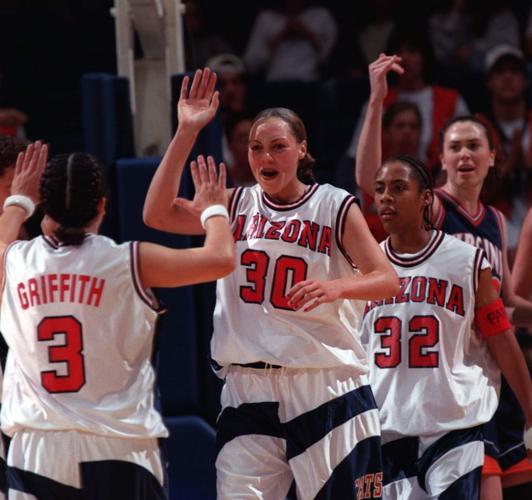
Adia Barnes (30) of the University of Arizona, who led all scorers with 30 points, is congratulated by Lisa Griffith (3) as DeAngela Minter (32) looks on in March 1998.
In all, with Barnes, the Wildcats made a leap from 11-19 in 1994-95 to a team that averaged 22.7 wins over the next three seasons. It helped that the build came in the 1990s and not the 2020s.
The core stuck around.
“We thought we'd be good,” Barnes said. “We had a really talented freshman class, and you weren't transferring. So we knew in a matter of time, we'd be good. We got our butts kicked the first year. (Bonvicini) had a really hard schedule. We were at Tennessee, and we ended up getting our butts kicked (109-57) and then it really paid off later.”
“But she was a good coach, she could recruit, and she took care of her players. So I didn't have a doubt that we'd be good. I didn't know how good, but to be in the Sweet 16, I always believed that we could be there.”
Barnes needed the same kind of faith when she returned to Arizona nearly two decades later.
A fourth-round WNBA pick by the Sacramento Monarchs in 1998, Barnes played 12 years in the WNBA and overseas, then was an assistant coach at Washington before then-Arizona AD Greg Byrne approached her about taking over the Wildcats as head coach in 2016.
The Bonvicini era had long run out of steam, ending with a 10-20 season in 2007-08, and successor Niya Butts posted losing records in seven of the eight seasons that followed. UA won just seven Pac-12 games over Butts' final three seasons, and there were questions about where the program was headed — and where another successor might wind up.
“We were rock bottom. All my mentors and all the important people in my life told me not to take the job,” Barnes said. "They said if I get fired, 'you won't get another job, because a lot of women don't get other opportunities.' They told me that it's hard to win there, that no one cares about women's basketball there, just a lot of stuff.”
Yet the Wildcats’ upward trajectory under Barnes the coach paralleled that of Barnes' playing days. The Wildcats won the 2019 WNIT, were a lock to make the 2020 NCAA Tournament at 24-7 before it was canceled over COVID concerns, then made it all the way to the NCAA championship game in 2020-21 before losing to Stanford by a point.

From left: Shawntinice Polk, Adia Barnes, Aari McDonald and Dee-Dee Wheeler.
Two of Arizona’s other four “Rushmore” picks followed Barnes in the Bonvicini era — Shawntinice Polk and Dee-Dee Wheeler — and Barnes also brought in the most-decorated player in the program’s history, guard Aari McDonald, the star of that 2021 tourney run.
“I went there, and kind of proved everybody wrong,” Barnes said. “I thought, why did I choose Arizona as a player? What attracted me? I thought as a coach, I could do that same stuff and attract people. It was really big to recruit in California, and I knew I could recruit. I knew we could coach, and I knew I loved Arizona.
“So I had passion to build it. I built my heart, my blood, sweat and tears. That's why it was so hard to leave.”
Now, Barnes is trying to rebuild another program as a coach. She said she arrived at both UA and SMU both with less than 300 season-ticket holders, but that she sees the potential to draw 5,000 at SMU — and to be able to draw financial resources from Dallas-area fans and alums in a supportive environment at SMU.
“It is totally collaborative, so I never felt down last season," Barnes said. "It was like, 'OK, we’ve got to build. We’re building this thing together.' It was just a different feel than I felt in a while.”
Here’s how Polk, Wheeler and McDonald followed Barnes as Arizona's most impactful players:
Shawntinice Polk
Years at Arizona: 2002-03 to 2004-05

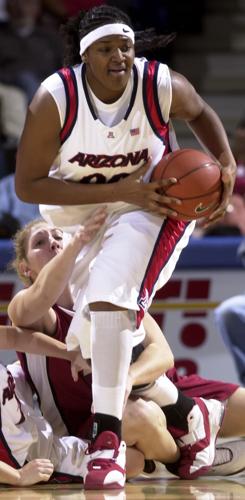
UA's Shawntinice Polk grabs the ball as Stanfords T'Nae Thiel tries to steal it from the ground during a game at McKale Center, Jan. 9, 2004, in Tucson.
What she did: After she made three All-Pac-10 teams over her first three seasons with the Wildcats, Polk was named a preseason Wooden All-American before the 2005-06 season. It would not have been a surprise if she won the Wooden Award, either.
But the well-liked, gregarious center known as “Polkey” never had the chance to earn it. She died of a blood clot on a shocking September 2005 morning, a loss that staggered the UA athletic community and arguably set the program back years, if not decades. Her death led to controversy over her treatment and dragged down the program after years of groundbreaking success under Bonvicini.
Even though she never had a chance to play that 2005-06 season, Polk still remains Arizona’s all-time leading shot-blocker (222) while she also ranks No. 8 in scoring (1,467) and fourth in rebounding (914).
Polk led UA in blocks all three seasons she played, and her 21 double-doubles in 2002-03 remain a program single-season record.
Dee-Dee Wheeler
Years at Arizona: 2001-02 to 2004-05
What she did: While Polk dominated inside, the Chicago-bred Wheeler was the engine of Bonvicini’s well-accomplished teams of the early 2000s. She was named the Pac-10’s Freshman of the Year in 2001-02, then made first team all-Pac-10 in each of the next three seasons, when the Wildcats won a cumulative 76 games and reached the NCAA Tournament every time.

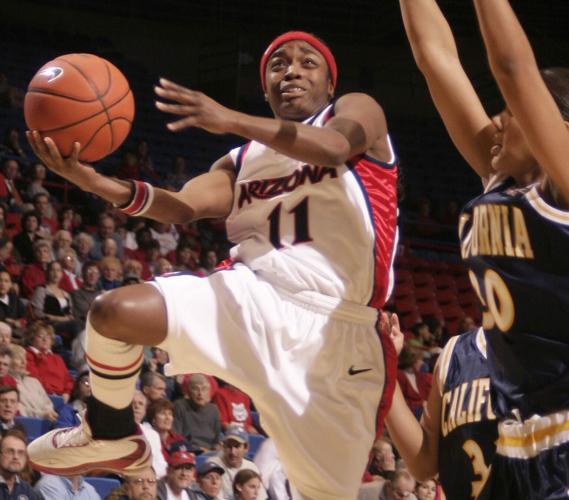
UA point guard Dee-Dee Wheeler prepares to finish a fast break with a basket against Cal in 2004.
UA’s all-time leader in steals with 304, Wheeler also ranks fourth on Arizona's all-time leading scorer list at 1,966, eighth in 3-point percentage (35.1) and fifth in assists (472).
A second-round WNBA pick of the Los Angeles Sparks in 2005, Wheeler played overseas before moving into youth sports mentoring. She worked in her hometown of Chicago, running a district-wide elementary sports program, before becoming TUSD’s Director of Interscholastics from June 2020 to April 2024 — and then moved back to Chicago again, where she is now the head girls basketball coach at Lincoln Park High School.
Aari McDonald
Years at UA: 2018-19 to 2020-21
What she did: A fearless, aggressive and athletic 5-6 guard who transferred from Washington as a sophomore in 2018, McDonald may be best known for willing the Wildcats to the 2021 title game.
McDonald led UA in scoring during all six of its 2021 NCAA Tournament games, including three straight games of 30-plus points, capped by a 36-point Final Four semifinal outburst against UConn.
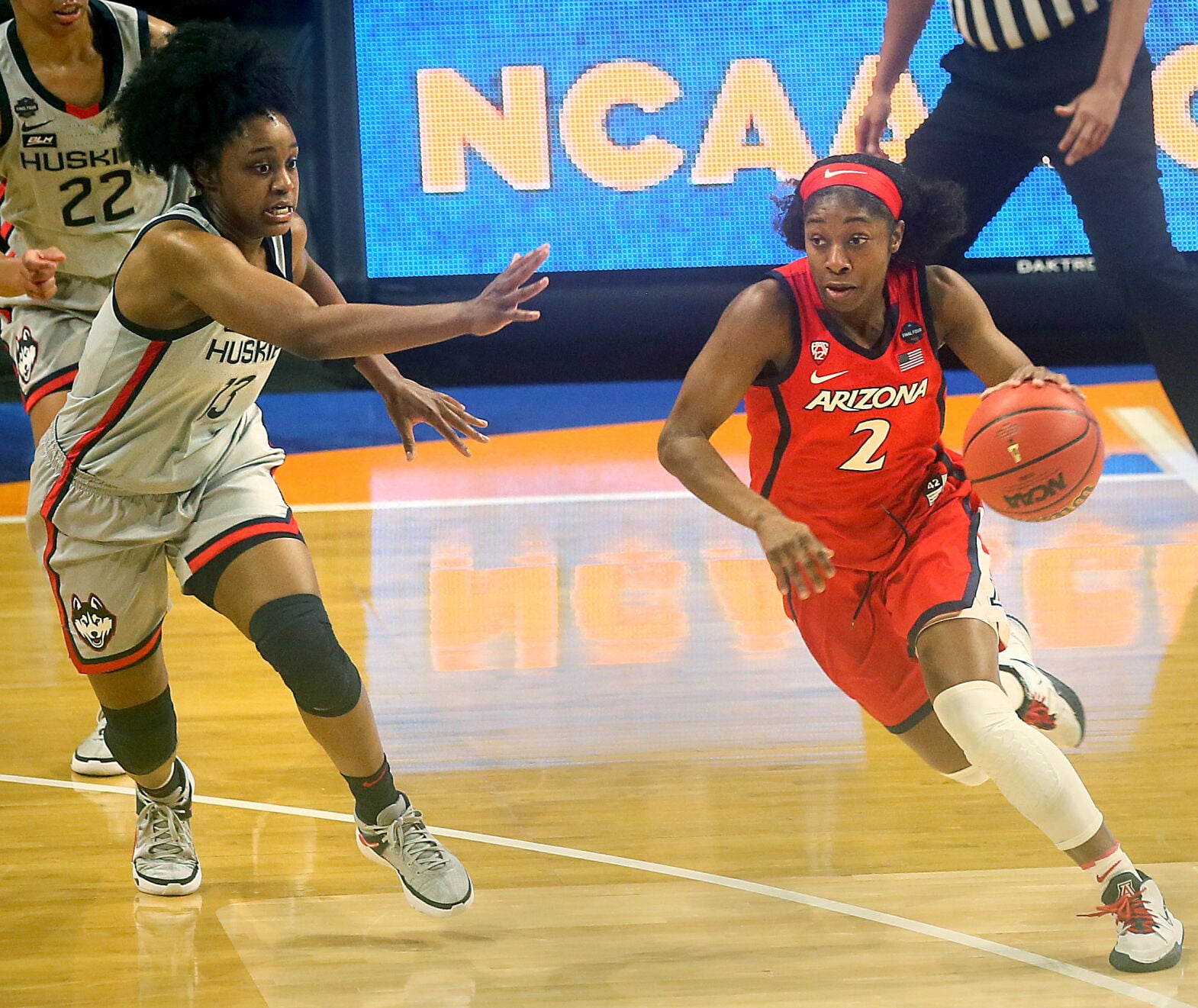
Arizona Wildcats guard Aari McDonald (2) makes a drive as UConn Huskies guard Christyn Williams (13) tries to defend in the first half during the NCAA Tournament Final Four game at the Alamodome in San Antonio, Texas on April 2, 2021.
She was a second-team All-American in 2019-20 and 2020-21, when she also became the only UA player to win the Pac-12 Player of the Year award other than Barnes. With her impact always visible on both ends of the court, McDonald also became the Pac-12’s Defensive Player of the Year in 2019-20 and 2020-21.
McDonald is Arizona’s all-time leader in scoring average at 21.9 points per game, while her 2,041 total points puts her third behind Barnes (2,237) and Davellyn Whyte (2,059) on Arizona’s list of all-time leading scorers. She’s also sixth on the school’s all-time steals list with 235.
The No. 3 overall WNBA Draft pick in 2021, to the Atlanta Dream, McDonald is a veteran of five WNBA seasons. She spent the first three with Atlanta, the 2024 season with Las Vegas and last season with Indiana. A free agent currently, McDonald is expected to miss at least the early portions of the 2026 WNBA season because of an injury.
Contact sports reporter Bruce Pascoe at bpascoe@tucson.com. On X(Twitter): @brucepascoe

Bruce Pascoe
Reporter


 The Mount Rushmore of Arizona Wildcats head coaches