The mantra is written on the whiteboard in the office of Aaron Knotts, general manager of the Arizona football program:
Development and Connection over Dollars and Cents.

Michael Lev is a senior writer/columnist for the Arizona Daily Star, Tucson.com and The Wildcaster.
The D’s and C’s are capitalized and underlined for emphasis.
It’s both a mission statement and a reflection of reality.
Brent Brennan and his staff would lean into the former (development and connection) even if the program were flush with the latter (dollars and cents). As it is not, development and connection are by far the biggest selling points when the staff seeks to add talent.
“We like to say we have to win on relationships,” said Knotts, who’s been Arizona’s GM since last December. “We want kids that want to be developed and are good culture pieces for this program. People that are gonna connect to their teammates, gonna connect with the coaches, gonna connect with the staff.
People are also reading…

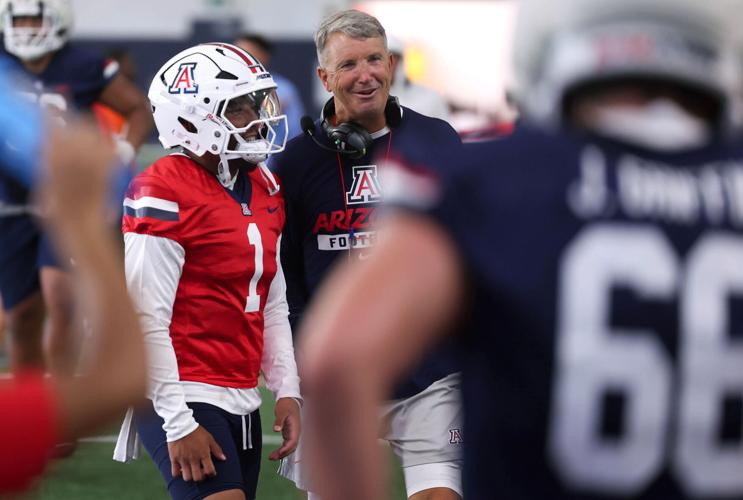
Arizona head football coach Brent Brennan and quarterback Noah Fifita share some words during warmups for fall football practice at the Davis Sports Center, Aug. 5, 2026.
“The connection piece is huge for us. That's going to help us elevate the level of play when we have a really connected, unified team.”
If last season is any indication, that approach can work — at least in the short term. Arizona went 9-4 without a Texas Tech-like war chest.
The Wildcats will try to do it again this season, which begins Saturday, Sept. 5, vs. NAU. Their roster budget, Knotts confirmed, is among the lowest in the Big 12.
Another nine-or-so-win campaign essentially would make Arizona the conference’s version of the Tampa Bay Rays. They lead the AL East despite having the third-lowest payroll in MLB. The second-place New York Yankees have the third highest.

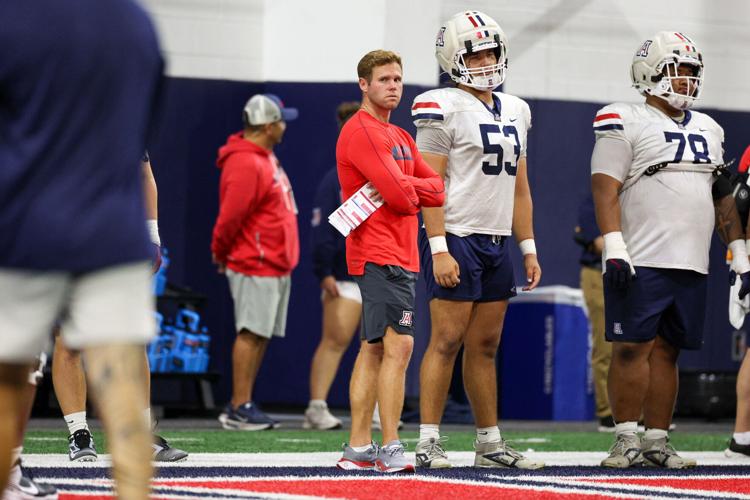
Arizona general manager Aaron Knotts (in red) watches a training-camp practice at the Davis Sports Center in August 2026 in Tucson.
The Rays excel at finding value and developing players. They’re the modern-day embodiment of “Moneyball” — a term that’s always been a bit of a misnomer. It’s really lack-of-money ball.
Whatever you want to call it, Arizona football (among other sports) is living it. The program has ample support from AD Desireé Reed-Francois’ department; she has emphasized the importance of “getting football right” many times and backed it up by giving key members of the coaching staff contract extensions and raises this past offseason.
Other signs of investment can be found at the former Arizona Stadium, which now has a title sponsor (Casino Del Sol), a new sound system and new lighting, among other enhancements.
Brennan and his staff have no complaints.
“The university, the administration, the athletic director, the president are all very supportive of Arizona athletics, Arizona football,” Knotts said. “We thank them for their support and their continued support to try to make it better and try to give us more resources. I know they're working on it around the clock.”
All true. But there’s only so much the UA can do in the NIL space — the roster-budget differentiator — without a billionaire benefactor such as Cody Campbell (Texas Tech) or Mark Cuban (Indiana).
Producing picks
Any school can allot up to $21.3 million in revenue-sharing to its athletes per the House settlement. Football’s piece of the pie is typically in the 75% range. To keep this simple, let’s call it $15 million.

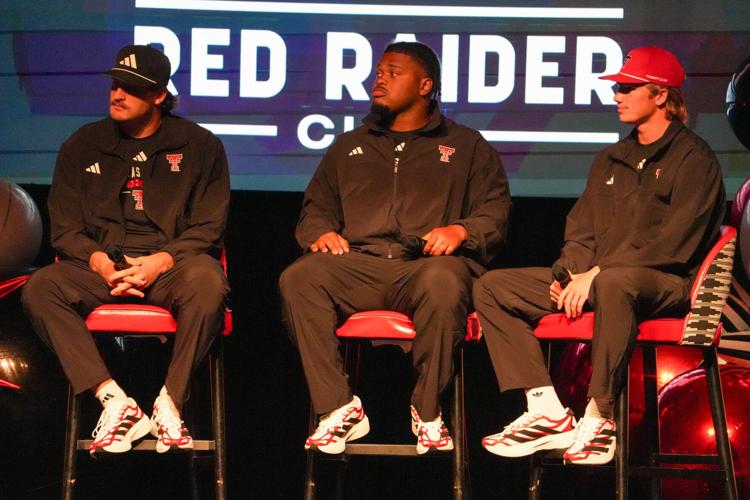
Texas Tech football players Ben Roberts, A.J. Holmes and Will Hammond speak during the Red Raider Club Kickoff Luncheon, Aug. 20, 2026, at the Lubbock Memorial Civic Center in Lubbox, Texas.
A survey by 247Sports of football general managers, personnel executives and others placed Arizona in the “under $20 million” tier for its total roster budget — revenue-sharing plus NIL.
The UA is one of 10 Big 12 programs in that tier. Texas Tech is the only school that’s between $30 million and $39 million. ASU, BYU, TCU, Utah and West Virginia are between $20 million and $29 million, per the survey.
Even the authors of the piece conceded there’s “no fully standardized way of reporting” the numbers; hence the tiering vs. exact figures.
Knotts declined to reveal Arizona’s 2026 roster budget. He did say that “nine times out of 10 in negotiations” Arizona will have “near the lowest of the offers on the table.”
So how do the Wildcats get good players? If not the most money — or even close to the most — what can the UA offer?
Development is at the forefront. After a multiyear drought, Arizona has produced high-end NFL Draft picks each of the past three years.
Receivers coach Bobby Wade helped Tetairoa McMillan become a first-round pick. Offensive line coach Josh Oglesby helped Jonah Savaiinaea become a second-rounder. Likewise safeties coach Brett Arce with Treydan Stukes.
“If you go down the line in each room, there's a certain story we can tell of why this guy's going to help you develop,” Knotts said. “(He has) has either done it himself or seen what it looks like at the highest level.”
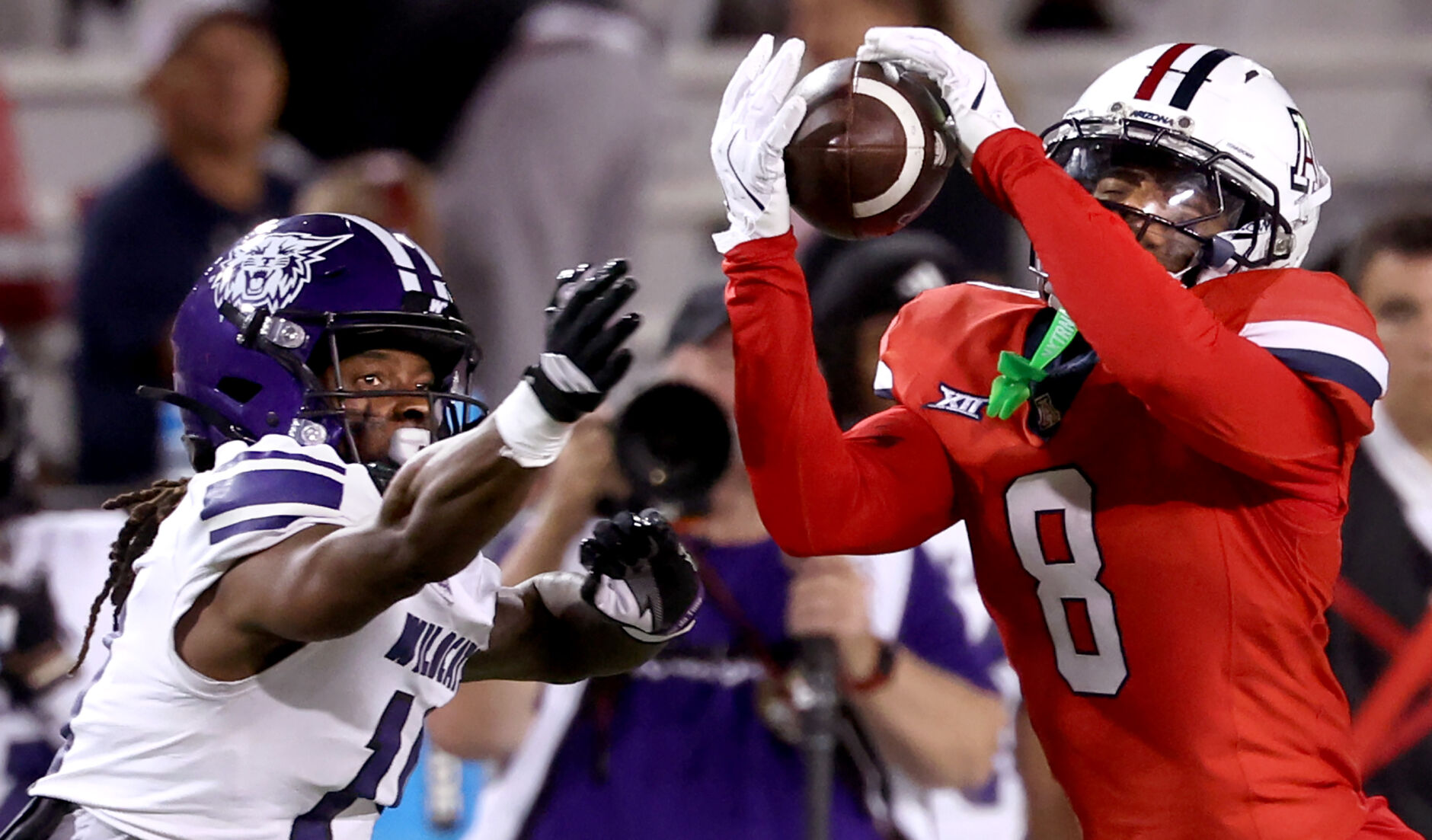
Arizona defensive back Jay'Vion Cole, right, steps in to snatch the ball from Weber State wide receiver Devin Ford for a pick-six in the third quarter, Sept. 6, 2025, in Tucson.
Under Brennan, Arizona has sought value in the transfer portal by mostly targeting players who have played and produced — even at lower levels — as opposed to former four- or five-star recruits who haven’t done much of either.
Standouts from the 2025 portal class included tailback Ismail Mahdi, center Ka’ena Decambra, linebacker Riley Wilson and defensive tackle Deshawn McKnight. All previously played at FCS or Group of Five schools.
The ’25 class also included power-conference alums such as tackles Ty Buchanan and Tristan Bounds and cornerback Jay’Vion Cole.
Cole is an example of a player who’s better off at thrifty Arizona than his previous stop, deep-pocketed Texas. Cole barely played in his one season in Austin. He earned third-team All-Big 12 honors last season at Arizona and is the second-highest-graded returning cornerback in the conference, per Pro Football Focus.
“Just because you take more money somewhere else right now doesn't mean that's going to put you in the best position to be showcased for the NFL Draft,” Knotts said, speaking generally. “What happens if you go to that other school and you're put in some tough situations where maybe you're going up against really good competition? Maybe the development or the coaching isn't as good? Now all of a sudden you've traded short-term dollars for long-term success.”
Familiarity and fits
Familiarity also can help to identify undervalued assets. Cole played for Brennan and cornerbacks coach Chip Viney at San Jose State in 2023. So did cornerback Michael Dansby, who became a surprise seventh-round pick after a strong ’25 season at Arizona.

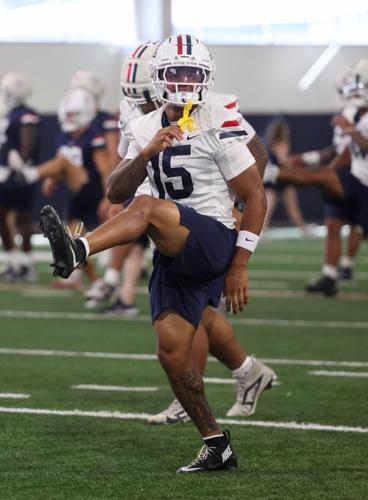
Arizona safety Malcolm Hartzog (15) warms up for fall football practice at the Davis Sports Center, Aug. 6, 2026.
Stukes’ successor at nickel corner, ’26 portal pickup Malcolm Hartzog, played two seasons at Nebraska under Tony White, who’s tight with UA defensive coordinator Danny Gonzales. They’re both products of the Rocky Long coaching tree and worked together at multiple schools.
That background has eased Hartzog’s transition — and made it easy for Arizona to overlook his lack of height.
“He’s maybe 5-9 on a good day,” Knotts said. “But man ... he's all over the place. The guy is such a hard worker.”
Arizona’s new starting center, Zach Henning, came from Washington, where Knotts worked before arriving in Tucson just before Christmas and cramming for the Jan. 2-16 portal rush. Knotts had to download a ton of information in a short time. The budget wasn’t at the forefront of his prep. Instead, he tried to answer questions like these:
What does this coach want? How do we operate offense and defense? What are the biggest holes and gaps we need to fill?
Knotts learned, for instance, that Arizona doesn’t need massive defensive tackles in Gonzales’ scheme, which relies more on movement and angles. That was another area where the Wildcats could find value.
Long-term viability?
We’ll find out this season whether Arizona can produce another winning team on a relatively tight budget — although next year might be the greater test.
In 2027, the UA no longer will have the services of star quarterback Noah Fifita. He’s basically the equivalent of starting pitchers Tim Hudson, Mark Mulder and Barry Zito of the early-2000s Oakland Athletics — the original “Moneyball” experiment.
Those Athletics teams consistently got more out of less — but never reached the World Series.
“We're always going to sell relationships,” Knotts said. “Now, do I think for us to continue to be competitive we have to continue to invest and find more third parties that are willing to do NIL deals with our players? Absolutely.
“We need to increase our budget, just like every other team in the country is trying to do. We need to explore all the different avenues of revenue that are out there. Because if our budget doesn't increase, our success will not be sustainable.
“The relationship thing is always something we're going to hit on, and it's going to help us win. But it's only going to take you so far.”
Contact sports reporter/columnist Michael Lev at mlev@tucson.com. On X (Twitter): @michaeljlev. On Bluesky: @michaeljlev.bsky.social
Michael Lev
Sports Reporter/Columnist


 College football’s rising payrolls soar to $2.9B, putting pressure on Arizona, Big 12